Category: DFW Real Estate News

  • A Struggling Arlington Office Property Finds a Buyer After a Sharp Turnaround

    Dallas-Fort Worth metroplex — TXRE bought Arlington Interlink during the post-pandemic office freeze, renovated it, raised rents and pushed occupancy to 95 percent before selling the building to Hielan Real Estate.

    Dallas-based TXRE Properties has sold Arlington Interlink, a north Arlington office property it bought during the post-pandemic office freeze and nearly filled to capacity. The buyer is Hielan Real Estate. The price was not disclosed. TXRE said occupancy rose from 36% to 95% before the sale, and asking rents climbed from $16 to $24 per square foot.

    TXRE’s play was simple. Buy a distressed office asset, spend money on it, and lease it to tenants that still need physical space. The roughly 80,000-square-foot property at 1701 E. Lamar Blvd. sits just off Interstate 30 and State Highway 360, near Arlington’s Entertainment District.

    TXRE announced in 2022 that it had acquired the building and would reposition it as Arlington Interlink. Current marketing materials describe a renovated, late-1990s asset with upgraded common areas, on-site management and ample parking.

    One tenant helps explain why the turnaround worked. In 2024, Munich-based Sportec Solutions established its U.S. headquarters in the building. Arlington officials said the move came with a $1 million performance grant through the Arlington Economic Development Corporation and was expected to create 17 jobs. Sportec, which supplies live match data and video assistant referee services, now lists Arlington Interlink as its U.S. address.

    The Sportec move also highlights a local economic strategy. Arlington officials backed the headquarters with public incentive money, and the building sits in a corridor shaped by sports, hospitality and regional access. That combination points to a clear local strategy, use targeted incentives to widen the area’s economic base beyond game-day traffic.

    Supporters argue this is exactly how local economic development should work by pulling in jobs and anchoring a high-value tenant in an office market many investors are still wary of. Critics might argue the public return is narrower than it looks, and that the same dollars might go farther in transit, housing or workforce development. Both sides have a valid point.

    The deal also highlights a stark reality about the DFW office market, showing that the sector has not fully recovered. It proves that certain buildings can still succeed if the fundamentals are in place, like highway access, fresh capital, realistic scale, ample parking, and tenants with a practical reason to be there. This is a much more realistic scenario in a region where some Arlington office properties still face distress and Dallas leans heavily into office conversions to clear out excess supply.

    For the buyer, this looks like a bet on one renovated asset with momentum, not a broad bet on the overall office market. For Arlington, it is another test of whether public incentives, the draw of the entertainment district, and private redevelopment can keep aging suburban office stock economically useful in a market that is still picking winners and losers.

  • Grand Hyatt Completes $34M Renovation at Dallas Fort Worth Airport

    Grand Hyatt hotel at Dallas Fort Worth International Airport connected to Terminal D.
    The Grand Hyatt DFW is located directly inside Terminal D at Dallas/Fort Worth International Airport

    DALLAS — The Grand Hyatt hotel inside Dallas Fort Worth International Airport has completed a $34 million renovation that adds guest rooms and expands meeting space, an upgrade the company and airport officials framed as part of a broader push to keep pace with the region’s growth and a wave of new construction at one of the nation’s busiest aviation hubs.

    The hotel, connected to Terminal D, now has 315 rooms, up from 298, Hyatt and airport leaders said as they marked the project’s debut on Feb. 11. The renovation also reworked event and conference areas, including what the hotel described as 20,000 square feet of updated meeting and event space and a renovated 6,600-square-foot ballroom.

    Jeff Babcock, the hotel’s general manager, said the renovation’s biggest operational shift was on the ninth floor, where previously underused space has been converted into corporate-focused meeting areas. The changes include a new Flight Deck meeting room with views of Terminal D’s runway and a DFW Board Room designed for 18 attendees, also oriented toward the airfield.

    The ninth floor was dormant,” Mr. Babcock said, adding that the additions were intended to serve business travelers and local companies looking for meeting space with immediate airport access.

    In a statement, Ripton Melhado, Hyatt’s vice president of field operations, said the renovation aimed to offer “more refined accommodations” for domestic and international travelers while modernizing conference and event spaces and updating the hotel’s culinary options.

    Airport leaders used the reopening as a moment to underscore DFW’s pitch to airlines, businesses and convention planners: that the airport is not simply a place to pass through, but an economic front door for North Texas. Chris McLaughlin, DFW’s chief executive, said in a statement that the revamped property would remain a premier destination in the region and reflect a “commitment to excellence” as DFW serves what he described as a growing global community.

    Beyond the meeting areas, the renovation rebuilt the fitness center on the first floor, maintaining its prior scale, Mr. Babcock said. The lobby was redesigned with more flexible seating, and first-floor meeting space was enhanced. The hotel’s Grand Met restaurant and lounge also received updates intended to increase seating capacity and introduce a new global fusion concept.

    Hyatt said the renovation was announced last May, with construction beginning in July. The hotel remained open throughout the project, Mr. Babcock said. Design One Studio served as the architectural firm.

    The Grand Hyatt at DFW opened in July 2005, and Hyatt Hotels Corporation, based in Chicago, now operates three properties at the airport, including a Hyatt Regency and a Hyatt Place DFW.

    The timing of the renovation is notable less for the new carpet and conference rooms than for the construction boom surrounding it. DFW is in the middle of a $9 billion capital improvement program known as DFW Forward, which calls for renovating Terminal C, adding five gates to Terminal A and building a new Terminal F.

    American Airlines, whose headquarters are in Fort Worth and which has long treated DFW as its principal hub, is also expanding at the airport. The airline is pursuing an expansion tied to Terminal F, a project it has said would make DFW the largest single-carrier hub in the United States. The scope grew last year when American announced a $4 billion investment that the company said would double the terminal to 31 gates.

    During the company’s January earnings call, American’s chief executive, Robert Isom, said the airline planned to add new satellite facilities in Terminals A and C and move to what he described as a 13-bank operation, which is an approach to scheduling flights in concentrated waves to accommodate a growing local market. Reliability, he said, would be central to serving one of the country’s fastest-growing metropolitan areas. He also said American was approaching 100,000 daily customers at DFW.

    Taken together, the hotel’s renovation and the airport’s broader buildout illustrate a familiar dynamic in public infrastructure: large transportation assets rarely operate as standalone utilities. They anchor a wider ecosystem of private investment, including hotels, restaurants, meeting space and logistics services, that both benefits from and reinforces public spending on capacity.

    For airport operators and regional leaders, the pitch is straightforward. Expanded terminals and gate capacity can attract additional service, which can help sustain corporate relocations, tourism and convention business. A renovated on-airport hotel, especially one with substantial meeting space, effectively turns layovers and travel days into usable work time, lowering the friction for companies that rely on frequent travel or want to hold events without adding an extra commute into the city.

    But the same ecosystem raises policy questions that airports increasingly confront as they behave like small cities. When capital plans scale into the billions, the public interest is often defined not just by passenger convenience, but by how growth is managed: congestion on access roads, pressure on surrounding neighborhoods, environmental impacts, and whether the economic gains are broadly shared.

    In practical terms, the debate is less about whether an airport should modernize and more about how to balance rapid expansion with accountability, resilience and long-term flexibility in an industry that can shift quickly with economic cycles and changes in business travel habits.

    For now, DFW and Hyatt are betting that the fundamentals in North Texas, including population growth, corporate presence and the airport’s role as a national connector, will keep demand strong. The newly finished Grand Hyatt, with more rooms and a runway-facing “Flight Deck” built for board meetings, is positioned as one more piece of that broader bet.

  • Crescent Closes a Fresh $241.5 Million Fund and Doubles Down on Dallas Trophy Offices

    The Crescent Office. Image courtesy of crescent.com

    Crescent Real Estate has closed a new $241.5 million investment fund to target commercial property deals, leaning heavily into high-end office real estate even as fundraising across private markets remains under pressure.

    The Fort Worth based firm’s latest investment vehicle, GP Invitation Fund IV, came in just under its $250 million target, according to the Dallas Business Journal. A federal securities filing shows the fund was structured for a $250 million offering and had reported $207.36 million sold to 43 investors as of Dec. 19, 2025. This suggests the bulk of the capital was in place heading into year-end, as regulatory disclosures often lag behind final closes.

    The timing is significant. Global private equity fundraising fell for a third straight year in 2025, sliding 12.7% to $480.29 billion from $551.16 billion in 2024, according to S&P Global Market Intelligence. Additionally, fewer funds launched in 2025 than the year prior.

    A concentrated bet on “flight towards quality” assets

    While Crescent’s mandate is broad which involves spanning office, hospitality, and multifamily sectors, its recent moves show where it sees the clearest upside being trophy office space in prime submarkets.

    The firm reports a portfolio totaling more than $16 billion in investments, including 67 million square feet of office space, 10,100 multifamily units, and 9,300 hotel keys with these figures based on its existing portfolio as of February 2025.

    That scale is now being deployed within a very specific geography

    In Uptown Dallas, Crescent has been snapping up marquee office towers. In late 2025, the company bought the 19 story office building at 2100 McKinney Avenue which is an Uptown property with prominent CBRE signage acquired using $170.4 million in financing, according to The Real Deal’s review of deed records. The deal closed Dec. 17.

    A few months earlier, Crescent acquired Texas Capital Center at 2000 McKinney Avenue representing one of the biggest office trades in the Dallas and Fort Worth market in 2025. The 21 story, roughly 457,000 square foot tower is anchored by Texas Capital Bank, which has a lease running through 2040.

    Fort Worth is becoming a new office hub taking shape as Crescent is also building at home, where in April 2025, the firm broke ground on “Crescent Offices West,” a 170,000-square-foot office building at its Fort Worth campus that it says will be anchored by JPMorganChase and open in 2027.

    That project isn’t just a real estate play because it’s part of a broader shift in how business districts form in fast growing Sun Belt metros. When a major employer anchors a high-end building outside a traditional downtown core, it acts as a magnet for other tenants, restaurants, and services.

    For city leaders, that’s a win if it expands the tax base however it also raises hard questions about what happens to older office stock and legacy central business districts.

    The policy backdrop: interest rates, downtown strategy, and what comes next

    Here’s the bigger picture noting that commercial real estate doesn’t move in a vacuum. The Federal Reserve’s pandemic era low rate environment helped fuel dealmaking and fundraising, and the higher rate era that followed has reshaped the math by compressing values, tightening lending, and making investors far pickier.

    That’s where public policy quietly enters the story as follows.

    Monetary policy sets the cost of capital. Higher rates don’t just slow transactions but they also create market dislocation thereby offering windows where well capitalized buyers can negotiate better pricing especially on assets that still have strong tenants and long leases.

    Local policy determines whether downtowns rebound or stagnate. Cities can influence office outcomes through zoning flexibility, permitting speed, transit access, and incentives for conversions of obsolete buildings. If capital flows mainly to “best in class” properties in prime districts, the policy challenge becomes managing the obsolete inventory meaning aging buildings that can no longer compete on amenities, efficiency, or location.

    Economic development becomes a tug of war. Fort Worth and Dallas like many large metros are competing submarkets inside one regional economy. When investment and leasing momentum cluster in specific nodes such as Uptown Dallas or the Cultural District area in Fort Worth then public sector decisions around infrastructure and placemaking can accelerate that clustering.

    None of that guarantees Crescent’s strategy will pay off. But it explains why a firm can be bullish on trophy office while much of the broader office market still looks shaky since the office sector is increasingly bifurcated meaning it is split between premium buildings with strong tenancy prospects, and everything else.

    For Crescent, Fund IV signals that its investors believe this divergence is real furthermore that the firm can keep finding deals on the right side of it.

  • Texas awards DART $25 million to extend Cotton Belt Trail along newly opened Silver Line

    Image Source: nctcog.org

    DALLAS — Dallas Area Rapid Transit will receive $25 million in state funding to help build the next segment of the Cotton Belt Trail, a planned shared-use path that will run alongside DART’s newly opened Silver Line and expand walking and biking access across North Texas.

    The North Central Texas Council of Governments’ Regional Transportation Council announced the award on December 18, and said the Texas Transportation Commission approved the grant to support construction of phase three of the Cotton Belt Trail. The money will be issued through the Transportation Alternatives Set-Aside Program, part of a statewide push to expand “active transportation” options like sidewalks and bike lanes.

    DART’s funding is included in a broader $55 million package for North Texas projects aimed at improving mobility and expanding trail connections. The Transportation Commission is also directing $30 million to six other trail projects across the Metroplex, including the Trinity Forest Spine Trail and the Midtown Dallas Shared Use Trail.

    Supporters have promoted the Cotton Belt Trail as a 26-mile east-to-west corridor stretching from Plano to Dallas / Fort Worth International Airport, tracking the route of the Silver Line, which opened Oct. 25. Backers say the trail is designed to link multiple communities and give riders a safer option to bike or walk between stations and nearby destinations, an approach transit agencies nationwide are using more often to strengthen “first-mile, last-mile” connections.

    Work is already underway on phase two, which focuses on an 11-mile section from western Addison to the Shiloh Road Station in Plano. The newly funded third phase is expected to extend walking and biking access into Addison, downtown Carrollton, and Cypress Waters, while tying into three stops along the Silver Line.

    Kevin Kokes, a program manager for the North Central Texas Council of Governments’ Land Use and Mobility Options team, welcomed the state’s support in a statement. “By improving connections to employment, housing, schools and recreational opportunities, these projects help build a stronger, more accessible future for everyone,” he said.

    Construction on phase three is scheduled to begin by mid-2027. Transportation officials say the next steps include finalizing plans and getting the project ready ahead of the planned start date.

  • $85 Million Valley View Project Finally Breaks Ground After Decade of Delays

    Former Sanger-Harris building, Valley View Center, Dallas

    Dallas – After more than a decade of false starts, redevelopment of the former Valley View Mall site in Dallas is finally underway. On Friday, developers broke ground on a roughly $85 million mixed-use project that will serve as the anchor for the long-planned Dallas Midtown district.

    The first phase, called Premier at Midtown, will rise on about four acres at the southwest corner of Dillbeck Lane and Preston Road. The six-story building will feature 296 apartments above as much as 26,000 square feet of ground-floor retail, kicking off the broader Dallas Midtown vision, according to Scott Beck, president of Beck Ventures. The average unit will be about 865 square feet, with rents around $1,800 a month.

    Dallas-based Anthem Development is leading the project in partnership with Beck Ventures and Prime Life Technologies America, a joint venture between Toyota Motor Corporation and Panasonic Holdings Corporation. NexBank is providing financing, Cross Architects designed the building, and Anthem’s construction arm will handle the general contracting.

    Beck and his partners celebrated the milestone with a ceremonial groundbreaking Friday that featured speeches and the traditional dirt toss, along with new renderings of the luxury apartment building and its street-level retail. They expect to pull permits within the next 45 to 60 days. Construction is projected to take about two and a half years, with the first residents expected to move in by early 2028, Beck said.

    “After 12 years of planning, patience, setbacks and perseverance, we are breaking ground on our very first project that will officially begin the rebirth of this district,” Beck told attendees. He added, “This time is definitely different,” nodding to the site’s history of stalled plans.

    The stakes stretch far beyond a single apartment building. Beck Ventures first unveiled plans more than 10 years ago to transform the 110-acre Valley View Center site at Preston Road and LBJ Freeway into Dallas Midtown. The vision is a multibillion-dollar mixed-use destination with roughly 1.5 million square feet of retail, restaurants, residential units, office towers, and a hotel-condo tower. In 2013, the city created a 450-acre development zone covering Valley View and the nearby Galleria Dallas to support that vision.

    Yet the sweeping redevelopment stalled. Beck has blamed the slow progress in part on the city’s failure to install a needed sewer line, saying that a $36 million city incentive package tied to the project eventually expired as construction never got going. City representatives did not immediately respond to his comments when asked by DALTX Real Estate Team.

    Meanwhile, the mall sat decaying. Valley View went dark in 2015, with only an AMC theater operating at the largely abandoned complex at LBJ and Preston until early 2022. The structure was finally demolished in 2023 after a series of fires at the vacant site, including one that left two Dallas firefighters injured.

    Premier at Midtown represents only a small slice of the Valley View property, and the future of the remaining acreage is still up in the air. Beck’s firm joined with Seritage Growth Properties and fitness operator Life Time Inc. at the end of 2024 to market the entire site in hopes of drawing additional development partners. Beck has not disclosed which parties have made offers but said the goal is to secure collaborators to develop the rest of the land.

    Plans for a larger, multibillion-dollar mix of retail, dining, residential, office space, and more remain on the table, though how and when that full build-out will come together is unclear. “There are other groups out there that are very interested in working with us,” Beck said, describing ongoing talks but offering few specifics.

    One lingering question is whether professional sports could become part of the site’s future. Beck would not confirm whether representatives of the Dallas Mavericks are exploring the area for a potential new NBA arena, but he suggested the surrounding district would be suitable for a major venue. “The table is set to make a deal like that happen,” he said.

    For now, the focus is on turning years of renderings and promises into visible construction. The broader Dallas Midtown redevelopment is projected at around $4 billion, and Friday’s groundbreaking marked the first real step toward replacing the long-vacant mall with dense, urban-style development. After years of stalled momentum, cranes and concrete at Valley View may finally signal that Dallas Midtown is moving from concept into reality.

    Valley View Center (1973)

    Below is a timeline of Valley View Center Mall from its opening through 2025

    [wpchtmlp id=522409]

  • Major Development, Infrastructure Votes on Agenda in Dallas-Fort Worth

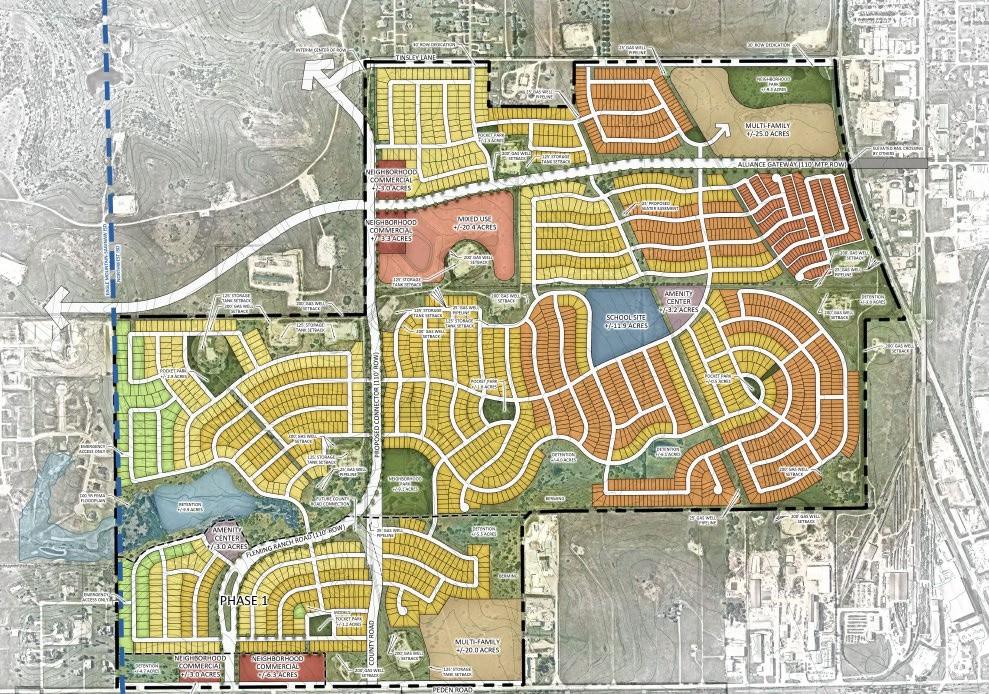
    Major development and infrastructure decisions are on the agenda in both Fort Worth and Dallas on Tuesday, highlighting the region’s ongoing expansion. In Fort Worth, the City Council will consider an agreement for a massive 858-acre master-planned community, while Dallas transportation officials are holding a public meeting on the redesign of a 3-mile corridor in West Oak Cliff.

    The Fort Worth vote, scheduled for 10 a.m. at City Hall, centers on the Shelton Ranch property located just outside city limits in its extraterritorial jurisdiction. Developer Green Brick Partners is seeking an agreement to build infrastructure for a community that, according to city documents, would allocate 505 acres for homes, 45 acres for apartments, and additional space for schools, parks, and commercial use. Under the proposal, the developer would form a municipal utility district to finance infrastructure, while the city would serve as the retail provider of water and sewer services. The item is currently on the consent agenda, suggesting it could be approved with minimal discussion.

    Shelton Ranch master plan (878 acres, Green Brick Partners) within Fort Worth’s ETJ.

    Fort Worth officials are also set to vote on a revised funding structure for the Evans and Rosedale Urban Village project in the Historic Southside. The development, led by Milwaukee-based Royal Capital Group, is planned to include 184 residential units and commercial space. The new agreement would see the Fort Worth Housing Finance Corp. take ownership of the land. It also includes a $2.5 million forgivable loan from the Department of Housing and Urban Development and $7 million in Tax Increment Financing district funds, which would be allocated to the developer over two phases.

    Meanwhile, in Dallas, city staff will present new details and take public feedback on upgrades to a three-mile stretch of West Davis Street in West Oak Cliff. The project is in early design and focuses on safer walking and biking, with possible additions like landscaping and better sidewalk lighting.

    Residents are invited to review “preferred options for potential roadway alignments” at a meeting scheduled for 5:30 p.m. at Saint Cecilia Catholic School. This transportation project is a component of the city’s broader West Oak Cliff Area Plan, which Dallas City Council approved in 2022 to improve quality of life and help existing residents remain in the district. A timeline for construction has not yet been established as the city continues to gather public input.

  • Starbucks to close six North Texas stores as corporate cuts ripple nationwide

    Starbucks to close six North Texas stores as corporate cuts ripple nationwide

    Starbucks logo illustration with closed sign overlay

    Dallas, Texas — Starbucks is closing six cafés across Dallas–Fort Worth this weekend, part of a $1 billion restructuring that is eliminating nearly 900 corporate roles and trimming the chain’s U.S. and Canada footprint for the first time in years. The shutdowns take effect after service Saturday, Sept. 27, and follow six consecutive quarters of weak sales.

    The closures hit high-traffic corridors like Greenville Avenue and Mockingbird Station in Dallas, downtown Fort Worth, plus suburban spots in Richardson and Plano. A rural café in Italy, Texas, is also on the list. Workers are being offered transfers or severance packages with extended benefits. Starbucks insists union status played no role in the choices.

    CEO Brian Niccol, in a memo last week, framed the move as a portfolio “reset” designed to weed out underperforming stores and focus investment on cafés that can deliver the brand’s promised “third place” vibe. The company plans to end fiscal 2025 with roughly 18,300 North American stores—about 1% fewer than last year, before resuming growth in 2026. More than 1,000 cafés will be redesigned over the next year to look warmer and less like pickup counters.

    The timing underscores how the brand, long synonymous with reliable growth, is navigating a post-pandemic consumer slowdown. Starbucks has rarely finished a year with fewer outlets, and this cutback signals a shift from sheer expansion to tighter curation. Analysts say the company is betting that fewer, better stores can reignite traffic while avoiding the drag of unprofitable locations.

    For North Texas, the closures are targeted, not a retreat. But they mark the new reality: Starbucks is recalibrating, putting efficiency and experience over ubiquity, and reminding investors and customers alike that the coffee giant is willing to pull back before it pushes forward again.

  • Western Wealth Capital Acquires Park Place Townhomes in Euless, Texas

    Western Wealth Capital Acquires Park Place Townhomes in Euless, Texas

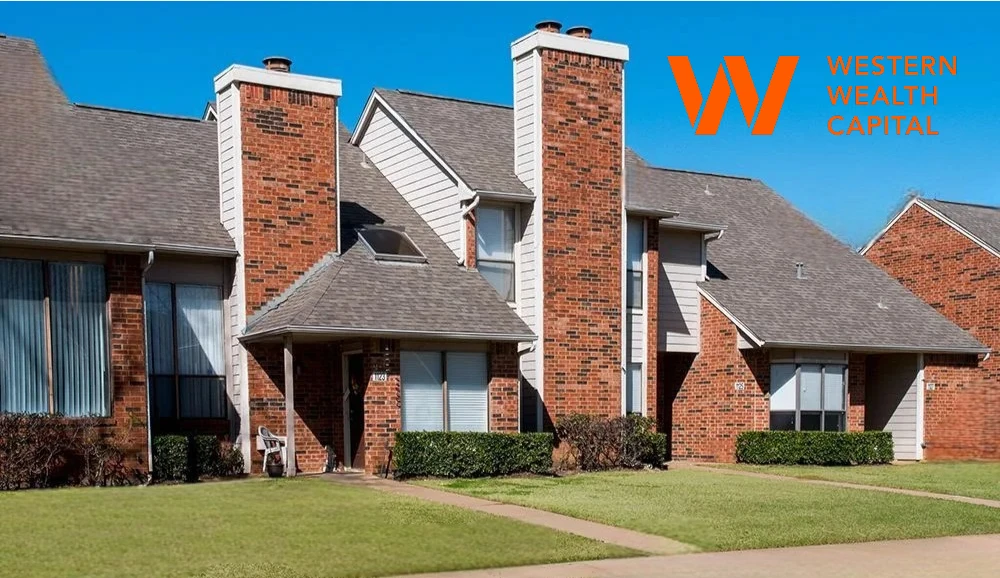
    DALLAS, Texas — Western Wealth Capital (WWC) announces the closing of its 130th real estate acquisition – Park Place Townhomes in Euless, Texas. This is Western Wealth Capital’s 22nd multifamily acquisition in the Dallas-Fort Worth market.

    WWC and its investment partners closed on the 97-unit multifamily community of Park Place Townhomes. The transaction was advantageously purchased off-market with the assistance of Brian Murphy of Newmark Dallas. StepStone Real Estate (“SRE”), the real estate arm of private markets investment firm StepStone Group (Nasdaq: STEP), is a major equity partner in the transaction. Park Place is a follow-on investment into an existing WWC/SRE joint-venture initiated by a broader GP-led portfolio recapitalization in 2024.

    Built in 1980, Park Place Townhomes features spacious two-story units with an average size of 1,116 square feet, offering residents a comfortable and well-designed living experience. As part of the acquisition, WWC assumes a 3.07% fixed-rate mortgage from the previous owner, resulting in an estimated $1.6 million in interest savings over the loan term compared to current market rates. The loan assumption was handled by Katie Runyan of Walker & Dunlop.

    This Dallas-area acquisition strengthens WWC’s presence in the U.S. multifamily housing market and reflects the firm’s disciplined investment approach. Ideally situated between Dallas and Fort Worth, the property is just six minutes from Dallas-Fort Worth International Airport and within close proximity to major employers such as American Airlines headquarters, Lockheed Martin, and AT&T Stadium—all reachable within a 23-minute drive.

    “This acquisition comes at an opportune time in the market cycle,” said Jay O’Connor, Vice President of Acquisitions at WWC. “We’re acquiring this asset at 42% below current replacement cost, which presents a compelling opportunity for equity growth and attractive returns.”

    Doug Mather, WWC’s Chief Investment Officer, echoed this sentiment: “We’re seeing clear buying signals in the market, with property values down 30–40% from their peak, rent growth poised to rebound, and job growth remaining strong. Park Place Townhomes offers a rare chance to invest near the bottom of the market in a highly desirable product located in a prime area.”

    About Western Wealth Capital

    WWC has developed a proven system for investing in multifamily properties in key real estate markets across the U.S. WWC offers investment partners the opportunity to invest in properties with substantial value-add opportunities. Since its inception, WWC has successfully completed more than $6.4 billion in real estate transactions, acquiring 130 multifamily assets representing more than 29,000 total units.

    WWC’s vision is to build wealth for its investment partners with exceptional returns. A people-first approach promotes excellence at every point, with highly efficient operations and a true commitment to our communities. The company’s current portfolio of assets under management includes 35 multifamily rental buildings across five different U.S. metropolitan areas located in the Sun Belt region.

  • Highwoods Properties buys 3,057‑space Charlotte garage for $110M

    Dallas, TX.Highwoods Properties Inc. (NYSE: HIW) has purchased SEVEN20 at Legacy Union, a 14‑story, 1.1‑million‑square‑foot parking garage at 720 S. Church St., from Dallas-based real estate firm Lincoln Property Co. for $110 million. The deal closed Aug. 21, according to Mecklenburg County property records.

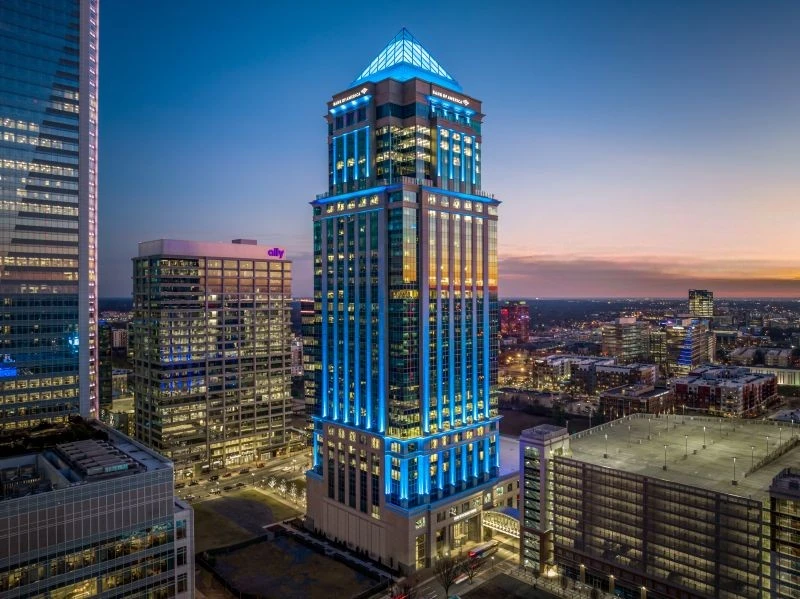
    The structure, which is among the largest parking facilities in the Carolinas, primarily serves Legacy Union’s office tenants and event traffic near Bank of America Stadium. It includes 14,360 square feet of ground‑floor retail along Church Street and a pedestrian bridge on the fifth level that links directly to Bank of America Tower at 620 S. Tryon St. Lincoln will continue to manage the property.

    Highwoods plans roughly $1.5 million in near‑term upgrades; details weren’t disclosed. The garage is expected to generate about $8 million in net operating income over the first four quarters after the sale.

    By the numbers:

    • Implied cap rate: ~7.3% (based on $8M NOI on a $110M price)
    • Price per space: ~$36,000 (3,057 spaces)
    • Price per square foot: $100
    • Planned upgrades: ~1.4% of the purchase price (≈ $491 per space)

    CBRE’s Patrick Gildea and Matt Smith represented Lincoln in the transaction. Highwoods did not use a broker.

    Lincoln executives called the garage the operational center of the Legacy Union campus, critical for office users during the workweek and a workhorse on event days around the stadium. The company said the sale was off‑market. Lincoln and its investment partner, Goldman Sachs, had tested buyer interest in recent summers but waited until they believed pricing reflected the asset’s value.

    The purchase deepens Highwoods’ footprint at Legacy Union. The REIT acquired Bank of America Tower in 2019 for $441.6 million and SIX50 in 2022 for $201.2 million. Elsewhere in Charlotte, Highwoods also owns Capitol Towers and One, Two and Three Morrocroft Center in SouthPark.

    Legacy Union, a 10‑acre, class‑A office district developed by Lincoln in partnership with Goldman Sachs, has delivered in phases: the parking garage and Bank of America Tower (2019); SIX50 (2020); Honeywell’s headquarters (sold in 2021 for $275 million to PRP Real Estate Investment Management); and Legacy Union 6HUNDRED (2024). Lincoln says 6HUNDRED is the only delivered asset there it still owns and may eventually sell.

    The deal consolidates control of key campus infrastructure under a landlord that already owns two neighboring towers, a setup that can streamline access, pricing, and operations for tenants. With downtown parking demand supported by both office users and stadium events, the income profile of this garage offers a buffer as the office market continues to adjust.

  • Dallas’ trophy office tower fetches $218 million, setting a 2025 high-water mark

    Source: linkatuptown.com

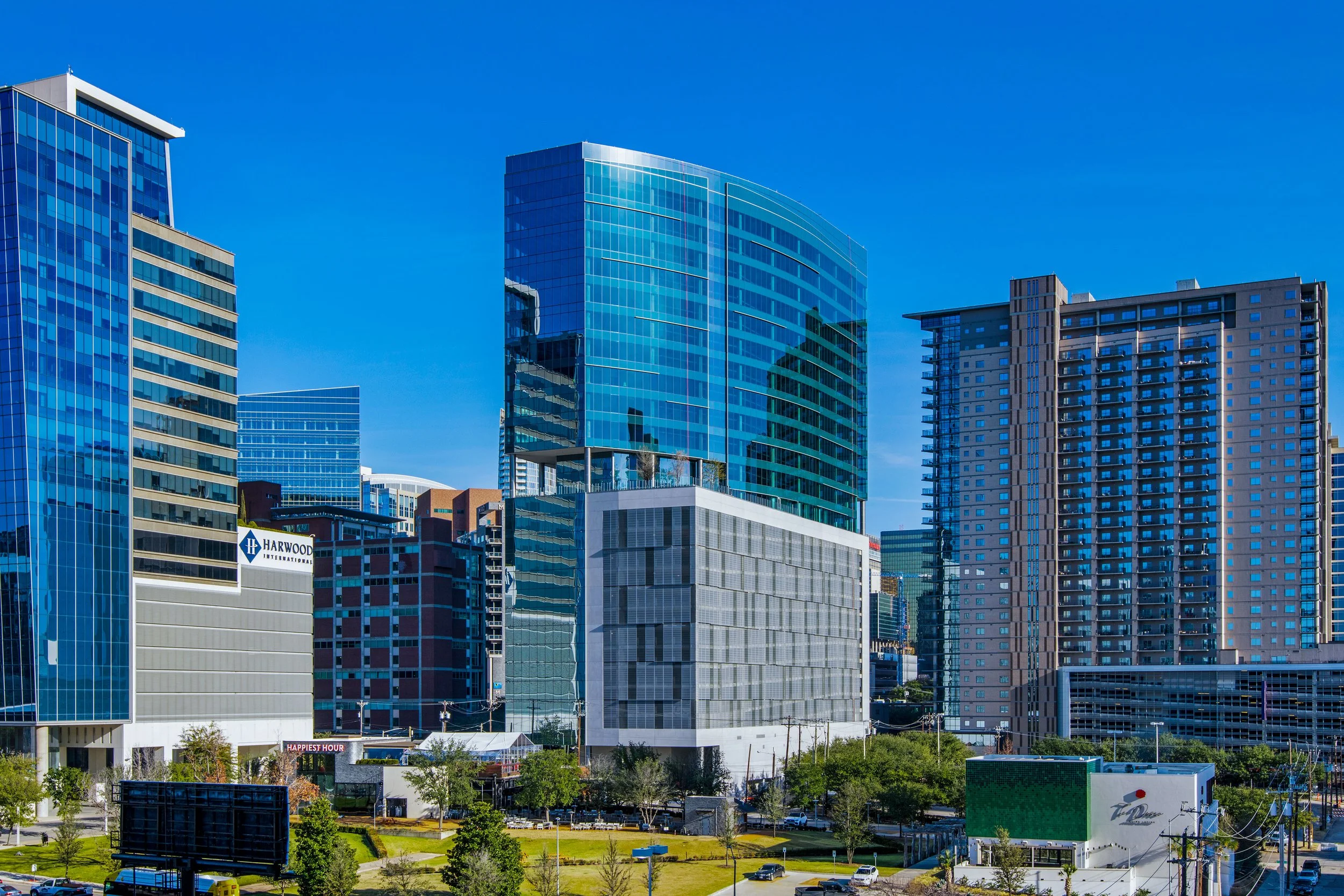
    A newly built high-rise in Dallas’ Uptown district has changed hands in what brokers say is the most expensive office sale in the Dallas–Fort Worth area this year. Cousins Properties, an Atlanta‑based real estate investment trust, has purchased The Link at Uptown for roughly $218 million. The 25‑story tower, completed in 2021, totals 292,000 square feet and is about 93.6% leased.

    The deal, announced July 31 by Newmark Group Inc., surpasses the previous record set by this month’s sale of Sterling Plaza and underscores strong demand for high‑quality office space in DFW. “This transaction is a resounding endorsement for Dallas‑Fort Worth and a clear indicator of the market’s strength,” Chris Murphy, one of the Newmark vice chairmen who arranged the sale, said in a statement.

    Inside The Link

    Located at 2601 Olive St., The Link offers panoramic views and an amenity floor with a tenant lounge, fitness center, conference facilities and an outdoor terrace. The Class‑AA building houses a mix of tenants spanning finance, law and advertising, including Houlihan Lokey, McGuireWoods and PMG. According to research firm Yardi, its leases carry a weighted average term of more than nine years.

    Kaizen Development Partners built the tower using a US$128.3 million construction loan from Goldman Sachs in 2020 and delivered it a year later. At the time of sale, the asset was encumbered by a $143 million loan from JPMorgan Chase due in 2028. Cousins financed the purchase with excess proceeds from its unsecured bond issuance and the settlement of previously forward‑issued shares.

    The record-setting sale comes amid signs of resilience in the North Texas office market. A Newmark analysis notes that Dallas‑Fort Worth ranks first in projected job and population growth through 2026 and boasts one of the nation’s top return‑to‑office rates.

    Still, the office sector is navigating a long recovery. A recent JLL report cited by WFAA found that large office users are scouting roughly 7.6 million square feet of space across the Metroplex — the strongest leasing pipeline since 2019 and more than double last year’s 3.3 million square feet. Actual leasing activity, however, slipped from 3.1 million square feet in the first quarter to 2.4 million in the second.

    Kaizen isn’t stepping away from Uptown; the developer has started abatement and demolition at a site on Harry Hines Boulevard that could see another office tower as well as condos and a hotel. Cousins, meanwhile, adds The Link to a Dallas‑area portfolio that includes 5950 Sherry Lane in Preston Center and the mixed‑use Legacy Union project in Plano. Collectively, the flurry of deals and development suggest investors are willing to pay a premium for trophy assets even as the broader office market continues to heal.