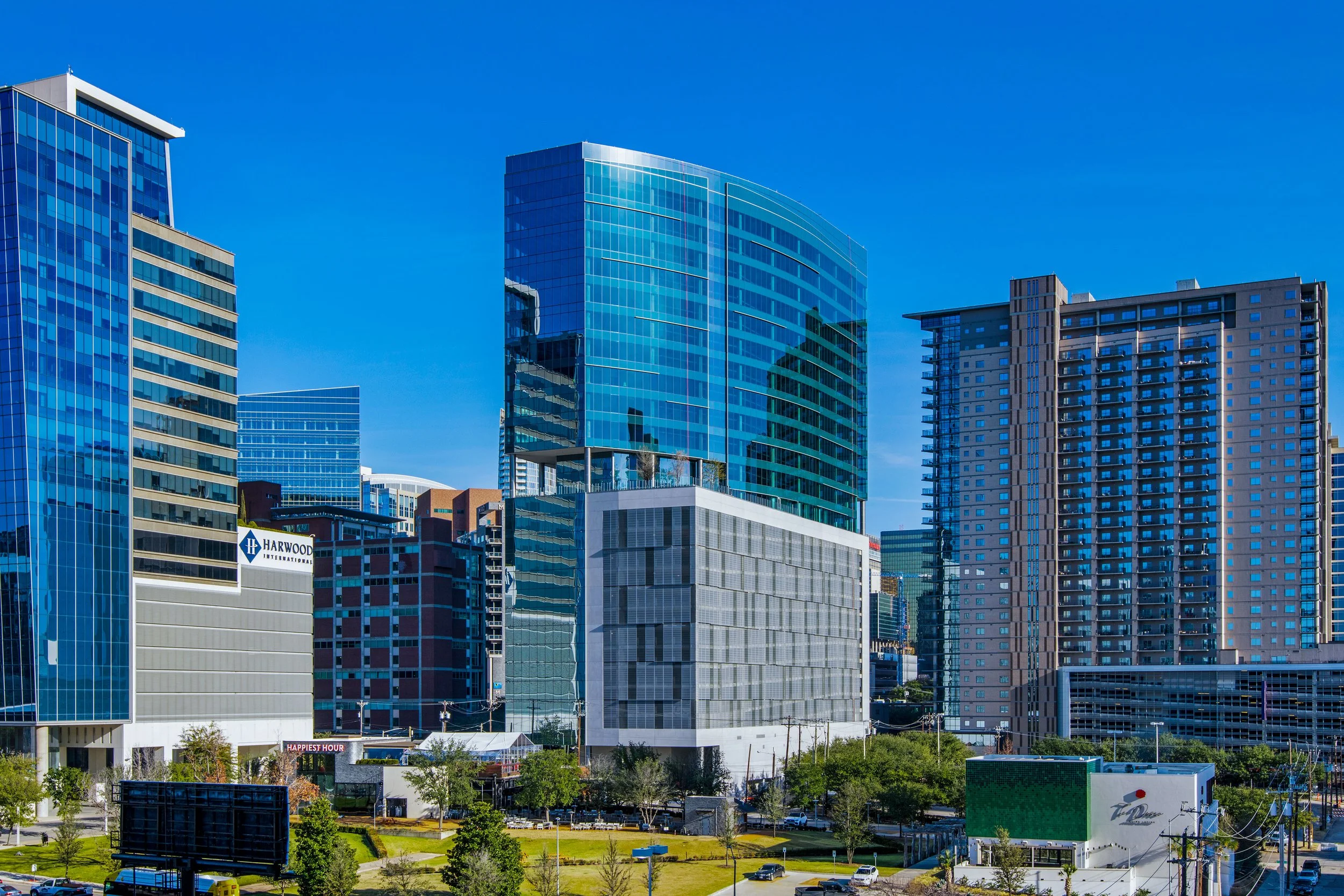
The Crescent Office. Image courtesy of crescent.com
Crescent Real Estate has closed a new $241.5 million investment fund to target commercial property deals, leaning heavily into high-end office real estate even as fundraising across private markets remains under pressure.
The Fort Worth based firm’s latest investment vehicle, GP Invitation Fund IV, came in just under its $250 million target, according to the Dallas Business Journal. A federal securities filing shows the fund was structured for a $250 million offering and had reported $207.36 million sold to 43 investors as of Dec. 19, 2025. This suggests the bulk of the capital was in place heading into year-end, as regulatory disclosures often lag behind final closes.
The timing is significant. Global private equity fundraising fell for a third straight year in 2025, sliding 12.7% to $480.29 billion from $551.16 billion in 2024, according to S&P Global Market Intelligence. Additionally, fewer funds launched in 2025 than the year prior.
A concentrated bet on “flight towards quality” assets
While Crescent’s mandate is broad which involves spanning office, hospitality, and multifamily sectors, its recent moves show where it sees the clearest upside being trophy office space in prime submarkets.
The firm reports a portfolio totaling more than $16 billion in investments, including 67 million square feet of office space, 10,100 multifamily units, and 9,300 hotel keys with these figures based on its existing portfolio as of February 2025.
That scale is now being deployed within a very specific geography
In Uptown Dallas, Crescent has been snapping up marquee office towers. In late 2025, the company bought the 19 story office building at 2100 McKinney Avenue which is an Uptown property with prominent CBRE signage acquired using $170.4 million in financing, according to The Real Deal’s review of deed records. The deal closed Dec. 17.
A few months earlier, Crescent acquired Texas Capital Center at 2000 McKinney Avenue representing one of the biggest office trades in the Dallas and Fort Worth market in 2025. The 21 story, roughly 457,000 square foot tower is anchored by Texas Capital Bank, which has a lease running through 2040.
Fort Worth is becoming a new office hub taking shape as Crescent is also building at home, where in April 2025, the firm broke ground on “Crescent Offices West,” a 170,000-square-foot office building at its Fort Worth campus that it says will be anchored by JPMorganChase and open in 2027.
That project isn’t just a real estate play because it’s part of a broader shift in how business districts form in fast growing Sun Belt metros. When a major employer anchors a high-end building outside a traditional downtown core, it acts as a magnet for other tenants, restaurants, and services.
For city leaders, that’s a win if it expands the tax base however it also raises hard questions about what happens to older office stock and legacy central business districts.
The policy backdrop: interest rates, downtown strategy, and what comes next
Here’s the bigger picture noting that commercial real estate doesn’t move in a vacuum. The Federal Reserve’s pandemic era low rate environment helped fuel dealmaking and fundraising, and the higher rate era that followed has reshaped the math by compressing values, tightening lending, and making investors far pickier.
That’s where public policy quietly enters the story as follows.
Monetary policy sets the cost of capital. Higher rates don’t just slow transactions but they also create market dislocation thereby offering windows where well capitalized buyers can negotiate better pricing especially on assets that still have strong tenants and long leases.
Local policy determines whether downtowns rebound or stagnate. Cities can influence office outcomes through zoning flexibility, permitting speed, transit access, and incentives for conversions of obsolete buildings. If capital flows mainly to “best in class” properties in prime districts, the policy challenge becomes managing the obsolete inventory meaning aging buildings that can no longer compete on amenities, efficiency, or location.
Economic development becomes a tug of war. Fort Worth and Dallas like many large metros are competing submarkets inside one regional economy. When investment and leasing momentum cluster in specific nodes such as Uptown Dallas or the Cultural District area in Fort Worth then public sector decisions around infrastructure and placemaking can accelerate that clustering.
None of that guarantees Crescent’s strategy will pay off. But it explains why a firm can be bullish on trophy office while much of the broader office market still looks shaky since the office sector is increasingly bifurcated meaning it is split between premium buildings with strong tenancy prospects, and everything else.
For Crescent, Fund IV signals that its investors believe this divergence is real furthermore that the firm can keep finding deals on the right side of it.
Parking in Dallas often feels like a competitive sport—drivers circle Uptown blocks, and guests show up frazzled before the party even starts. Choose the right valet partner, and that stress flips: curb-side lines vanish, smiles return, and your event begins on a high note.
For this 2026 guide, we reviewed every Dallas-licensed valet company, verified active insurance, combed through 900+ online reviews, and even secret-shopped three local weddings. The result is a data-backed ranking of the six best valet teams—and a clear roadmap to match each one with your venue, headcount, and budget.
A well-run valet stand turns stressful Dallas parking into a smooth, welcoming arrival experience.
First, we pulled the full roster of 34 companies that hold an active City of Dallas valet parking license. That permit requires proof of at least $1 million in garage-keepers coverage and compliance with Chapter 43, Article VI of the city code (Dallas Code §43-126). From that list, we removed any firm with lapsed insurance or expired permits.
Next, we interviewed 12 venue managers and scanned more than 900 Google, Yelp, and BBB reviews. A Dallas Morning News feature that spotlighted Lone Star Valet and Prime Valet as restaurant standouts confirmed that our research covered the market’s key players.
Each remaining contender earned a weighted score in six areas that shape guest experience:
Reputation and longevity (25 percent)
Training quality (25 percent)
Insurance depth and regulatory compliance (15 percent)
Technology and innovation (15 percent)
Service scope (10 percent)
Verified customer sentiment (10 percent)
When two companies tied, we gave the nod to the firm with the most transparent, line-item pricing. Hidden fees frustrate hosts and skew budgets.
The result is a ranked shortlist you can trust, whether you are planning a black-tie gala or a 5,000-person food festival. Next, a side-by-side table shows how the finalists compare at a glance.
At-a-glance: how the top six valet parking teams stack up
Want the quick view? The grid below shows each company’s age, reach, and signature edge, so you can match a valet partner to your priorities.
When you look at the “Tech extras” row, think in terms of how much visibility you as the host get into the operation.
FC Parking’s published technology overview describes a system that sends guests digital tickets by text, tracks staff time and attendance with GPS stamps, and gives venues real-time performance dashboards and revenue reports they can export after the event.
Using that feature set as a model helps you tell whether any vendor’s tech offering is basic convenience or a true management tool.
Criteria
FC Valet
Jack Boles
Lone Star Valet
Prime Valet
United Valet
Next Level
Founded
1998
1946
1995
2012
2005
2012
Footprint
Nationwide hub in Dallas
Dallas–Fort Worth only
Dallas–Fort Worth plus suburbs
Uptown and Downtown Dallas
Dallas–Fort Worth metro
Multiple Texas cities
Signature strength
GPS tracking plus deep training
White-glove legacy service
Large-scale staffing depth
VIP dining focus
24/7 residential versatility
Ticket-free, app-driven system
Typical client
Hospitals, hotels, malls
Luxury hotels, private clubs
Busy restaurants, malls
Trendy eateries, private events
Residential towers, corporate events
Weddings, modern events
Insurance depth
≥ $1 million, A.M. Best Class IX
Full coverage
Full coverage
Full coverage
Full coverage
Full coverage
Tech extras
QR/text retrieval, live analytics
Traditional tickets
Digital tracking
SMS retrieval
Text notifications
Online booking, mobile pay
Review average†
Strong corporate references
Elite word-of-mouth
3.5–4 stars
≈ 4.5 stars
≈ 5.0 stars
≈ 5.0 stars (fewer reviews)
†Averages combine Google, Yelp, and BBB ratings gathered December 2026; they illustrate sentiment rather than exact scores.
6. Next Level Valet – best for modern events
Overview
Founded in 2012, Next Level Valet treats valet parking as full-scale hospitality, keys included. Its edge rests on two investments: ticket-free software that trims wait time, and attendants trained to greet every driver as a VIP.
From the first quote request, handled entirely online, planners receive digital contracts within minutes. A project lead follows up by video call, and one week before go time the team shares a traffic-flow sketch worthy of an event architect.
Technology that keeps lines moving
Guests scan a QR code, enter their license plate, and receive a text confirmation, so no paper tickets go missing. Hand-held scanners sync to a live lot map that logs stall number, key-box slot, and arrival time. When pickup texts arrive, the system stages cars by wait order and walking distance.
After the event, hosts receive a report with totals parked, average retrieval time, and peak arrivals—data planners can feed into future staffing models.
When Next Level is the right fit
Choose Next Level when your crowd lives on smartphones and the schedule is tight, think weddings with a 90-minute room flip or launches where executives need a two-minute exit. The Dallas crew routinely parks more than 300 cars at seasonal festivals and clears the lot in under 30 minutes, according to internal case updates shared with clients.
Need more than valet parking? Next Level can layer in golf-cart shuttles, traffic marshals, or security checkpoints without boosting headcount. Pricing lands mid-pack in our top six, but tech-powered efficiency often shortens both lines and event timelines.
Bottom line: if first and last impressions matter, and you would rather text for the car than search for a paper stub, Next Level’s modern toolkit delivers.
5. United Valet Service – best versatile all-rounder
Why it ranks
With more than 20 years of valet parking across Dallas–Fort Worth, from black-tie galas to condo driveways, United Valet has earned a reputation for solving nearly any parking puzzle. That breadth rests on cross-training: every attendant cycles through high-volume restaurant shifts, medical-facility drop-offs, and luxury-residential etiquette before working solo. The outcome is consistent courtesy whether a guest arrives in a Bentley or a budget SUV.
Management keeps the same flexible mindset. Need 24/7 coverage at a new high-rise? They create a rotating supervisor schedule. Hosting a pop-up fundraiser on a narrow driveway? A scout maps cone placement and emergency lanes days in advance, so the fire marshal signs off without stress.
Flexibility you feel from first call to final car
Planning starts with a blunt question: “What could go wrong?” Backup valets stay on standby, rain tents ride in the truck, and each stand carries a jump-start kit. Dispatch uses a cloud schedule that tags drivers by specialty; if your guest list leans toward exotics, certified dual-clutch drivers appear without you asking.
Communication stays tight. A single point of contact texts photos when the podium is set, shares mid-event wait-time snapshots, and emails a time-stamped traffic report within 24 hours. At one downtown condominium, that system cut average retrieval time from nine minutes to under four, according to the property manager’s 2026 renewal letter on file with United Valet.
Bottom line: choose United Valet when you want a partner that treats a four-hour reception with the same diligence it gives a multiyear residential contract. From contingency plans to post-event analytics, their versatility buys hosts peace of mind.
4. Prime Valet – best boutique dining experience
Why they own Uptown’s curb
Prime Valet has delivered valet parking for Dallas restaurants since 2012, running more than a dozen nightly stands along McKinney Avenue and Knox Street. The company’s burgundy podiums, paired with familiar attendant faces, set a warm tone that often starts with “Happy anniversary” before guests reach the host stand.
Unlike larger firms that chase hospital contracts, Prime measures success in table-turn minutes. Valets review the reservation sheet each shift, flag VIP notes or celebrations, greet regulars by name, and prompt a faster seat-to-server hand-off.
Small team, fast pivots
Because leadership works on-site, last-minute changes never stall in layers of approval. When a rehearsal dinner moved up 30 minutes, Prime’s owner rerouted a spare crew and adjusted the off-site shuttle without guests noticing, a story several Uptown planners cite when recommending the firm.
The tight urban footprint has also honed an art called tandem stacking, letting Prime fit 40 percent more cars into an alley lot than standard single-file parking. The payoff: entrées stay hot, sidewalks stay clear, and diners post reviews that praise “quick, polite valet” almost as often as the steak.
Choose Prime when curb space is scarce, ambience is intimate, and you want a valet captain who knows both the regulars and the city inspector by first name.
3. Lone Star Valet – best for scalability
Why scale is their superpower
Lone Star Valet has provided valet parking in Dallas since 1995 and now staffs more than 120 local locations on a typical weekend night. That bench lets the company deploy more than 200 attendants for a single stadium concert without diverting staff from other clients.
The roster grows through monthly training cohorts, and schedules are built airline-style with on-call crews. In December 2024 a flu wave sidelined five valets at NorthPark Center; a rapid-response shuttle filled the gap in 18 minutes, according to Lone Star’s service log shared with mall management.
How the logistics work
Site walk-through. A captain maps ingress and egress lanes, then drafts a color diagram: green arrows for arrival flow, yellow boxes for overflow lots, and red stars for police assist points.
Staffing grid. Headcount scales at one valet per 30 cars during the peak hour; supervisors track the ratio on tablets and shift floaters as live counts update.
Traffic dashboards. On event day, tablet maps refresh every five minutes, letting captains pre-stage cars when they see an exit spike coming.
Choose Lone Star when your biggest concern is gridlock at stadium festivals, convention-center galas, or city-block restaurant crawls. Their playbook turns volume into choreography, so you can focus on the show, not the street.
2. Jack Boles Parking – best for luxury and reliability
Legacy that sets the bar
Jack Boles Parking has offered valet parking in Dallas since 1946, when the founder opened his first stand outside The Adolphus Hotel. After nearly eight decades, its burgundy-trimmed podium at Rosewood Mansion on Turtle Creek signals white-glove service before guests step from the car.
Longevity shows in the roster: many attendants have logged ten or more years, a stability rare in an industry known for turnover. That tenure produces nearly choreographed arrivals as doors open together, luggage appears before guests ask, and the drive stays whisper-quiet.
Execution built for high-profile events
Preparation is everything. For a recent museum gala featuring multimillion-dollar autos, Jack Boles sent a mechanic two days early to install drip trays and battery tenders. For a Fortune 500 board dinner, valets memorized license plates matched to headshots so CEOs were greeted by name, badge-free.
The firm lists liability coverage above industry standard, and incidents stay rare thanks to slow-speed driving rules and on-site supervisor ride-alongs.
Choose Jack Boles when your guest list includes dignitaries, vintage automobiles, or anyone who expects refined courtesy at the curb. After 79 years, the craft keeps getting finer.
1. FC Parking Valet Services – best overall, tech-forward partner
Why FC sits at the top
Founded in 1998, FC Parking Valet Services brings national valet parking muscle to Dallas, operating in eight states and managing more than 600 employees. The Dallas hub applies that playbook to local malls, hotels, and black-tie galas.
Training that shows up curb-side
Every hire completes classroom hospitality courses, shadows a senior mentor for 30 shifts, and must pass a defensive-driving road test before handling keys. Quarterly mystery-shop audits reward crews posting the highest greeting scores and sub-two-minute average retrievals, a metric FC shares in client dashboards.
Technology that proves it
FC’s ticket-free software captures a photo and GPS stamp of each vehicle on arrival. Guests text to retrieve and pay, while hosts view live dashboards that display cars parked, average wait time, and staffing efficiency. Facilities managers often export those logs to forecast future headcounts.
Risk management above city minimums
The firm carries A.M. Best Class IX garage-keepers coverage, along with workers’ compensation and cyber liability to protect guest data. Few Dallas competitors list cyber coverage, a key safeguard when license-plate numbers live in the cloud.
Whether you are hosting a 50-car cocktail hour or a 1,000-car convention, FC scales without losing polish. The blend of deep training, transparent data, and extra-strong insurance keeps them our number-one choice for 2026.
Honorable mentions worth a look
Pinky’s Valet: women-owned flair
Founded in 2009 as Dallas’s first all-female valet company, Pinky’s still fields the city’s largest female-led crews. Event planners book them for weddings and nonprofit galas where tailored uniforms with pink accents match the décor.
Gold Crown Valet: formal, old-school polish
Serving Dallas since 1994, Gold Crown sends valets in vests and white gloves to charity balls, heritage venues, and black-tie dinners. Founder R. W. Raabe’s team has parked cars for visiting heads of state and 5,000-guest hotel openings, evidence that time-honored etiquette can handle large crowds.
If you prize diversity or classic presentation over app-based tech, add these companies to your shortlist.
How to choose the right valet parking partner
The best fit depends on three variables: arrival volume, venue type, and operator professionalism.
Use a simple checklist and side-by-side comparison to match the right Dallas valet partner to your event.
Estimate the surge, not just headcount.
Match expertise to the venue.
Confirm paperwork before you sign. Dallas requires a valet permit and at least $1 million in garage-keepers liability (Dallas Code §43-126). Reputable companies send certificates proactively; hesitation is a warning sign.
Compare apples to apples on cost. Request a line-item quote that lists hours, attendants, supervisor, insurance, and whether gratuity is included. A bid that is $100 lower can balloon if overtime or permit fees surface later.
Test responsiveness. Great valet parking mirrors great hospitality: quick replies and clear solutions. If the pre-sale call feels scattered, expect the curb to feel the same.
Use these five checks and guests will remember only how effortless parking felt, not the logistics behind it.
What valet parking costs in Dallas
Professional pricing follows a simple equation: number of attendants × hourly rate × hours on site.
Break valet pricing into staff hours, permits, digital ticketing, and gratuity so your Dallas event budget has no surprises.
In Dallas, full-service companies quote $25–$40 per valet, per hour (rate cards collected from three licensed operators, December 2026).
Most enforce a four-hour minimum to cover set-up, peak service, and teardown.
Real-world scenarios
Scenario
Cars
Staff
Hours
Typical cost*
Backyard wedding
40
2 valets
5 hours
≈ $300
Corporate gala
200
8 valets and 1 supervisor
5 hours
≈ $1,500
*Assumes $30 hourly rate for valets and $35 for a supervisor.
Extra fees to budget
Curb-lane permits. Dallas charges $250 per curb space (first six) inside the Central Business District and $1,000 for each space after six. Outside downtown, the city charges $350 for the first two spaces and $1,000 beyond that (Dallas Code §43-126.6).
Digital ticketing. QR-code or text platforms from Next Level or FC typically add 10–20 percent.
Gratuity. Hosts often pre-pay 15 percent so guests skip tipping; otherwise expect $2–$5 per car.
Bottom line: plug your headcount, arrival surge, and any tech or permit add-ons into the equation above, and a detailed quote should hold no surprises on invoice day.
Dallas valet parking rules and etiquette you can’t ignore
The City of Dallas treats curb space like real estate, both valuable and highly regulated. Operating a valet stand on public right-of-way requires a permit under Dallas Code §43-126; the permit must be displayed at the podium and used only in the mapped pick-up zone approved by Transportation.
Insurance. Licensees must carry at least $1 million in garage-keepers and $1 million in general liability coverage per occurrence (Dallas Code §43-126.4). Reputable firms email certificates the same day you ask; hesitation is a warning sign.
Tipping norms. In Dallas, guests usually tip $2–$5 per retrieval; ten dollars is common in rainstorms or after midnight. If you pre-pay a 15 percent gratuity, post a sign so wallets stay tucked away.
ADA compliance. Drivers with disability placards may self-park in reserved spaces at no extra cost. Top crews station an attendant near the loading zone to assist with mobility aids and keep ramps clear.
Neighborhood courtesy. Blocked driveways or idling engines after midnight draw complaints quickly. Hand out flyers to nearby residents, and post a two-space buffer to keep exhaust away from bedroom windows.
What’s next: trends shaping Dallas valet parking in 2026
Contactless becomes standard. QR-code and text-for-car systems jumped from 18 percent of local stands in 2020 to 62 percent in 2026, according to Dallas Transportation permit data. Momentum grew after Dallas-based JustPark purchased valet-tech firm Oobeo in September 2026. Expect guests to pay, tip, and rate service with one tap, leaving paper tickets behind.
Electric vehicles reshape the curb. High-end hotels now ask valets to plug EVs into Level-2 chargers during dinner service; FC Valet reports that EVs make up 14 percent of arrivals at NorthPark Center. Attendants train on charger etiquette and aim for an 80 percent cap when stalls are limited. Some firms even rent portable chargers for pop-up events.
Sustainability expands past idle reduction. Digital tickets already eliminate about 400,000 paper stubs each year across the six largest Dallas operators. Companies also add electric golf carts for staff shuttles and routing software that trims circling miles by up to 22 percent.
Dashboards move from back office to boardroom. Live heat maps of arrivals and average retrieval time let venues adjust staffing on the fly and plan bar promos around departure peaks. Meeting Professionals International-DFW found that real-time valet metrics shifted from “nice to have” to “required” on 41 percent of RFPs in 2026.
Tomorrow’s best valet partner will not just park cars; it will deliver data, greener practices, and a friction-free journey from curb to cocktail.
FAQ: quick answers to common valet parking questions
How far in advance should I book?
Dallas weekends fill fast. Wedding planners recommend reserving valet 8–12 weeks ahead; smaller events can secure crews in 4 weeks, yet earlier booking locks permit windows and lower rates.
What happens if a guest loses the ticket?
Modern systems link each license plate to a digital record. Valets confirm ID and match the photo; retrieval usually adds one extra minute, not an hour.
Do I need extra insurance as the host?
Generally no. Licensed Dallas operators must carry $1 million in garage-keepers and $1 million in general liability (Dallas Code §43-126.4). Ask to be named as an additional insured for full coverage.
Can valets handle electric vehicles?
Yes, if you provide chargers. Mention EV counts during booking so attendants can stage cars near Level-2 plugs; Next Level reports that EVs make up 14 percent of Uptown arrivals.
Is tipping required if I’m already paying a valet fee?
Customary but optional. National etiquette guides suggest $2–$5 per retrieval, or 15–20 percent of the valet fee. Hosts who pre-pay a 15 percent gratuity often post a sign reading “Our pleasure—no tips tonight.”
What if a storm rolls in?
Top crews arrive with tents, umbrellas, and plastic seat covers. They stage vehicles on higher ground and double retrieval staff, cutting wait times by about 40 percent, according to FC Valet’s 2024 rain-plan report.
Will valets park oversized trucks or exotic sports cars?
If a vehicle fits in a standard space, yes. Flag lifted trucks or low-clearance exotics early so staff can reserve suitable spots or provide ramps.
Conclusion
A great valet partner does more than park cars—it sets the tone on arrival and leaves a lasting impression at departure. With the insights above, you can match your event’s needs to a Dallas valet team that delivers smooth, professional service every time.
A newly built high-rise in Dallas’ Uptown district has changed hands in what brokers say is the most expensive office sale in the Dallas–Fort Worth area this year. Cousins Properties, an Atlanta‑based real estate investment trust, has purchased The Link at Uptown for roughly $218 million. The 25‑story tower, completed in 2021, totals 292,000 square feet and is about 93.6% leased.
The deal, announced July 31 by Newmark Group Inc., surpasses the previous record set by this month’s sale of Sterling Plaza and underscores strong demand for high‑quality office space in DFW. “This transaction is a resounding endorsement for Dallas‑Fort Worth and a clear indicator of the market’s strength,” Chris Murphy, one of the Newmark vice chairmen who arranged the sale, said in a statement.
Inside The Link
Located at 2601 Olive St., The Link offers panoramic views and an amenity floor with a tenant lounge, fitness center, conference facilities and an outdoor terrace. The Class‑AA building houses a mix of tenants spanning finance, law and advertising, including Houlihan Lokey, McGuireWoods and PMG. According to research firm Yardi, its leases carry a weighted average term of more than nine years.
Kaizen Development Partners built the tower using a US$128.3 million construction loan from Goldman Sachs in 2020 and delivered it a year later. At the time of sale, the asset was encumbered by a $143 million loan from JPMorgan Chase due in 2028. Cousins financed the purchase with excess proceeds from its unsecured bond issuance and the settlement of previously forward‑issued shares.
The record-setting sale comes amid signs of resilience in the North Texas office market. A Newmark analysis notes that Dallas‑Fort Worth ranks first in projected job and population growth through 2026 and boasts one of the nation’s top return‑to‑office rates.
Still, the office sector is navigating a long recovery. A recent JLL report cited by WFAA found that large office users are scouting roughly 7.6 million square feet of space across the Metroplex — the strongest leasing pipeline since 2019 and more than double last year’s 3.3 million square feet. Actual leasing activity, however, slipped from 3.1 million square feet in the first quarter to 2.4 million in the second.
Kaizen isn’t stepping away from Uptown; the developer has started abatement and demolition at a site on Harry Hines Boulevard that could see another office tower as well as condos and a hotel. Cousins, meanwhile, adds The Link to a Dallas‑area portfolio that includes 5950 Sherry Lane in Preston Center and the mixed‑use Legacy Union project in Plano. Collectively, the flurry of deals and development suggest investors are willing to pay a premium for trophy assets even as the broader office market continues to heal.