Energy costs are rising, and for many Texans, that’s not just a budget line item. It’s a tipping point. As utility bills spike, people across the state are rethinking the realities of homeownership. A recent study from Home Energy Club digs into how different generations are adjusting their expectations and strategies in the face of rising energy costs.
Texans Losing Faith in Homeownership
Across Texas, more people are starting to question whether homeownership is still a realistic goal. Two-thirds of Texans in the survey said they’ve lost faith in the American Dream because of rising housing and energy costs. Millennials and Gen Z felt especially discouraged, 72% and 69%, respectively, said they’re feeling squeezed out. For baby boomers, the number was still significant at 42%.
And the frustration isn’t just a mindset issue. It’s financial. About 80% of respondents said that the cost of electricity is making it harder to afford a home in Texas. Roughly one in ten homeowners said they’ve had trouble covering their mortgage due to high energy bills. 15% have even thought about selling their homes to lower their bills.
Energy Efficiency Efforts and Limitations
Texans are making small changes to adapt. The survey shows a clear effort among homeowners to cut energy use and lower their bills. Here’s what they’re doing:
Using less and switching to LEDs: 59% of homeowners are focusing on reducing how much energy they use and switching to LED lighting.
Sealing drafts and improving insulation: 46% are sealing air leaks, and 41% are upgrading to more efficient appliances.
Installing smart thermostats and adding insulation: Roughly a third have installed smart thermostats or improved insulation.
But some solutions are still out of reach. Only 9% have installed solar panels. And 68% of both homeowners and buyers said options like solar simply aren’t realistic for most households right now.
Government Incentives Fall Short
Tax credits and energy rebates may look promising on paper, but many Texans say they’re not seeing the benefits. Almost half of homeowners in the study said government incentives aren’t enough to ease the burden. Only a quarter said those programs were making a real difference.
Part of the problem is that people are confused. Some homeowners said they don’t fully understand the requirements or steps involved in applying for these benefits. That uncertainty discourages many from using the programs designed to help them save.
What Today’s Buyers Want
With costs in mind, buyers are changing what they want in a home. Energy efficiency is at the top of the wishlist:
Energy efficiency has become the top priority for today’s homebuyers, with 66% of buyers favoring them.
Smaller homes and new builds with good insulation and energy-efficient systems are catching buyers’ attention.
Older homes have lost their appeal. Only 16% of buyers were interested in homes without efficiency upgrades. Downsizing is becoming a practical choice, especially among Gen X and baby boomers—73% and 70% said they’re thinking smaller to keep costs down.
Impacts Across Generations
Each generation is responding to rising energy costs in its own way. Gen Z is focusing on insulation, Gen X and millennials are dialing back their energy use, and boomers are making simple changes like switching to LED lighting.
Younger buyers still believe things can improve. Nearly half of Gen Z respondents think solar and other tech solutions are within reach. Older generations are more skeptical, 74% of boomers and 71% of Gen Xers don’t think those options are affordable.
The Bigger Picture: Reassessing the American Dream
The numbers tell a tough story. About 46% of participants said they’re starting to believe that owning a home is less attainable because of energy costs. Another 16% went further, saying the dream feels completely out of reach.
Only 18% believe owning a home is still realistic. Clearly, cost is a huge barrier, even for basic necessities, not just high-end features. Even basic affordability is in question for many families.
What’s Next for Texas Homeownership Amid Energy Price Pressures
Until energy prices stabilize or more affordable options emerge, Texas buyers will likely keep changing what they look for. Energy efficiency and overall cost-effectiveness are becoming essential, not extras. That shift is reshaping both buyer preferences and market behavior.
We might also see lenders and appraisers start giving more weight to energy-saving features. If mortgage terms and home values start reflecting the long-term savings of energy efficiency, that could finally give buyers the nudge they need to invest in upgrades.
This trend goes beyond home design, they’re changing how people think about what they can afford, where they can live, and whether the American Dream still makes sense today.
Scottie Scheffler won the 2025 PGA Championship by five strokes, showing he is the best golfer. With a total score of 11-under 273, Scheffler claimed his 15th PGA Tour title and pocketed a cool $3.42 million from a record-setting $19 million purse. But this wasn’t just any championship moment. This win made him the first golfer since Seve Ballesteros in 1983 to win each of his first three majors by at least three strokes.
Scheffler’s road to victory wasn’t exactly smooth, though. He stumbled a bit on the front nine, and Jon Rahm was close behind, breathing down his neck. But Scheffler did what he does best—kept his cool, found his rhythm, and reminded the world why he’s sitting comfortably at the top of the golf rankings.
What makes all of this even more remarkable is what happened just a year earlier: hours before the second round of the 2024 PGA Championship at Valhalla, Scheffler was arrested in a bizarre and tragic incident. According to police, he ignored orders while entering the course, resulting in charges including second-degree assault on a police officer and reckless driving.
The incident was tied to a fatal bus accident involving a pedestrian. It was heavy stuff, and for a moment, it seemed like his future might be on pause. But Scheffler showed up to play that day—and he still finished tied for eighth.
Golf isn’t the only arena where Scheffler’s been winning. Back in Dallas, Texas, he lives in a stunning ranch-style home that’s equal parts charm and luxury. Bought in 2020 for $2.1 million, following his marriage to high school sweetheart Meredith Scudder. This 4,881-square-foot residence feels like the kind of place you’d want to kick off your shoes and stay awhile. With five bedrooms and five-and-a-half bathrooms, there’s plenty of room for family, friends, and maybe the occasional putting contest in the hallway.
Built in 1946, the home has been thoughtfully renovated over the years, blending vintage character with modern convenience. One of the standout features? The chef’s kitchen—yes, the kind of kitchen that would make even the most casual cook want to start meal prepping. We’re talking high-end appliances, a gas cooktop, a double oven, and even a warmer drawer so dinner stays perfect, no matter when you’re ready to eat.
[envira-gallery id=’517705′]
Let’s take a closer look at the place he calls home, starting right from the front yard and making our way through each space that makes this Dallas ranch-style house feel more like a sanctuary than just a luxury address.
A Ranch-Style House
This sprawling ranch-style house, made from light-colored stone, feels both elegant and roomy. The dark gray shingle roof slopes gently, and big, well-placed windows let plenty of natural light inside. A stone chimney adds a classic touch, while the rich brown front door—framed by stone and flanked by outdoor lanterns—welcomes you in.
The house is surrounded by a vibrant green lawn, mature trees providing shade, and neatly trimmed bushes. Colorful flowers are near the entrance, and a wide, warm-toned brick driveway curves toward the house, indicating regular upkeep. The tranquil atmosphere and sunny lighting suggest upscale living.
The Main Entrance
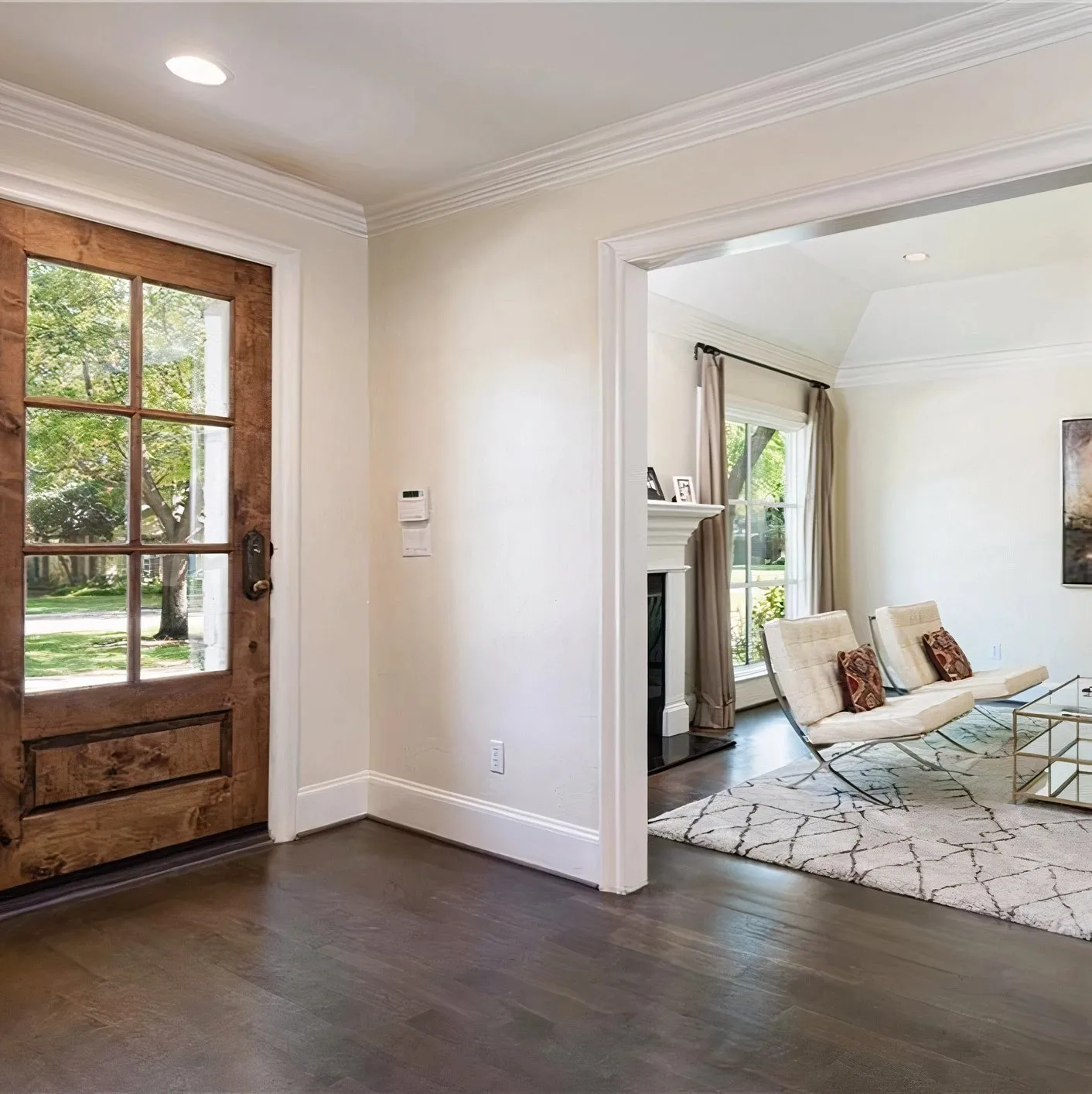
The main entrance features a beautiful natural wood door showcasing its grain and texture. It includes several rectangular glass panes that offer a clear view of the lush front yard and surrounding tree. The door is fitted with a dark bronze or antique-style handle and lockset. Walls and Trim:
The walls are adorned with a soft, creamy off-white hue, providing a neutral and inviting background. Elegant white crown molding lines the ceiling, accompanied by broad white baseboards that contribute to a refined and sophisticated appearance.
The entryway boasts dark-stained hardwood flooring, adding warmth and style to the area. Lighting: A recessed ceiling light brightens the entrance space. A wall-mounted digital thermostat or security panel is positioned on the wall to the right of the door, with an electrical outlet located beneath it.
Spacious Living Room with Modern Comfort
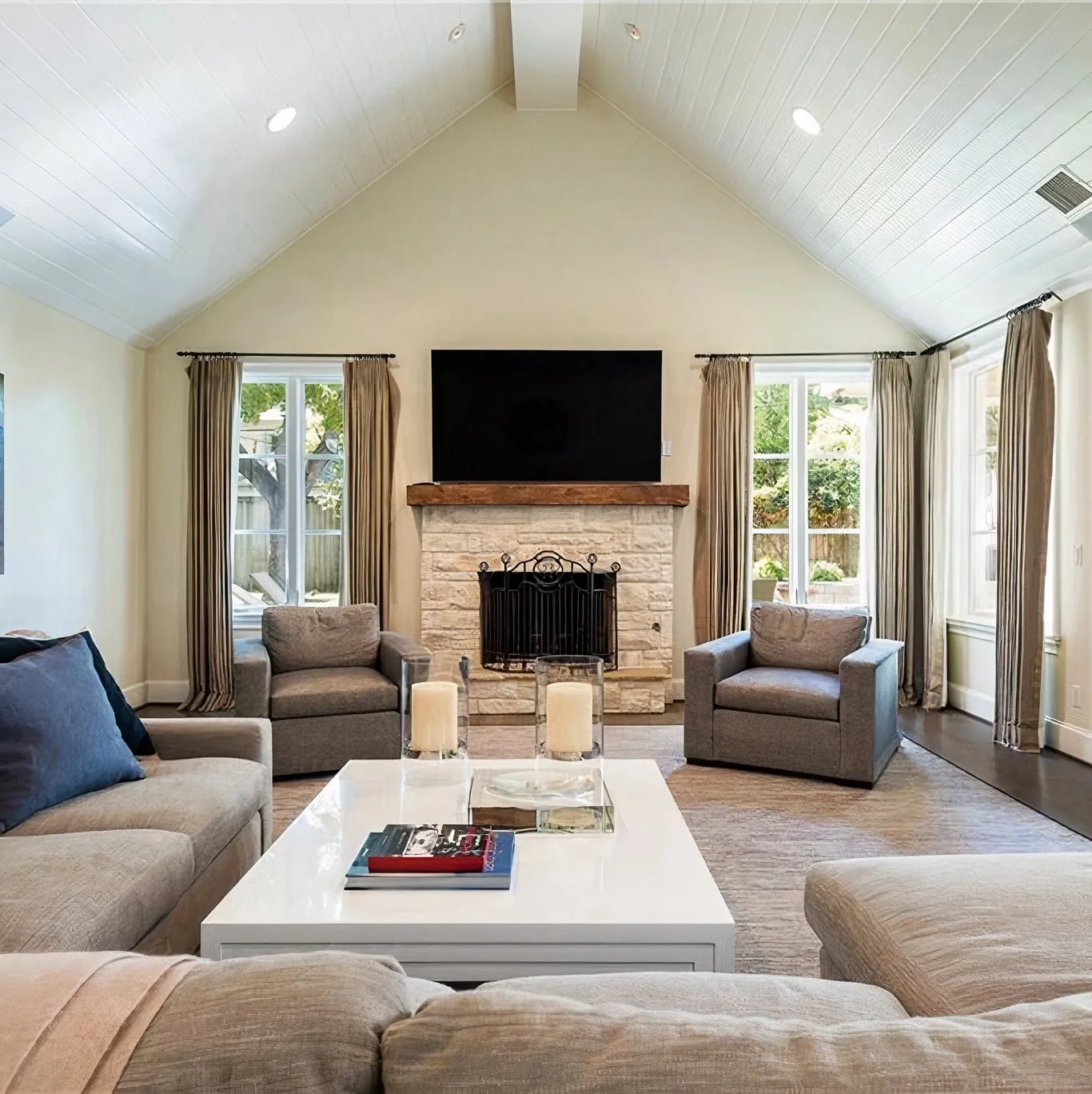
This spacious, light beige living room features a vaulted ceiling with white wooden planks, with walls in a similar light beige tone and large windows dressed in light taupe/beige curtains; a modern, flat-screen television is mounted above a stone fireplace mantel, topped with a dark wood beam, while gray upholstered sofas and armchairs are arranged around a large white coffee table that holds several decorative items and a stack of books, including two sets of candles in clear glass holders, all set on dark brown hardwood floors in a well-lit and spacious room with a backyard visible through the large windows.
Open-Plan Living Area
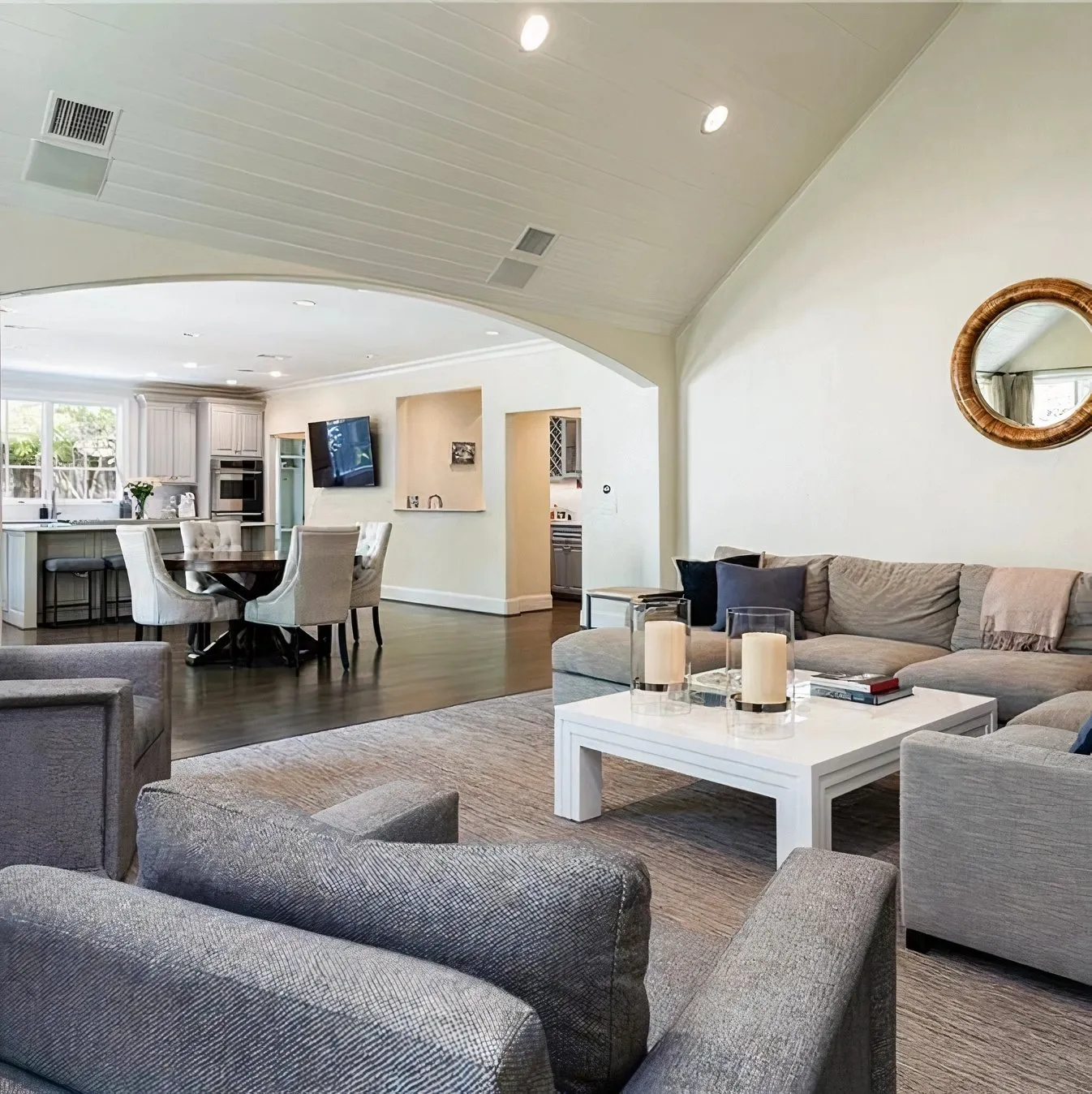
A large open-plan living area features a vaulted ceiling with light beige wood-plank detailing, and the space seamlessly connects a dining area—complete with a round table and upholstered chairs—to a living area furnished with a light gray sectional sofa, two armchairs, and a low, white coffee table. Natural light streams into the room through large windows.
The floors are dark hardwood, and a beige/gray area rug sits beneath the seating and dining furniture, while the walls are a soft, off-white color, complemented by decorative items, including a round mirror with a light brown frame situated on a wall.
Modern Kitchen Charm
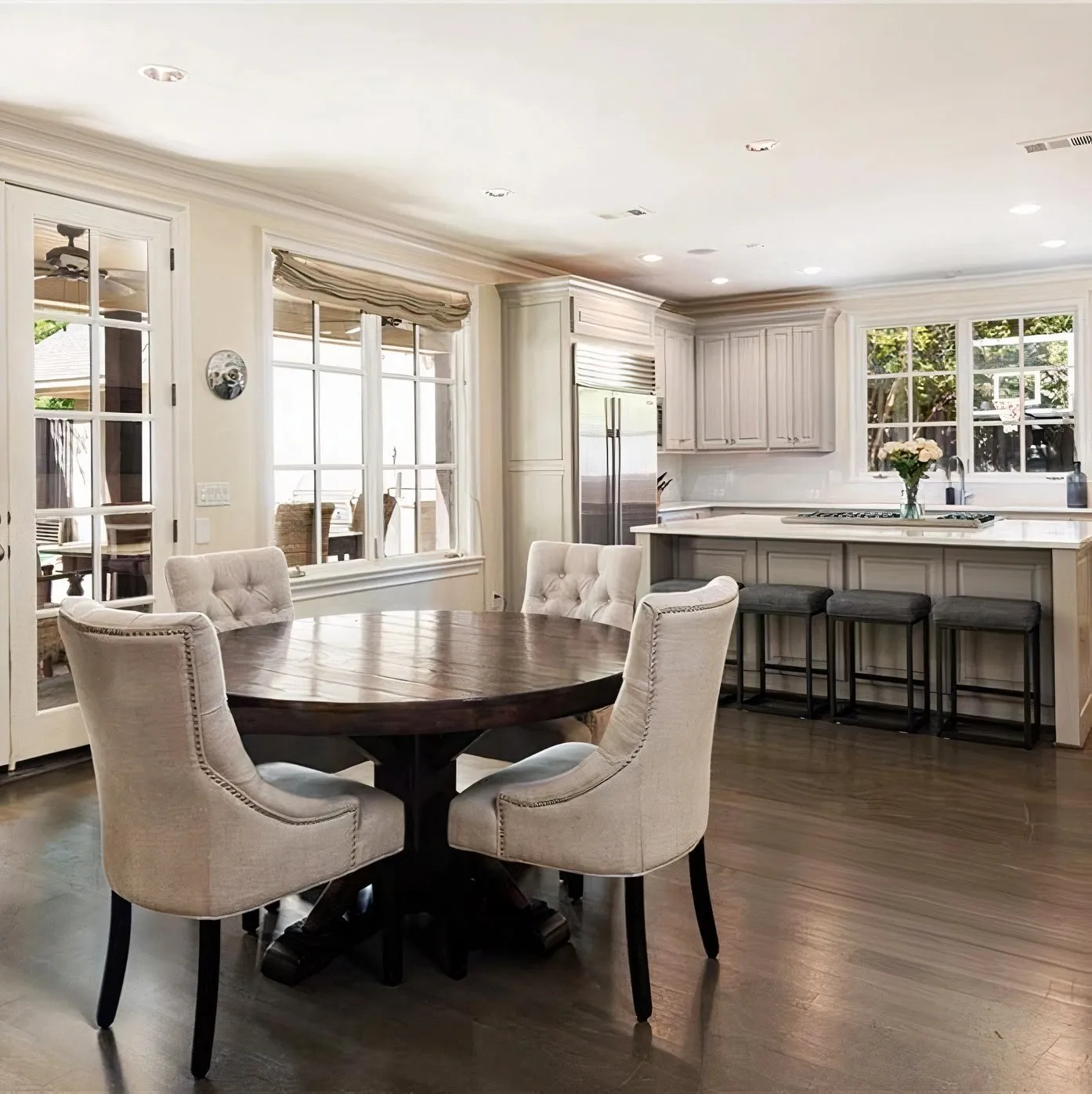
A light beige/cream-colored dining area features a large, round, dark brown wooden table with four upholstered chairs; the chairs have button-tufted backs and beige fabric with small nailhead trim, and the floor is a dark, grayish-brown hardwood.
The dining area is open to a light grayish-beige kitchen with shaker-style cabinets, stainless-steel appliances, and a large island countertop. Large windows allow natural light into the space, and the walls are a light beige/cream color. The kitchen area includes a breakfast bar with upholstered barstools. A portion of an outdoor patio or deck is visible through the large windows. The indoor lighting is bright and even.
Elegant and Calm Modern Dining Room
This modern dining room feels calm and inviting thanks to its light beige color scheme. The star of the room is a long, live-edge wooden table surrounded by six dark blue velvet chairs with sleek silver legs. A cool chandelier hangs right above, adding a little sparkle without being too flashy.
The walls are pale beige with some clean white molding, and a few abstract art pieces add just enough personality to keep things interesting. The dark brown floors catch the light and keep the room feeling open and airy. It’s a space that’s polished but not stuffy — really relaxed and easy to hang out in, with zero clutter getting in the way.
A Classic and Elegant Office
The office has this big, dark brown wooden desk that’s pretty fancy with all its carved details and molding. One wall’s mostly a huge window framed in white, looking out onto a backyard full of trees and landscaping. There’s a light beige cream fabric curtain pulled across it. On either side of the window, built-in white bookshelves hold books and random stuff—like a tiny orange toy car that adds a little personality.
A soft beige chandelier hangs from the ceiling, giving the room a warm glow. The light beige walls hold a simple painting of trees near the desk. A comfy dark gray office chair sits in front, and a brown leather armchair sits by a small side table with a framed photo near the big window. Light gray floors tie the space together, making it feel classic, bright, and inviting.
Cozy Master Bedroom
The master bedroom has a big window with light beige curtains that open up to a chill view of trees and greenery. The walls keep things cozy without being overwhelming. A dark brown wooden bed sits under a crisp white comforter, with a simple beige side table right next to it. Up above, a ceiling fan with dark brown blades quietly does its thing.
A large piece of artwork featuring a Buddha head is displayed on the wall that kind of sets a calm, peaceful tone for the whole room. Right next to it, you’ve got a soft, light brown armchair that just begs you to sit down and unwind with a book. The gray hardwood floors tie everything together, making the space feel open, bright, and super chill without trying too hard.
Game Room with Sleek Style
The room is painted a soft beige and features a modern ping-pong table with a sleek, curved gray-silver metal frame and a standard net ready for a game. Above it, a ceiling fan with light brown blades and a brushed nickel finish keeps the air moving.
A ceiling fan with light-brown blades and a brushed-nickel finish is mounted centrally above the ping-pong table. Beige-toned curtains hang at the window, which faces a street scene with trees and houses visible beyond the window pane. The walls are a light beige and have crown molding along the top edge. A light-colored area rug covers the floor beneath the ping-pong table.
Elegant Contemporary Bathroom
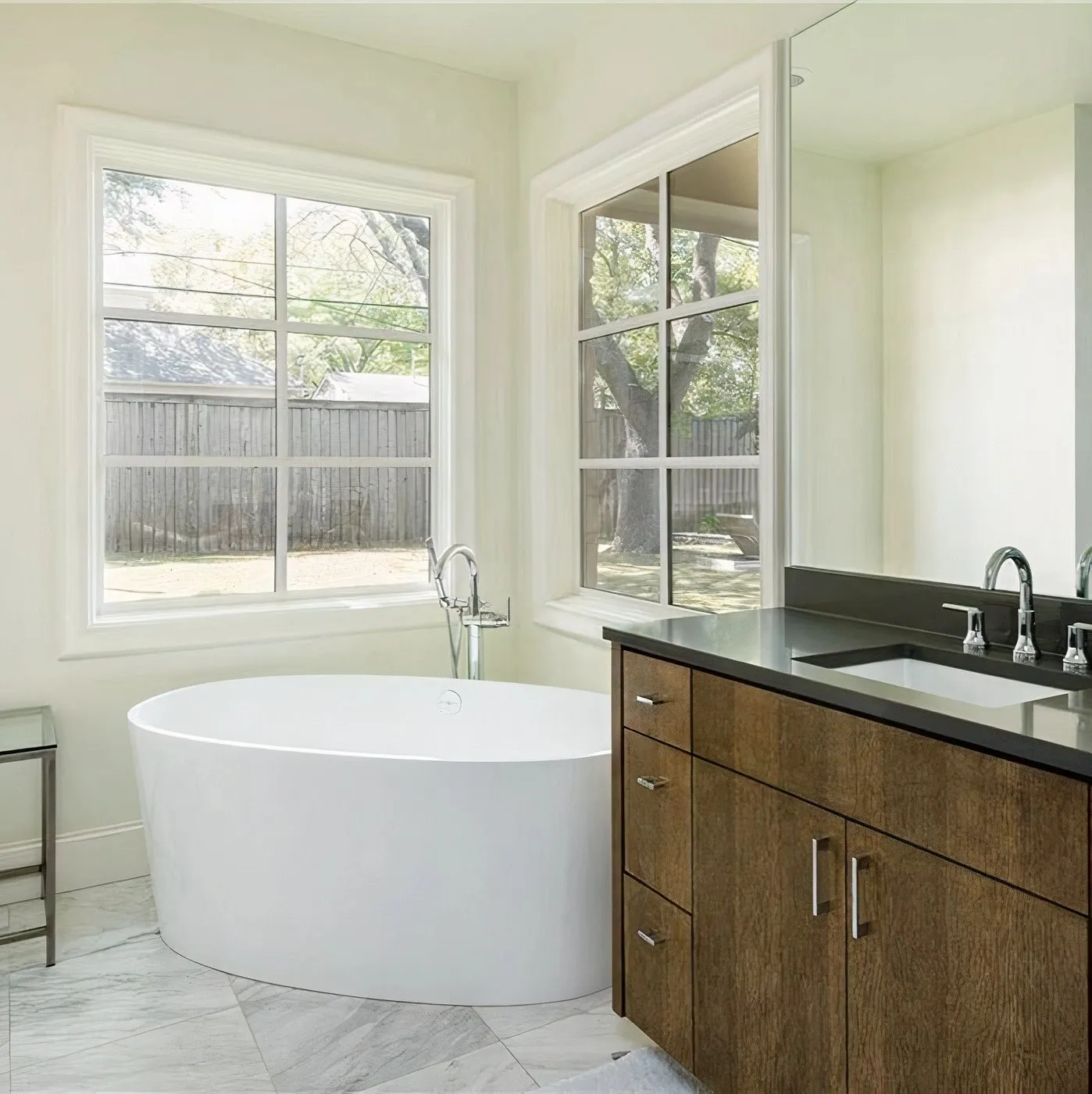
The modern bathroom has a large, oval white bathtub tucked in the corner under a matching white window frame, with dark wood cabinets topped by a dark gray granite or quartz countertop on the vanity. Above it, a full-length mirror catches the natural light streaming in.
The walls are painted a soft beige cream, while the floor shows off a marble-look tile pattern. Outside the window, you can see trees and greenery, bringing a bit of the outdoors in. Chrome fixtures catch the light everywhere—there’s a sleek faucet on the tub and two more by the sink. In one corner, a small dark wood side table adds just the right cozy vibe.
Luxurious Walk-In Closet
This walk-in closet is bright, spacious, and all white—cabinets, shelves, and a shiny countertop that runs the length of the room. Clothes hang on metal hangers, and mirrored panels make the space feel even bigger.
The dark wood floor keeps it from feeling too cold, and there’s a neat spot for shoes and clothes on racks. There’s even a vent above the door, which is a nice touch. Overall, it’s a super organized and pretty luxe closet that just makes you want to get dressed.
Backyard and Pool with Beautiful Landscaping
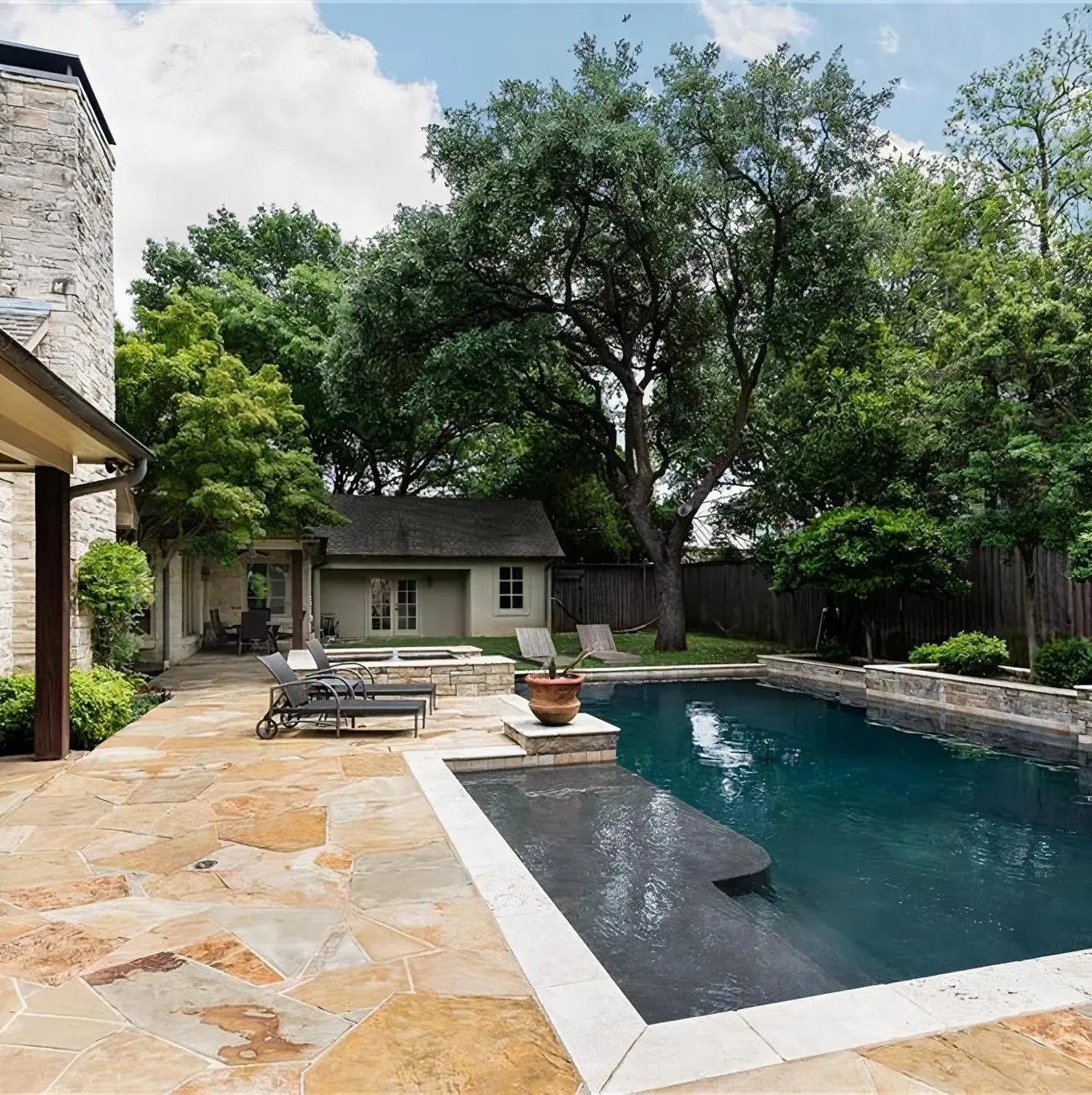
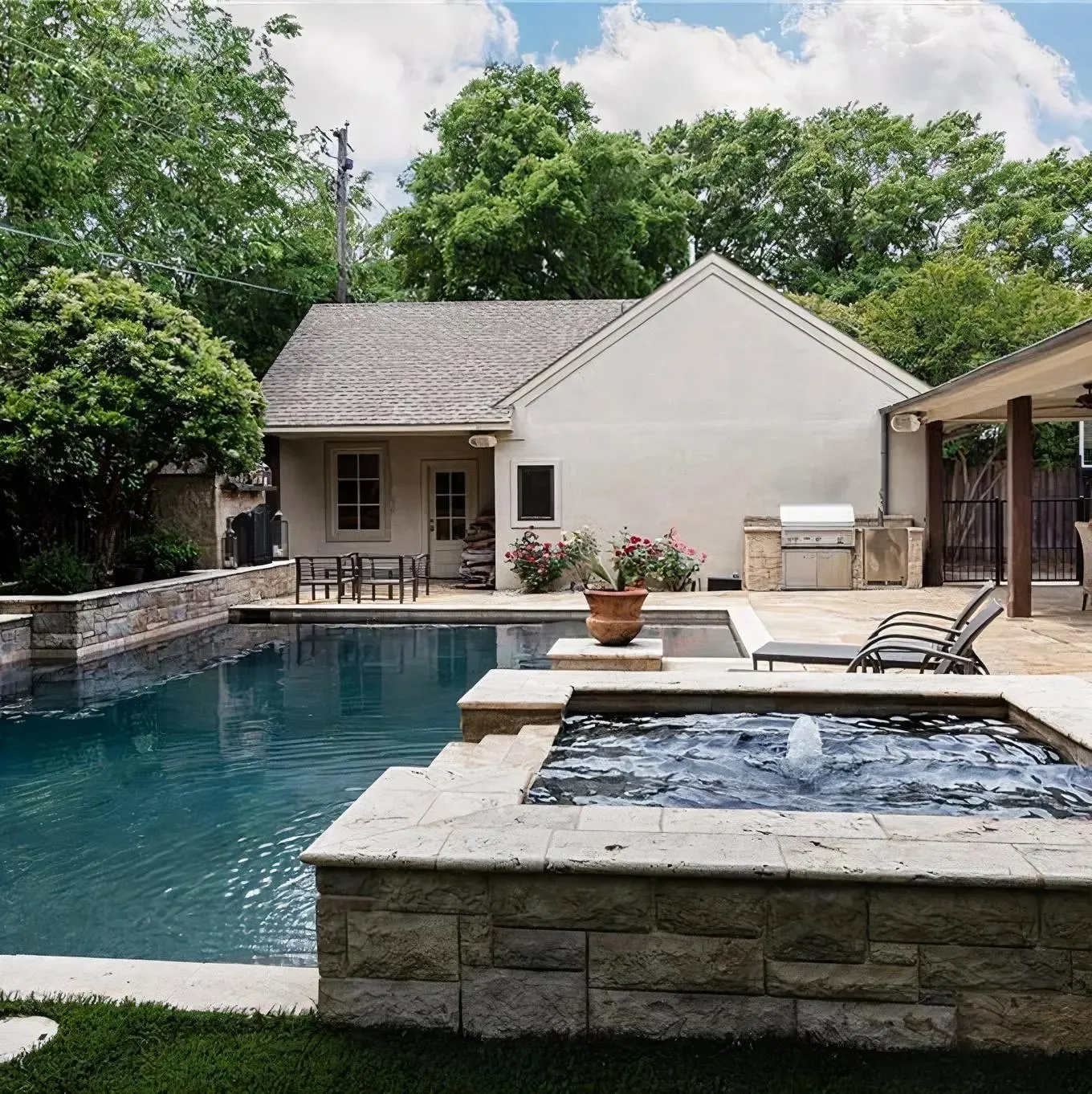
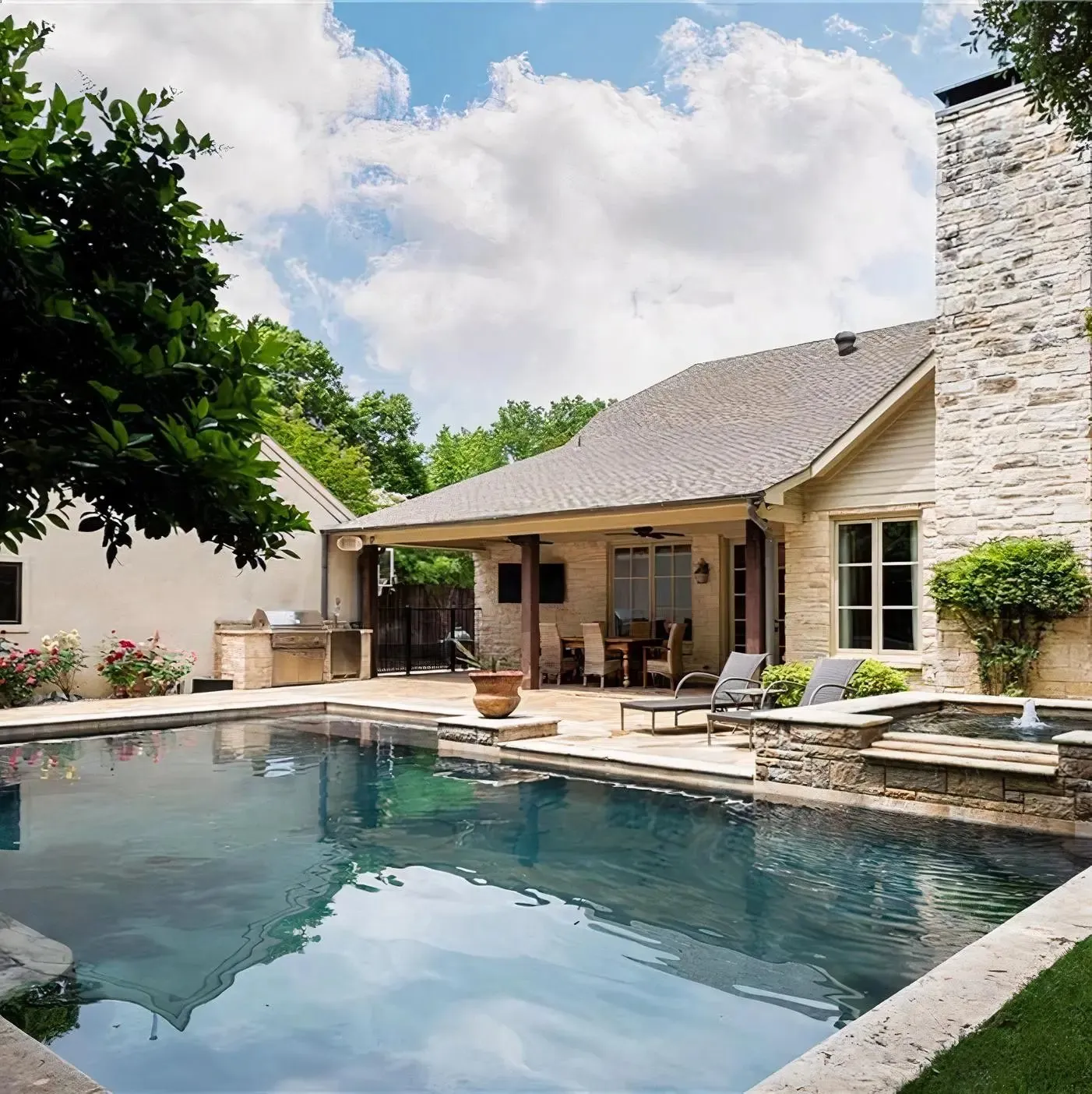
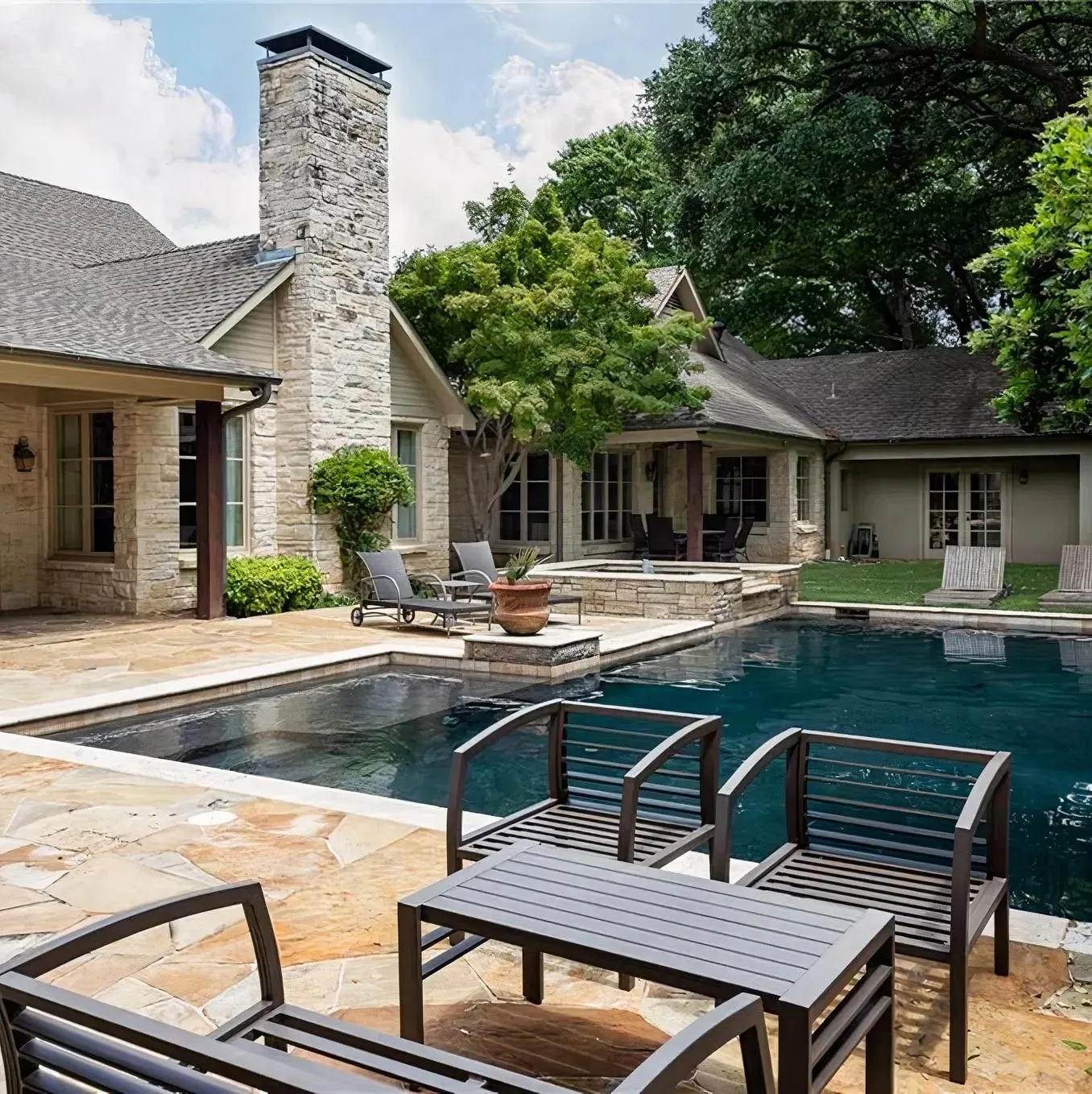
The backyard is beautifully landscaped with a rectangular pool that shows off bright blue water, framed by light stone coping and a tanning ledge. The patio’s made of beige and tan flagstones, which go great with the dark pool, and two cozy lounge chairs invite you to kick back. A terracotta pot with a plant on a low stone wall adds a nice touch of green.
Behind the pool, a light-colored shed hides among lush trees that give plenty of shade and privacy. A wooden fence lines the property, and you can catch a peek of a stone house nearby. The whole spot is flooded with soft sunlight, making it feel like a calm, luxurious getaway right at home.
San Antonio isn’t just a city—it’s a weird, beautiful mess of old soul and new hustle. Every neighborhood has its own flavor and story: historic charm in King William, suburban calm in Stone Oak, trendy brunch culture in the Pearl, and everything in between. You’re not just buying a house; you’re buying into a way of life. Which means if your agent doesn’t actually know San Antonio, they’re basically guessing. And so are you.
Let’s cut the crap: finding a real estate agent isn’t like picking a taco truck after a night out. It’s more like choosing a co-pilot for a cross-country trip, someone who won’t drive you off a cliff or make you listen to Nickelback on repeat.
Yet most people still pick one like they pick a pizza place: a few Google searches, shiny photos, maybe a couple of reviews that don’t seem fake. Then boom, you’re trusting a stranger with one of the biggest financial decisions of your life.
Why Most Agents Kinda Suck & How to Spot the Ones Who Don’t
Let’s get one thing straight: most real estate platforms are designed to make you feel like you’re doing something useful when you’re actually just spinning your wheels. Zillow? Compass? A digital popularity contest. And yeah, the agent with 200 five-star reviews might be amazing… or just really good at asking for reviews.
What you really want to know is:
Do they listen like an adult, or do they just pitch like a car salesman?
Can they walk you through a neighborhood without sounding like they just Googled it that morning?
Do their past clients say things like “I felt seen” or just “they were fast”?
Patterns matter. Look for patterns.
Your Agent Should Know Where the Best Tamales Are. Seriously
This isn’t a joke. If they don’t know where to get real tamales, how are they going to know which streets flood when it rains? Or where the schools are actually good—not just “technically rated well on paper”?
Local wisdom is underrated. Screw sales volume. Give me the agent who knows the neighbor who built his own chicken coop and the shortcut that dodges school traffic. That’s the person I want steering the ship.
Before you sign anything, meet them. Face-to-face. No pressure, no fake smiles. Just talk. Ask them how they negotiate. Ask them how they handle weird curveballs. If they look nervous, or give vague answers, that’s a red flag. You’re not hiring a magician—you’re hiring a strategist. A guide. A grown-up.
And by the way, if they talk more than they listen? Run.
Discount Brokerages: Because Regret is Free
Sure, saving money sounds great. But if your agent cuts corners because they’re cutting commissions, guess who ends up paying for it? You. In stress. In delays. In bad deals that could’ve been avoided with just a little more experience on your side. It’s about being smart.
Final Thoughts
Finding the right real estate agent in San Antonio isn’t about luck. It’s not about filters and search results and smiling headshots. It’s about people. Human connection. Gut instinct. It’s about asking better questions and expecting better answers.
Because when you’re moving your whole damn life, you don’t want someone who’s just “good enough.” You want someone who gets it. Someone who sees the whole messy, beautiful picture, and helps you make it yours.
Forney, Texas – Forney is experiencing significant growth in both housing and business development. More than 25,000 home lots are planned in the area, and the population is expected to exceed 100,000 within the next five years—making Forney an increasingly attractive destination for both residential and commercial developers. Nationally, it ranks among the fastest-growing cities, and when you visit, it’s easy to see why. From new neighborhoods to expanding roads, the city is undergoing a rapid transformation.
Between July 2022 and July 2023, Forney recorded a population growth rate of 10.4%. By 2025, the population is projected to reach approximately 43,196, with the city currently growing at an annual rate of about 9.82%.
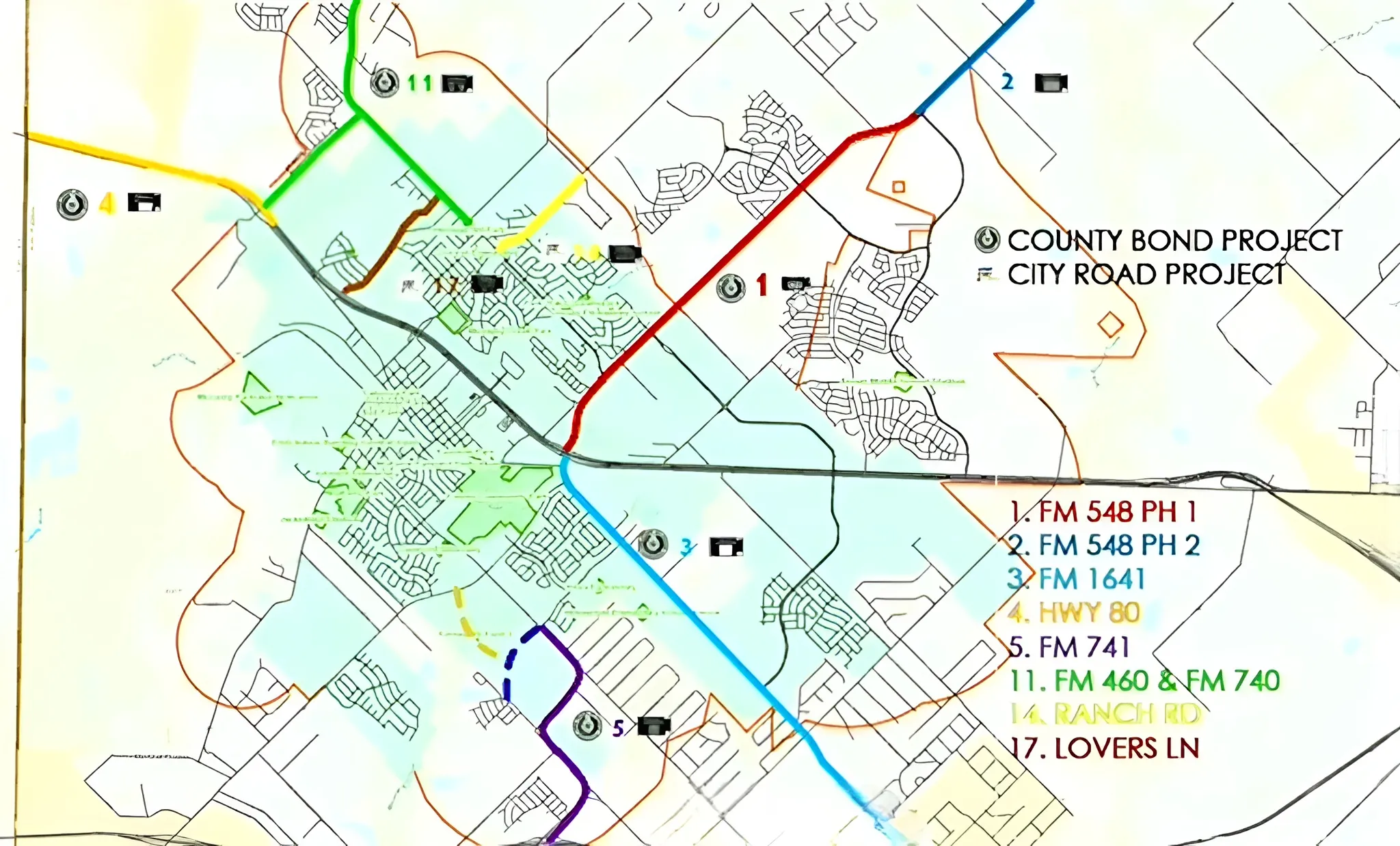
As part of this growth, Granite Construction has been awarded a major infrastructure project by the Texas Department of Transportation (TxDOT). The scope of work includes reconstructing and widening FM 548—from a two-lane rural road into a six-lane urban thoroughfare—which will significantly improve traffic flow and safety for both residents and commuters. Construction is scheduled to begin in July 2025, with an anticipated completion date in March 2027.
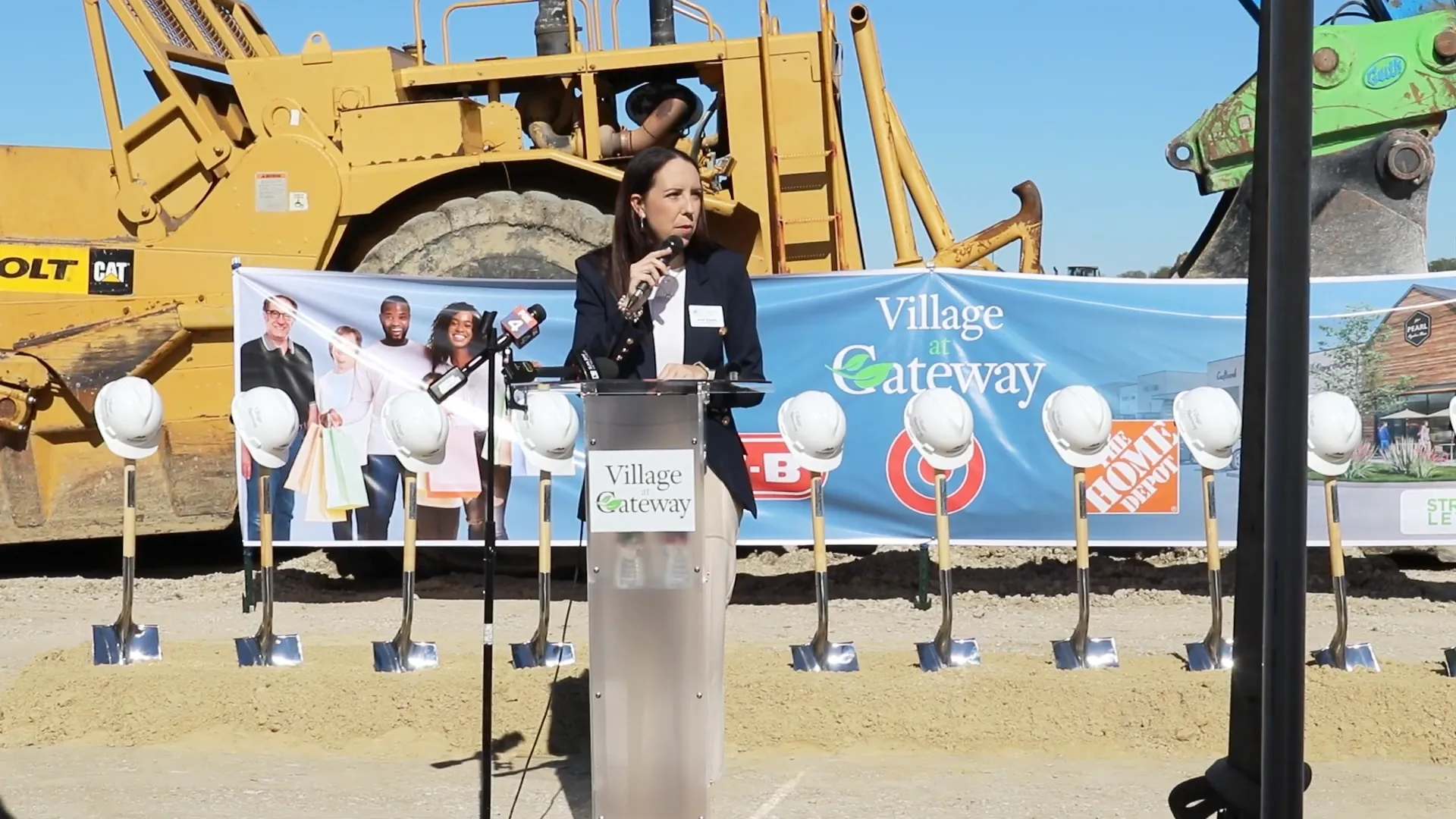
Interestingly, The Village at Gateway, located in Forney, was recently awarded “Best Retail Development of the Year” by D CEO. The Village at Gateway has been an exciting development since its groundbreaking in 2020. It is a 120-acre residential and retail center that is planned to be a regional destination for shopping, services, and dining. With over 500,000 square feet of retail space, The Village at Gateway is already attracting interest from both residential and corporate tenants looking to expand their businesses in the area. The Village at Gateway is also partnering with major retailers such as Target, Home Depot, and H-E-B. The presence of these well-known brands is a strong indicator of growth in the surrounding area and adds to the appeal for residents seeking improved shopping options.
One of the major projects currently underway is a community called Meraki, which will bring 2700 new homes by 2035. The development plan also includes a Forney ISD elementary school, a civic center, and a designated commercial area aimed at expanding the community’s infrastructure.
Additionally, Tractor Supply Company—a retailer specializing in farm, ranch, and pet supplies—is planning to open a new 25,000 square foot store on FM 1641. Construction is expected to begin in May 2025 and be completed by December 2025. This project underscores the significant growth potential in Forney’s retail sector.
Residents frequently praise Forney’s quiet atmosphere, diversity, and community-oriented lifestyle. Parks such as Forney Community Park, equipped with splash pads, playgrounds, and baseball fields, enhance the city’s family-friendly reputation. Fitness enthusiasts frequent Texas Fitness, a local gym known as a community staple. Additionally, Planet Fitness is expected to open soon, further expanding local recreational offerings.
However, Forney’s challenge with traffic congestion—particularly during peak commuting hours—has become a significant concern for residents. Without traffic, a trip from Forney to downtown Dallas typically takes around 35 minutes. Yet during rush hour, this commute can extend beyond an hour, highlighting infrastructure gaps that city leaders are actively working to address.
The interconnectedness between Forney and its neighboring community, Heartland, a smaller town located immediately adjacent to the city, is notable. Residents of Heartland often rely on Forney for shopping and entertainment. Although stores like Target and Tom Thumb are planned to open closer to Heartland, residents currently face longer drives—typically around 10 minutes—to access essential amenities.
Recently, Forney hosted a community event showcasing city machinery, including bulldozers, excavators, police vehicles, and fire trucks. This event allowed local children and families to engage directly with city workers and equipment, underscoring the city’s efforts to maintain a close-knit community atmosphere.
Local dining options also reflect the community’s diversity and growth. Popular eateries include Dillas, known for specialty quesadillas; Mix It Up, a newer establishment gaining positive local reviews; and Pizza Milan, a favorite among pizza lovers in the area.
For those considering relocation to the broader Dallas-Fort Worth (DFW) area but unsure if Forney matches their preferences, We suggests exploring other communities experiencing similar growth. Mansfield, Heath, Rockwall, Royse City, and Celina all offer appealing alternatives, each with unique characteristics and amenities. Rockwall and Heath, located near Lake Ray Hubbard, boast vibrant communities and scenic surroundings. Royse City, just outside Rockwall, similarly enjoys a boom in growth and infrastructure development.
Ultimately, whether newcomers choose Forney or another thriving suburb, Dallas itself remains a compelling option for those seeking urban conveniences and cultural vibrancy. Dallas offers shopping, city life, culture—whatever you might need. It’s always a solid choice for those interested in those amenities.
As Forney continues its trajectory of growth, residents and city planners alike face the ongoing challenge of balancing development with quality of life. With careful planning and community engagement, Forney aims to remain a welcoming, diverse, and thriving place to call home.
LEWISVILLE, Texas — As the housing market continues to shift in North Texas, two big developers are working together to launch new rental townhomes, starting with a large project in Lewisville.
Houston-based Wan Bridge, a leader in build-to-rent developments, is partnering with Centurion American Development Group, a prolific North Texas land developer, to roll out multiple rental home communities across the Dallas-Fort Worth metroplex. Their inaugural venture, Frontera Shores Townhomes, is planned for a 35.8-acre site near Interstate 35E, in what the companies describe as “the northern gateway to Lewisville.”
The master-planned community will eventually comprise 201 townhomes, with construction slated to break ground as early as July or August. The first homes are expected to be ready for tenants by the third quarter, and full buildout is anticipated by December 2026.
For Ting Qiao, co-founder and CEO of Wan Bridge, the decision to plant roots in Lewisville was as much about data as it was about demographics. “Lewisville stands out for its strong school district and strategic location,” Qiao said in an interview. “We see a gap in supply here, especially for families and professionals who want more space than an apartment offers, but aren’t ready or able to buy.”
Qiao noted that his team relies on artificial intelligence to forecast rental trends in the area—a nod to the increasingly tech-driven nature of modern real estate. “We’re really excited about the projected returns and how fast the homes are getting leased,” he added. “Even though the numbers don’t pencil out for every project in today’s market, this one is a compelling opportunity.”
The DFW region has emerged as a hotbed for build-to-rent communities, as high mortgage rates and surging home prices lock out many would-be buyers. Developers like Wan Bridge and Centurion American are betting that demand for quality rental homes will remain robust, particularly as families seek alternatives to dense apartment living.
Frontera Shores will offer two-, three-, and four-bedroom townhomes, catering to a range of household sizes. Residents can expect amenities such as walking trails, green spaces, a private dog park, and a resort-style pool—a suite of features designed to rival the comforts of traditional homeownership.
Rents for Wan Bridge’s existing communities start at $2,700 a month in Denton and $2,400 in Austin, according to the company’s website. While pricing for Frontera Shores has yet to be finalized, Qiao suggested it will be competitive within the submarket.
Mehrdad Moayedi, president and CEO of Centurion American, described the partnership as a natural fit. “Wan Bridge’s established model and commitment to excellence align seamlessly with our vision to deliver premier luxury rental communities,” Moayedi said in a statement. Centurion American, which has developed more than 100,000 single-family lots across North Texas, recently expanded its holdings with an 82-acre purchase near Sherman.
Scaling Back, But Moving Forward
The partnership comes at a time of recalibration for Wan Bridge. The company recently revised its five-year goal from 30,000 to 12,500 build-to-rent homes in Texas by 2030, citing investor caution amid economic uncertainty and slower rent growth. “We need to scale back because there’s market uncertainty, and pretty much all the capital in today’s situation is on the sideline,” Qiao acknowledged. “But this new partnership is already factored into our updated numbers. Without it, our targets would be even lower.”
Looking ahead, Wan Bridge and Centurion American envision Frontera Shores as the first of as many as ten similar projects across DFW, potentially adding more than 1,000 rental homes to the region’s inventory.
For now, all eyes are on Lewisville, where the first shovels will soon hit the ground—a tangible sign that, for North Texas renters, new options are on the horizon.
For those with limited credit, finding the right home can be very challenging. One straightforward way to own a home is through seller financing, where the homeowner offers a loan directly to the buyer, bypassing the traditional mortgage process. This approach simplifies the path to homeownership for those aspiring to have their own place without the hassle of credit checks or bank approval.
What Is Owner Financing?
Owner financing means the seller directly loans money to the buyer to purchase property, like land or a building, without involving a bank or traditional lender. Both the seller and buyer agree on their own terms, including the interest rate and payment schedule. This option is perfect for buyers with poor or no credit history and is especially appealing for those looking to buy acreage in Texas.
Benefits of Owner Financing
Owner financing has many benefits, including flexibility for purchasers who don’t need a credit check. It usually involves a smaller down payment than conventional financing and a quicker closing, thus speeding up the deal. Many choose owner financing because the contract can be tailored to fit the purchaser’s requirements. This approach simplifies the process of buying a home, ranch, or other types of property.
Finding Owner Financing Homes for Sale Near You
There are several ways to find homes for sale with owner financing near you. Here, we’ve outlined some of the simplest methods:
Online Resources
Sites like Zillow, Realtor, and other real estate platforms allow you to access owner financing homes near you online. Additionally, search engines like Google can be used to refine searches with terms such as ‘land no credit check‘ or ‘homes for sale with owner financing‘ to find relevant results.
You may also discover houses for sale with owner financing by exploring forums and social media, where you can directly contact the owner.
Local Listings and Real Estate Agents
Finding owner-financed homes through local classifieds can be very beneficial. A local real estate agent might offer ‘in-house land financing’ options that are readily available. These professionals can help you understand market trends and negotiate favorable terms.
Local classifieds usually include houses with owner financing, allowing you to discover options that suit your needs. Open houses provide an opportunity to view properties in person and discuss financing possibilities directly with the owners.
The Process of Owner Financing
Owner financing is a straightforward process that can be customized to meet the buyer’s needs. Here are the steps for buyers and sellers:
Steps for Buyers
Identify potential properties listed with owner financing options.
Contact the seller to discuss the property, ensuring clarity on terms and conditions.
Negotiate the financing terms, including down payment, interest rate, and monthly payments to suit your budget.
Review the seller’s agreement carefully, possibly with legal assistance, to ensure all details are understood.
Close the deal by signing the contract, gaining ownership of the property without a credit check.
Steps for Sellers:
Advertise the property as available for owner financing to attract buyers looking for no credit check options.
Set terms that reflect the property’s value, including payment plans and interest rates.
Screen potential buyers to ensure they have a genuine interest in ownership and can afford the terms.
Draft a clear and comprehensive purchase agreement outlining all details to prevent future disputes.
Close the transaction efficiently, helping buyers transition smoothly into their new ownership.
For more details about how to buy land with bad credit or explore available properties, visit Santa Cruz Properties or reach out directly at (956) 383-0868.
Pros and Cons of Owner Financing
Owner financing has pros and cons for both buyers and sellers. While it offers flexibility, it also requires careful attention to the terms
Owner Financing
Buyers
Sellers
Pros
– No credit check required — great for buyers with poor or no credit.
– Reach more potential buyers.
– Lower down payments than traditional mortgages.
– Steady income from interest payments.
– Flexible payment terms that suit their budget.
– Faster property sales with flexible terms.
– Faster closing process, quicker move-in.
– Ability to negotiate favorable terms.
– Easier to qualify than with a traditional loan.
– Potential for higher return by holding the note.
Cons
– May face higher interest rates.
– Risk of buyer default and possible foreclosure.
– Fewer legal protections than traditional financing.
– May need to manage the loan themselves.
– Risk of losing the property and any payments made if they default.
– Capital is tied up until the loan is paid in full.
Owner financing makes it easier to own a home without traditional hurdles like credit checks and bank approvals. This allows you to achieve your dream of home ownership or invest in property.
When people are purchasing a home, the majority of buyers are concerned about home prices and mortgage rates. There is however another significant factor that people tend to overlook: local government policies. It’s worth mentioning that policies such as the Texas homestead exemption, property tax exemptions, tax relief programs, and zoning regulations significantly influence the overall cost of homeownership.
From tax rates to land use rules, local measures can make owning a home more affordable or more costly. Be ready to choose the right home purchase thus making an effective buying decision.
So here are four of the local homeownership policies in Texas:
1. Property Taxes and Local Rates
Property taxes are one of the most common ways local governments fund essential services. These taxes are set by the city, county, or township government, and the proceeds from these taxes fund vital services like schools, emergency services, and neighborhood infrastructure.
Two homes with the same price tag can have very different annual tax bills depending on their location.
Some areas in Texas, such as San Antonio, Austin, and Harris County, offer tax breaks or exemptions for homeowners, while others, like Dallas County and Travis County, tend to have higher property tax rates. So you should also pay attention to your local taxes when you’re looking for a home.
Keep in mind that local tax rates are periodically reviewed and adjusted.
2. Zoning Laws and Housing Supply
Zoning regulations themselves do not directly influence the cost of homeownership, but they do control what you can build, how dense an area must be, and even the size of a home.
Zoning regulations also limit the development of affordable housing such as townhouses or duplexes, which may result in a housing shortage and drive home prices within that area higher.
In Texas, areas with overly restrictive zoning laws, such as Austin, have created a housing shortage that has driven up prices and made it harder for buyers to find affordable homes. In other areas, such as Dallas, zoning laws are less restrictive, so Dallas has a large supply of affordable homes.
3. Homeowners Tax Breaks and Tax Deductions
A homeowner tax break is a local government policy that can reduce the homeowner of the tax burden. Through the program, homeowners are permitted to exempt a portion of the home’s value from taxable value.
For example, homeowners in Texas who qualify can deduct up to $40,000 from the taxable value of their home. The tax break is intended for seniors, veterans, and people with disabilities. While tax breaks do not lower the market value of a home, they do significantly reduce the annual tax bill, making homeownership more affordable for many people.
While not all areas of Texas offer these tax breaks, each area has its own rules. So it’s important for prospective homeowners to find out if their area offers tax breaks.
4. Local Infrastructure and Community Growth
You need to know if your local government is investing in infrastructure such as roads, public transportation, and utilities, as this will ultimately affect the cost of homeownership.
Good neighborhood infrastructure can increase property values and make it more comfortable to live in the neighborhood, but even if your property value increases, you will be charged higher taxes as well.
A well-developed neighborhood community tends to attract more buyers, thus increasing property prices. On the other hand, neighborhoods with poor infrastructure usually have lower house prices and face many other challenges, such as long distances from workplaces, unstable internet connections, and deteriorating neighborhood infrastructure.
It is important to remember that a strong community environment not only increases property values but also the quality of life for its residents.
Final Thoughts
Local government policy tends to be overlooked, since people are more concerned with loan rates for their home or overall housing trends. Most people are unaware that local government policies can significantly impact the value of their property and the costs they incur.
From tax rates to zoning regulations, the future value of your property is also affected by local infrastructure projects and government policies, which determine whether your property’s value will appreciate or decline, affecting the homeowner financially. The more you understand local policies, the better you will be able to protect your investment.
If you’re planning to buy a home in Texas but worry about your credit score, savings, or past financial setbacks, an FHA loan might be the perfect solution. Backed by the Federal Housing Administration, these loans are built to help people with moderate incomes and less-than-perfect credit finally become homeowners. In this guide, we’ll break down why FHA loans are a smart move for Texans—and how to qualify.
What Is an FHA Loan?
An FHA loan is a type of government-backed mortgage insured by the Federal Housing Administration, which operates under the U.S. Department of Housing and Urban Development. FHA loans are made by FHA-approved lenders and are particularly sought after by first-time homebuyers but are available for repeat homebuyers as well.
Unlike conventional loans, FHA loans have lenient conditions, and are therefore appropriate for those who cannot qualify for the more stringent terms of the usual mortgage programs.
Top Benefits of an FHA Loan in Texas
1. Low Down Payment – As Low as 3.5%
Saving for a large down payment can be a huge barrier for buyers. FHA loans require only 3.5% down if your credit score is at least 580. Even with a credit score between 500–579, you may still qualify with a 10% down payment.
2. Easier Credit Qualification
FHA loans are designed for low credit score borrowers. They require only a 580 credit score in 2025 for the lowest down payment category. There are lenders that approve loans for borrowers with credit scores as low as 500 under specific conditions.
3. Higher Debt-to-Income (DTI) Ratios Allowed
Texas FHA lenders are more flexible, allowing a debt-to-income (DTI) ratio of up to 57%, compared to the 45–50% cap on most conventional loans. That makes it easier for borrowers who already have things like student loans or car payments.
4. No Minimum Income Requirement
There’s no official minimum income required. You just need to show a stable income over the past two years, with documentation such as tax returns, pay stubs, or W-2s (Wage and Tax Statement).
5. Flexible Sources for Down Payment
Your down payment funds may come from your personal savings, down payment assistance programs, or from financial gifts from family members or friends. Just keep in mind: financial gifts over $19,000 for an individual ($38,000 for a couple) could be taxable to the donor in 2025.
Texas-Specific Down Payment Assistance Programs
Texas offers several down payment assistance programs for first-time and repeat homebuyers:
Texas Homebuyer Program: Offers up to 5% of your first mortgage amount in assistance, usable for down payment or closing costs.
Pathway to Homeownership: Through New American Funding, eligible buyers may receive up to $6,000 in assistance.
Local Programs: Many cities and counties in Texas offer their own DPAs—check with your local housing office or HUD for details.
FHA Loan Property Options in Texas
FHA loans in Texas can be used for a wide range of property types, including:
Single-family homes
2–4 unit properties (duplex, triplex, fourplex)
Condos and townhomes
Manufactured homes
Fixer-uppers (with FHA 203(k) loans)
The property must be your primary residence—FHA loans are not for vacation homes or rentals.
FHA 203(k) Loans: Buy & Renovate in One
Want to buy a fixer-upper? FHA 203(k) loans roll the purchase price and renovation costs into a single loan. Two types are available:
Limited 203(k) – Up to $35,000 in repairs (no structural changes)
Standard 203(k) – Includes major renovations, accessibility upgrades, or structural repairs
Great for buyers looking to build equity or customize their homes.
FHA Streamline Refinance: Lower Your Rate
Already have an FHA loan? The FHA Streamline Refinance can help you lower your interest rate without:
A new appraisal
Income verification
Employment checks
Credit review
It’s a fast, easy way to lock in better terms when rates drop.
Mortgage Insurance: What You Need to Know
All FHA loans require Mortgage Insurance Premiums (MIP):
Upfront MIP: 1.75% of the loan amount, paid at closing or rolled into the loan.
Annual MIP: Paid monthly as part of your mortgage payment.
MIP is required for the life of the loan if your down payment is below 10%. If you put down 10% or more, you may be eligible to remove MIP after 11 years.
FHA Loan Requirements in Texas (2025)
To qualify, you’ll generally need:
Credit score of 580+ for 3.5% down (or 500–579 for 10% down)
Verifiable, consistent income for the past 2 years
Primary residence (not a rental or investment)
DTI ratio under 57% (most lenders prefer ≤43%)
Home inspection that meets FHA standards
Mortgage insurance Premiums (MIP)
Down payment of 3.5%–10%, depending on your credit score
FHA Loan Limits in Texas
Loan limits vary by county and are adjusted annually. In 2025:
Most Texas counties: $524,225 for single-family homes
High-cost areas (e.g., Austin, Dallas, San Antonio): Up to $571,550
4-unit properties: Up to $1,099,150
Check your specific county’s limit on the HUD or FHA websites.
How to Apply for an FHA Loan in Texas
Follow these steps:
Check your credit score and start improving it if needed
Set your budget with an online FHA mortgage calculator
Gather documents: tax returns, W-2s, bank statements, ID, debt info
FHA loans are the most flexible and affordable mortgages available to Texas homebuyers—especially first-time homebuyers and those with low credit scores. With low down payment requirements, relaxed DTI limits, and access to state-sponsored assistance programs, an FHA loan in Texas may be your ticket to homeownership.
When you’re getting ready to sell your home, first impressions matter. Most potential buyers make snap judgments the moment they walk through the door. A clean, well-maintained property not only looks more appealing—it also suggests the home has been properly cared for. This can increase your home’s perceived value and help it sell faster in a competitive market like Austin.
Unfortunately, many homeowners overlook small details—like clutter and unused items—that can turn off potential buyers during showings. A tidy, well-kept home creates a strong first impression and can instantly make buyers feel at home.
For those who live in Austin, working with a professional service like Austin dumpster rental pros can help make this cleaning process much easier and more efficient, they handle all the heavy lifting and hauling. You just focus on getting your home ready to sell.
Make a Good First Impression
Potential buyers don’t just evaluate a home based on its size or layout—they also pay close attention to how it feels. A clean, open space sends the message that the home has been well cared for. On the other hand, a cluttered or disorganized home can raise red flags, making buyers wonder: “Has this home been properly maintained?” or “Are there hidden issues?”
Cleaning goes beyond shiny floors and dust-free furniture. It also means clearing out anything that doesn’t serve a purpose—like bulky furniture, damaged cabinets, or stacks of old boxes in the garage. The fewer distractions there are, the easier it is for buyers to picture themselves living there.
Toss What You Don’t Need
It might seem like a small thing, but decluttering is a crucial step before putting your home on the market. A spacious room feels bigger, more functional, and more inviting. On the flip side, a house filled with stuff can make buyers feel overwhelmed and closed in.
If you’d rather not deal with the hassle, consider using a junk removal service like Austin Dumpster Rental Pros. They’re especially helpful if you’ve got leftover debris from old renovation projects, broken furniture, or unfinished DIY materials. A clean, clutter-free home not only looks great—it can also boost your home’s value.
Cleaning Is Also an Investment
Don’t underestimate it, even though the appraisers only focus on the size, location, and condition of the building. But if the house is neat and clean, it can also help increase your property’s value. Homes that look move-in ready tend to sell faster and for better prices, because buyers know they won’t have to spend extra money cleaning up after closing.
Tidy Up, Sell Faster
Selling your home isn’t just about listing it and hoping buyers show up. Prepping your home—by cleaning and decluttering—can help it sell faster and at a better price.
If you’re in Austin, don’t stress about the cleanup. You can leave the decluttering to the pros and focus on the next chapter. A home that’s clean, organized, and show-ready gives buyers every reason to fall in love—and make an offer.
If you own property in Dallas, you may feel like your property tax bill is higher than it should be. Many homeowners take tax assessments for granted, but these assessments are often inaccurate. The good news is that you have the right to protest these tax assessments and could save yourself thousands of dollars.
Protesting property taxes may seem complicated, but with the right approach, the process can be easier and more rewarding. This guide will explain why reviewing your tax assessment is important and the steps to successfully file a protest.
What Is a Property Tax Protest?
A property tax protest is the process of appealing the assessed value of your property set by your local assessment district. This assessed value determines how much property tax you pay each year. If the assessment is too high, your tax bill will go up. The goal of a protest is to ensure that your property is assessed fairly and accurately.
Inaccuracies can occur due to errors in the assessment or improper comparisons to similar properties in your neighborhood. Many homeowners who file a protest are successful in getting their taxes reduced.
Why You Should Protest Your Dallas Property Taxes Now
Paying too much? Here’s why challenging your assessment could save you thousands
1. Property Assessments Are Often Too High
Assessment districts use a mass assessment method that isn’t always accurate. Factors like neighborhood sales trends or ignoring the specific conditions of your home can lead to an overvalued property. By filing a protest, you can ensure a fairer assessment and pay your true value in taxes.
2. Reduce Your Tax Burden and Save Money
Dallas property taxes can be a major burden, especially as property values continue to rise. By lowering your assessed value, you can reduce your tax bill. You can use the savings for home renovations, paying off debt, or building your savings. While you can’t change your tax rate, you can still play a role as a voter in determining your local budget.
3. Ensure Transparency and Accountability
Protesting your property taxes isn’t just about saving money. It also ensures a more transparent assessment system. By filing a protest, you force the assessment district to prove that their assessments are accurate. This makes the process fairer for all homeowners.
4. Adapt to the Changing Real Estate Market
Assessment districts are often slow to adjust assessed values. If property values drop or the market weakens, you can protest to make sure your taxes reflect actual market conditions.
5. New Laws Could Impact Your Taxes
Texas lawmakers are considering major changes to property taxes. This includes increasing the home tax exemption from $100,000 to $140,000 and reducing school district taxes. However, these policies won’t take effect for the 2024 tax bill. By filing a protest now, you can get savings sooner without having to wait for regulatory changes.
What is the Dallas Property Tax Protest Process?
A step-by-step guide to lowering your tax bill the right way.
Step 1:File a Protest
Submit your protest to the Dallas Central Appraisal District (DCAD) by May 15 or within 30 days of the date your assessment notice is printed, whichever is later. You can file your protest online, by mail, or in person at a DCAD office.
Step 2: Gather Supporting Evidence
To support your protest, prepare evidence that your property’s assessed value is too high. This might include photos of property damage, repair estimates, sales data of similar homes in your area, or an independent third-party appraisal to support your claim.
Step 3: Attend an Informal Meeting
Before the formal hearing, you will have the opportunity to meet with a representative from the appraisal district. Here, you can present your evidence and negotiate a reduction in the assessed value. If approved, your case may be closed at this point.
Step 4: Attend a Hearing with the Appraisal Review Board (ARB)
If you can’t reach an agreement at the informal meeting, you can take your case to the Appraisal Review Board (ARB). The board will review your evidence and make a final decision on the value of the property to be used for taxes.
Step 5: Consider Professional Help
While you can handle the protest on your own, using a professional like Gill, Denson & Company can increase your chances of success. With a data-driven approach and tailored strategies, they can make sure your case is as strong as possible.
Why Hire Gill, Denson & Company?
Protesting your property taxes can be time-consuming and complicated, especially when you’re trying to maximize your savings. That’s where Gill, Denson & Company comes in:
Proven Results – Over 80% of their clients are successful in obtaining tax relief in 2024.
Personalized Approach – Unlike mass appeal firms, they handle each property individually, developing a strategy specific to each case.
Results-Based Pricing – No tax reduction, no fees. You only pay if they save you on your taxes.
Local Expertise in Dallas – With years of experience and strong relationships with local assessment districts, their team understands the ins and outs of the Dallas property tax system.
Client Success Stories
Real savings from homeowners and businesses who took action.
Homeowner in Dallas saves $25,648, reducing tax burden by 13.39%.
Commercial property in Las Colinas gets a 19.78% reduction, resulting in a tax savings of $15,607.
Gill, Denson & Company handles the entire process, from filing a protest to representing you at a hearing, so you don’t have to.
Upcoming Changes in 2025 Property Tax Laws
Texas lawmakers are proposing changes that could significantly alter property tax bills statewide:
Increased Homestead Exemption: The tax exemption would be increased from $100,000 to $140,000, providing significant relief for homeowners.
School Tax Rate Compression: School district tax rates would be further reduced to ease the financial burden on Texas taxpayers.
While these changes are promising, they likely won’t take effect until after the 2025 protest season. Filing a protest now ensures you don’t miss out on potential savings while you wait for the rule changes to take effect.
Exercise Your Legal Rights and Save More
Protesting your Dallas property taxes isn’t just about saving money—it’s about making sure you’re being treated fairly. If your home is overvalued or your taxes no longer reflect market conditions, taking action can make a real difference. Not sure where to start? Gill, Denson & Company is here to help. They have extensive experience handling Dallas property taxes and have helped 80% of their clients save on taxes in the past year.
Charles Denson is the Co-Founder of Gill, Denson & Company. He is a native Texan and has been involved in real estate for more than 10 years. While studying at the McCombs School of Business at the University of Texas at Austin, Charles began his real estate career in real estate accounting, followed soon after by multi-family sales and then progressed into owning commercial assets alongside partners and investors. Through extensive knowledge of commercial real estate, finance and hands-on operational experience, Charles launched Gill, Denson & Company alongside Richie and Morgan Gill to focus on a service that is critical to the prosperity of any real estate investment. As a tenured entrepreneur, Charles has challenged old ways of thinking in the property tax consulting industry, in order to do what he loves most: helping others. In his free time, Charles enjoys golfing, hunting and spending time on the beach with his wife and his golden doodle.