Not long ago, using the sunshine on your roof to charge your car would’ve sounded unreal. Now it’s totally normal. All over North America, families are taking control of their energy, not just for lights and fridges, but for their cars too.
The shift isn’t about gadgets or trendy tech. It’s about security, rising bills, and the desire for independence. At the center of this change are integrated systems that combine solar panels, smart batteries, and EV chargers into a single, cohesive setup. Among the leaders in this space is the OCEAN Pro solar battery storage, which acts like the backbone of an energy-resilient household.
Image Source: ecoflow.com
Why solar is moving from “nice to have” to essential
Sure, solar panels have long been marketed as eco-friendly. But let’s be honest—that’s not the only reason people are climbing onto rooftops to install them. The practical side is just as compelling.
Electricity rates in North America are not slowing their climb. On average, they’ve risen almost 3% a year for decades. Add that up, and you’re paying far more for the same comfort. With solar power for your home, you suddenly flip the script. Instead of relying entirely on the grid, you’re producing a chunk of your own electricity every single day.
Image Source: ecoflow.com
EcoFlow makes this transition easier by offering panels that match different lifestyles:
Portable panels: Flexible, lightweight, and great for road trips or emergencies.
Rigid rooftop panels: A more permanent setup for homeowners ready to commit.
Balcony systems: Compact but clever, ideal for apartments or smaller spaces.
Bottom line: solar isn’t just about “going green.” It’s about taking control.
Storage turns solar into a 24/7 solution
Here’s the catch—solar panels stop producing once the sun sets. That’s where storage changes the game.
The OCEAN Pro is more than just a big box of batteries. Think of it as an energy brain for your home. It manages solar input, grid electricity, and even generator backup automatically. With a continuous output of 24kW and expandable storage up to 80kWh, it’s built to keep entire households running without skipping a beat.
However, the real magic lies in its intelligence. It doesn’t just store power—it predicts when you’ll need it most, and even factors in utility pricing. That means using stored energy when rates are high, or saving excess solar to sell back to the grid in some regions. It’s not just backup power—it’s bill management with brains.
For homeowners, the difference is clear: no spoiled groceries, no stuffy nights without AC, and no surprise utility charges.
Smarter driving starts right at home
EV ownership is climbing fast across North America. But charging is often the sticking point. Public stations are expanding, but they’re not always convenient or affordable. Charging straight from the grid at home can also rack up costs during peak hours.
EcoFlow’s OCEAN EV Charger plugs directly into the OCEAN Pro system. Instead of unquestioningly pulling from the grid, it prioritizes solar first, then stored energy, and only dips into grid power when necessary. That means cleaner miles and cheaper fueling.
Why it matters:
Speed: Up to 11.5kW charging, giving you ~46 miles of range per hour.
Smart scheduling: No need to wake up at midnight to plug in—the system knows when to charge.
Compatibility: Works with most EVs thanks to the SAE J1772 connector.
Weather-ready: Outdoor rated with a 25-foot cable.
For EV drivers, this is freedom. You wake up each morning with your car fully charged—without spending hours at a public station or watching your bill creep up.
The financial equation
Money always tells part of the story. And when it comes to solar + storage + EV charging, the math makes sense:
Bill savings: Households can cut costs by 30–40% through smart scheduling.
Tax credits: A 30% U.S. federal tax credit applies to solar + storage, with state rebates layered on top.
Outage protection: Hotels, spoiled food, missed work—all the hidden costs of blackouts—disappear.
EV charging savings: Solar charging is often half the cost of public charging.
What was once seen as an “extra expense” is now a long-term savings plan.
Convenience without complexity
Here’s a reality check: most families don’t want to tinker with their energy system. They want something that works. That’s where EcoFlow’s design shines.
Plug-and-play setups simplify installation.
App-based control keeps everything visible—solar production, storage, even car charging.
Quiet, clean systems eliminate the noise and fumes associated with gas generators.
Scalable design lets you start small and expand later.
This balance of power and simplicity is what makes energy independence attainable for everyday households.
EcoFlow’s lineup for every stage
One size doesn’t fit all. That’s why EcoFlow created a whole ecosystem:
OCEAN Pro → The flagship, whole-home system.
DELTA Pro Ultra → Modular, expandable up to 90kWh for long-term planners.
DELTA Pro 3 → A hybrid solution for portability and backup.
DELTA Pro → Compact yet expandable, scaling up to 25kWh.
RIVER Series → Lightweight power stations for travel or emergencies.
Pair these with solar panels and the EV charger, and households can build energy independence step by step.
The human side of energy
Beyond savings and specs, energy security changes how families feel. Imagine a summer blackout where your neighbors are sweating it out, but your AC is humming. Or waking up after a storm knowing your EV still has a full charge.
For parents of young children or caregivers supporting older relatives, this isn’t just convenience—it’s peace of mind. No frantic trips to gas stations, no worrying about medical devices, and no stress about spoiled food.
Resilience isn’t only technical. It’s emotional.
Looking ahead
What used to be a “nice extra” is quickly becoming a standard expectation. Just like Wi-Fi and air conditioning once shifted from luxuries to necessities, home energy systems are heading the same way.
Solar panels on rooftops, smart batteries in garages, and EV chargers in driveways—it’s a picture of everyday life that’s becoming more common across North America. And it’s not futuristic anymore. It’s practical, affordable, and, increasingly, essential.
Conclusion: the future starts in your driveway
From the OCEAN Pro Solar battery storage to solar power for your home and the OCEAN EV Charger, EcoFlow’s solutions aren’t about flashy tech—they’re about giving households more control.
In a world where outages, costs, and EV adoption are colliding, these systems give families the independence they need. The driveway, the rooftop, the garage—they’re no longer just parts of a house. They’re where the future of energy lives.
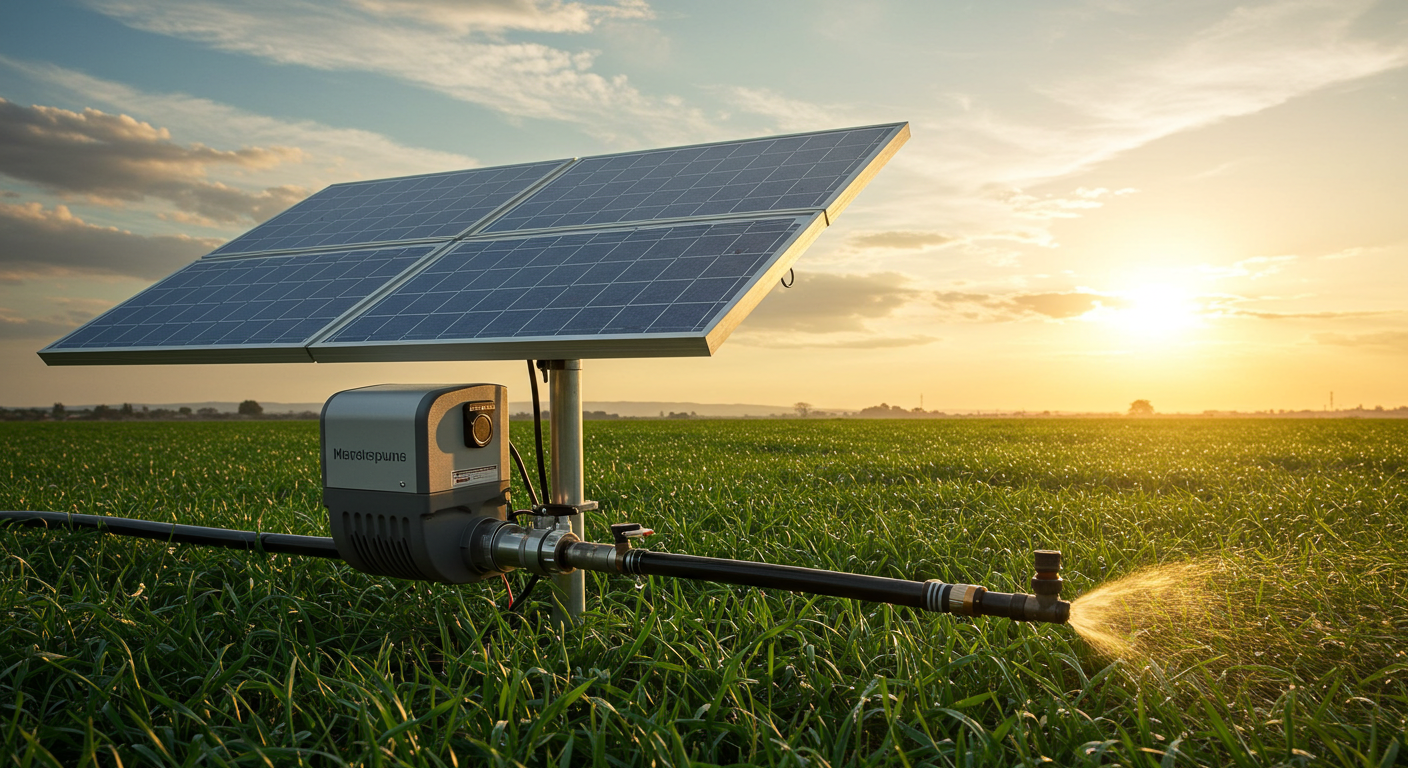
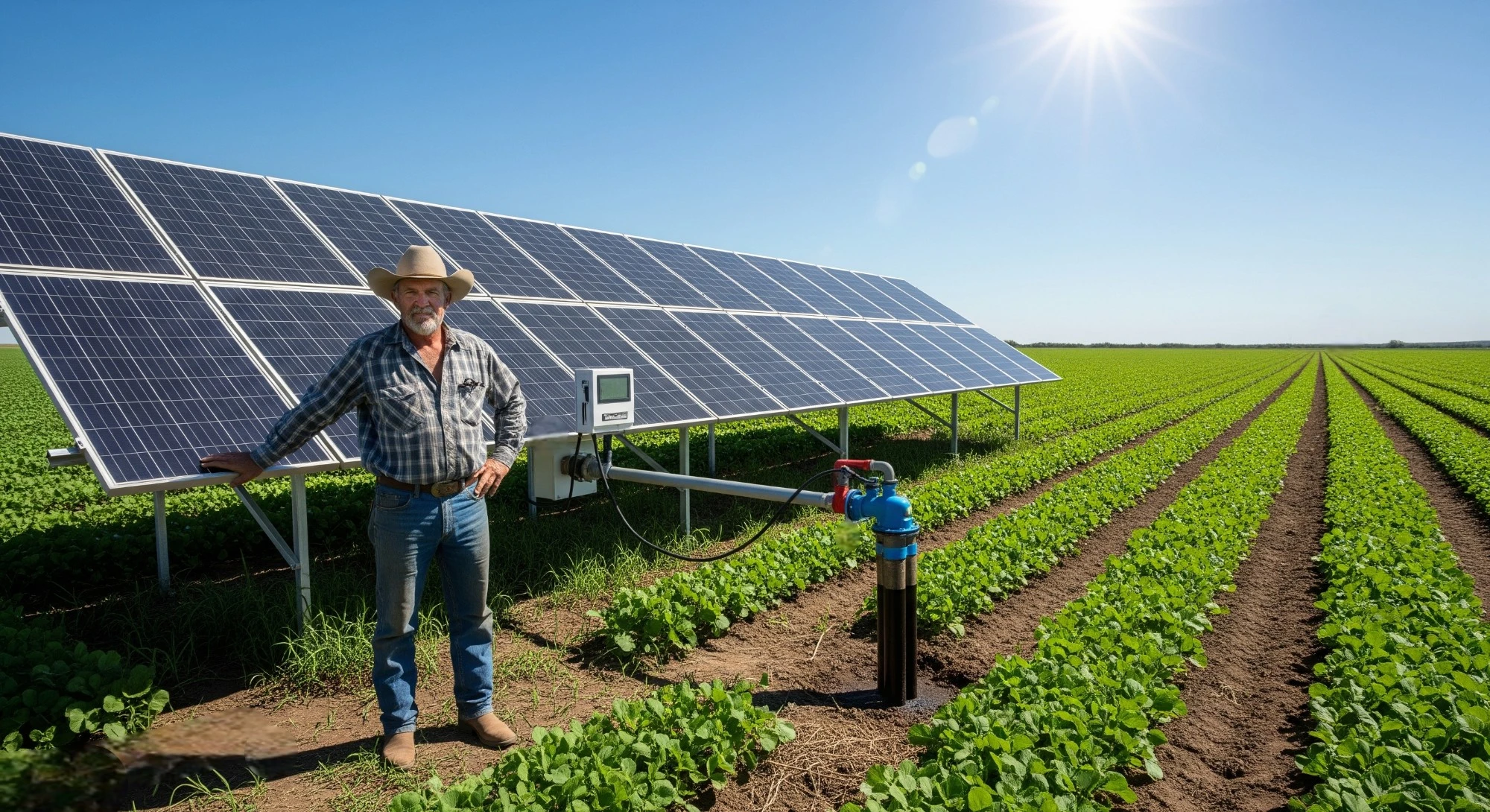
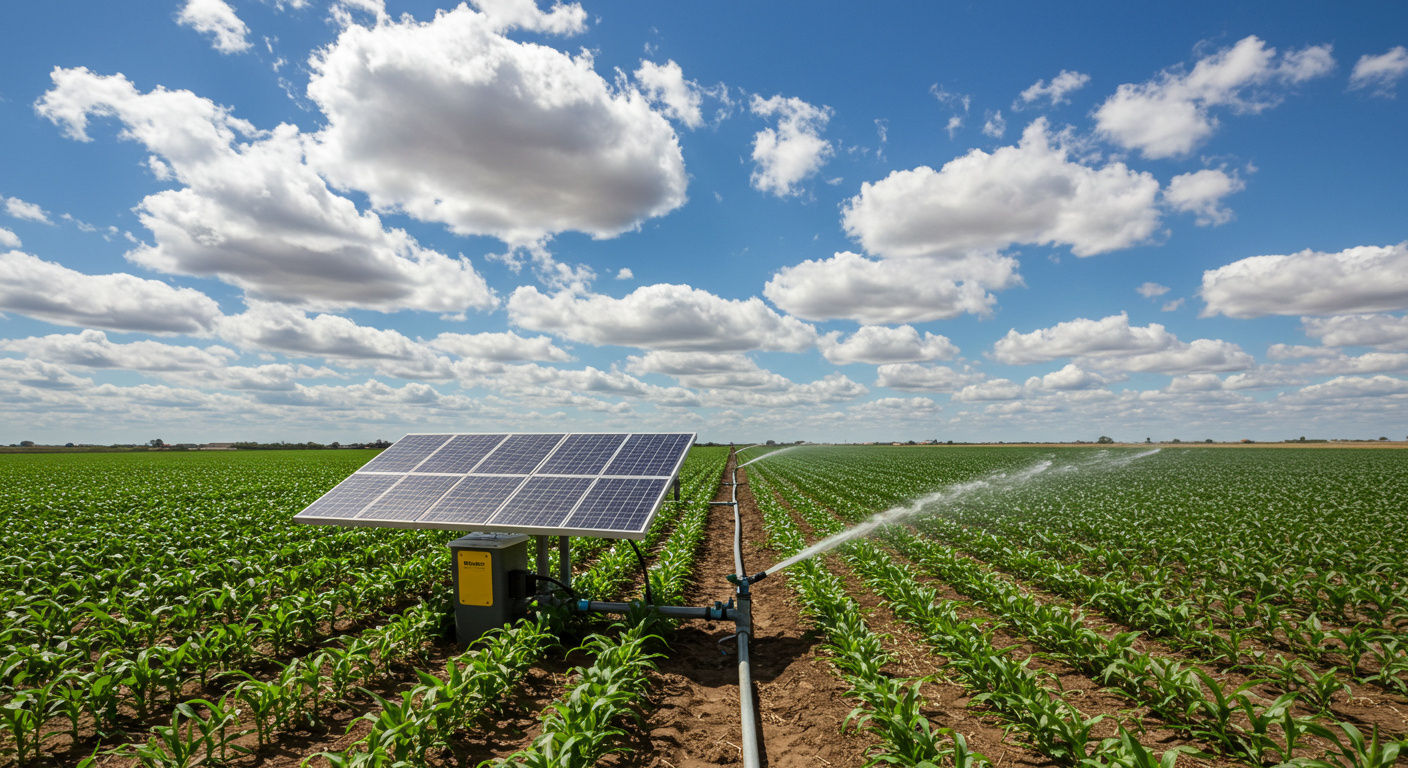
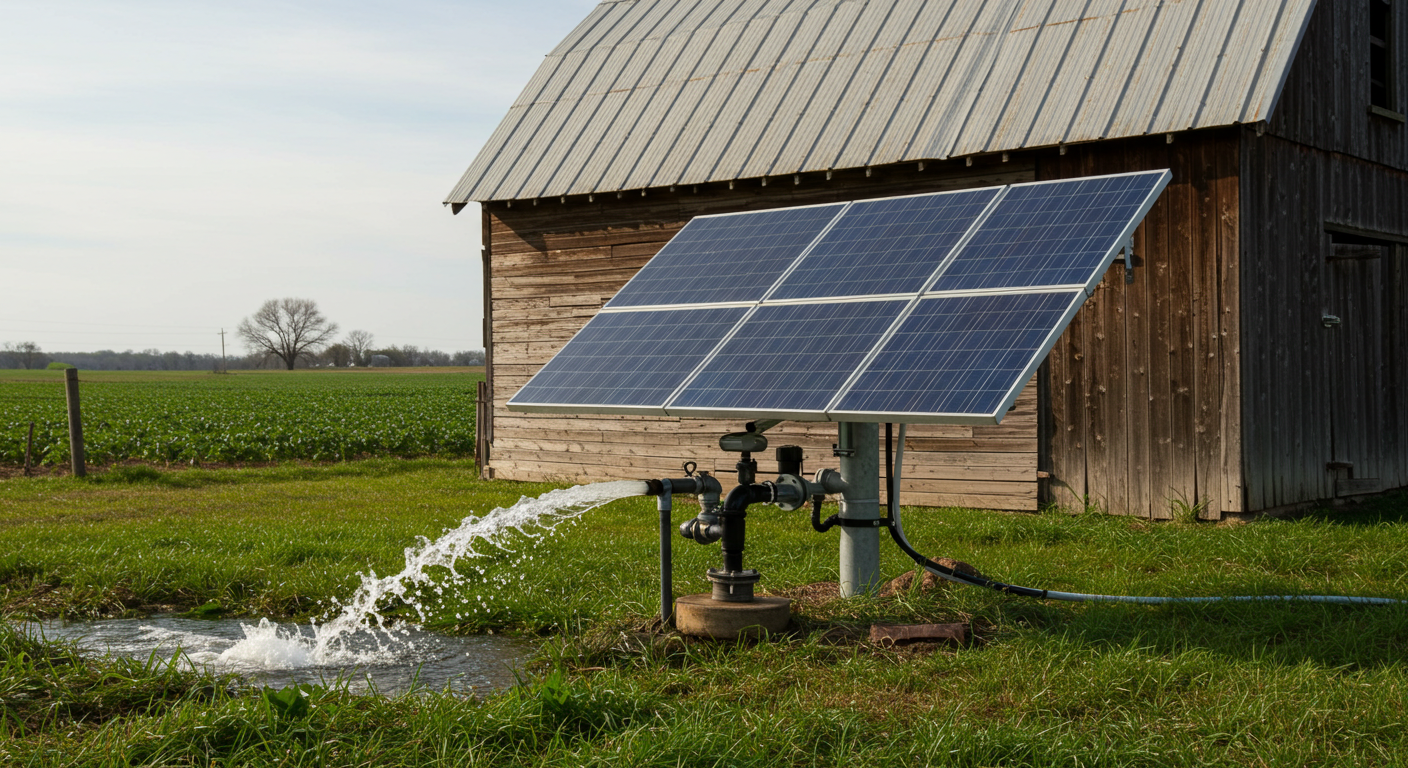
A solar-powered water pump provides a steady water supply without the need for grid electricity or diesel fuel. Solar panels convert sunlight into electricity, which powers pumps that move water from wells, ponds, or other sources. Operating costs can drop as low as two cents per thousand gallons, saving farms significantly over time. It also fits naturally into daytime watering schedules, since solar output tends to peak when crops need water most.
These systems now cover everything from small garden beds to wide-acre farms. Daily water output can reach between 500 and more than 10,000 gallons, depending on system size and setup. With proper upkeep, these systems run reliably for decades, making them a strong choice for both off-grid locations and rural operations.
How Solar-Powered Water Pumps Work for Irrigation
Solar irrigation systems work by converting sunlight into electricity that powers water pumps to deliver water from your source to where it’s needed. Here’s how the complete system operates:
Basic System Operation
Solar pumps follow the sun. Here’s when they work hardest and why that matters.
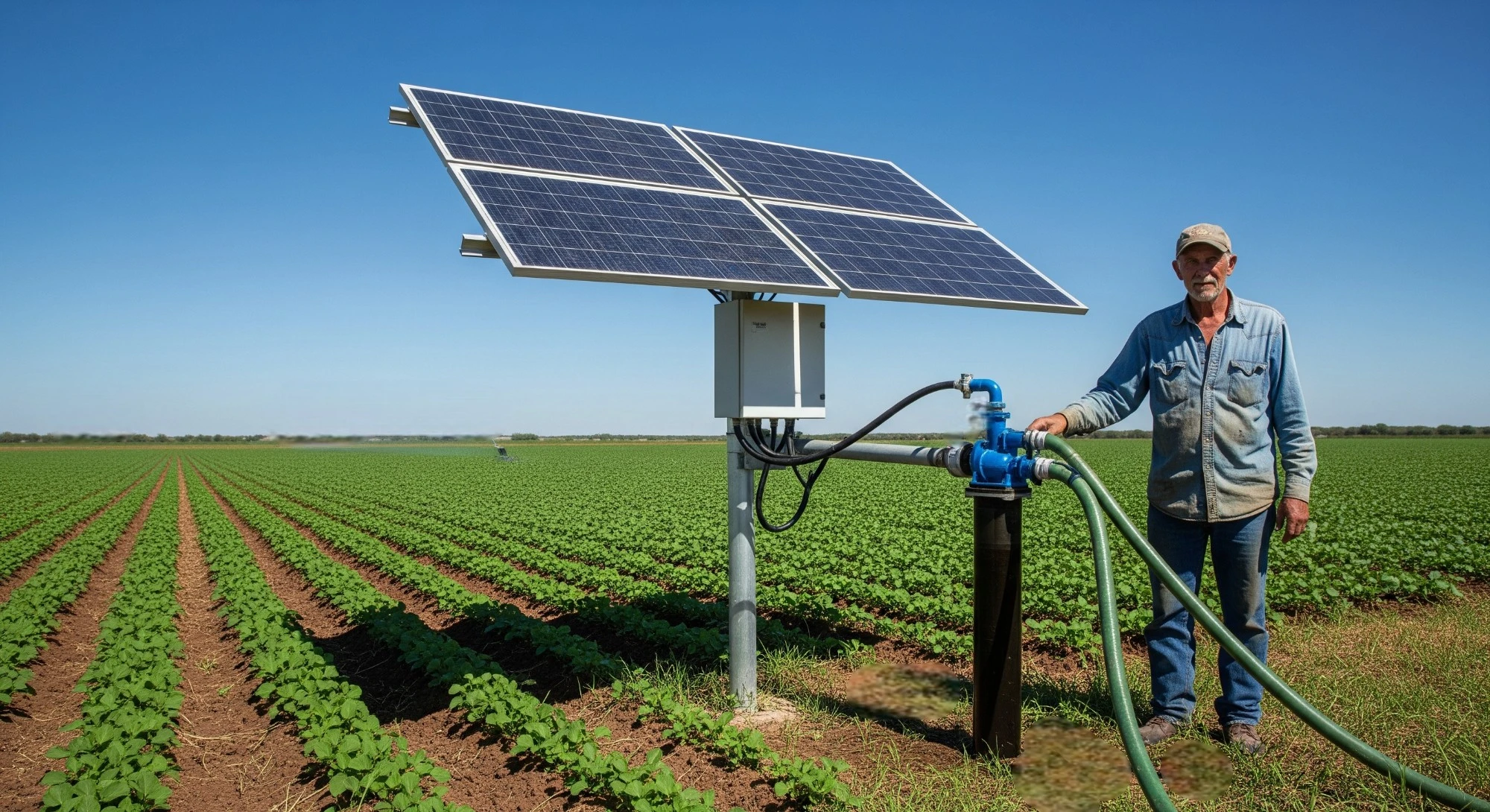
Solar Panel Array: Solar panels convert sunlight into DC electricity that powers the water pump. The solar array size determines how much water you can pump daily – larger arrays pump more water and can operate pumps with higher horsepower requirements.
Pump Controller: Most solar water pump systems include a pump controller that regulates power flow from solar panels to the pump.
Water Delivery: The pump moves water from your source (well, pond, stream) through pipes or hoses to irrigation areas. Many systems include storage tanks that fill during sunny periods and provide water during cloudy times or for evening irrigation.
System Components and Integration
Every solar-powered pump relies on a few core parts. Get these right, and the rest falls into place.
A solar panel array (typically 12V, 24V, or 48V systems).
A surface or submersible pump.
An MPPT pump controller.
An optional storage tank for water pressure and timing.
Pipes and lines to distribute water where it’s needed.
For complete irrigation solutions, a quality solar-powered water pump system includes all necessary components designed to work together efficiently.
Most solar pumps turn on automatically when sunlight hits the panels and shut off as light fades. The strongest output usually happens from late morning to mid-afternoon. Around 60 to 80 percent of daily water volume is delivered between 10 AM and 4 PM, when solar power is at its peak.
According to the International Water Management Institute, “Solar-powered irrigation systems can reduce pumping costs by 70-90% compared to diesel generators while providing more reliable water access in remote areas.”
Water Storage and Distribution
Some setups store water, others send it straight to the field. Both work, depending on the flow. Storage tanks make it possible to collect water during sunny hours and use it whenever needed. They also help maintain steady pressure for sprinkler systems or drip irrigation, so the pump doesn’t need to stay on the entire time. This setup adds flexibility and reduces wear on equipment.
In some cases, water is pumped straight to the fields without storage. That works best for flood irrigation or when watering times naturally line up with solar production during the day.
Types of Solar Water Pumps for Irrigation Systems
Choosing the right pump type depends on your water source depth, daily water needs, and irrigation system requirements:
Surface Pumps vs Submersible Pumps
Pump Type
Best For
Water Source
Advantages
Disadvantages
Surface Pumps
Shallow wells, ponds, streams
0-25 feet deep
Easy maintenance, lower cost
Limited suction depth
Submersible Pumps
Deep wells
25-500+ feet deep
Higher pressure, more reliable
Harder to service, higher cost
Solar Well Pump Systems
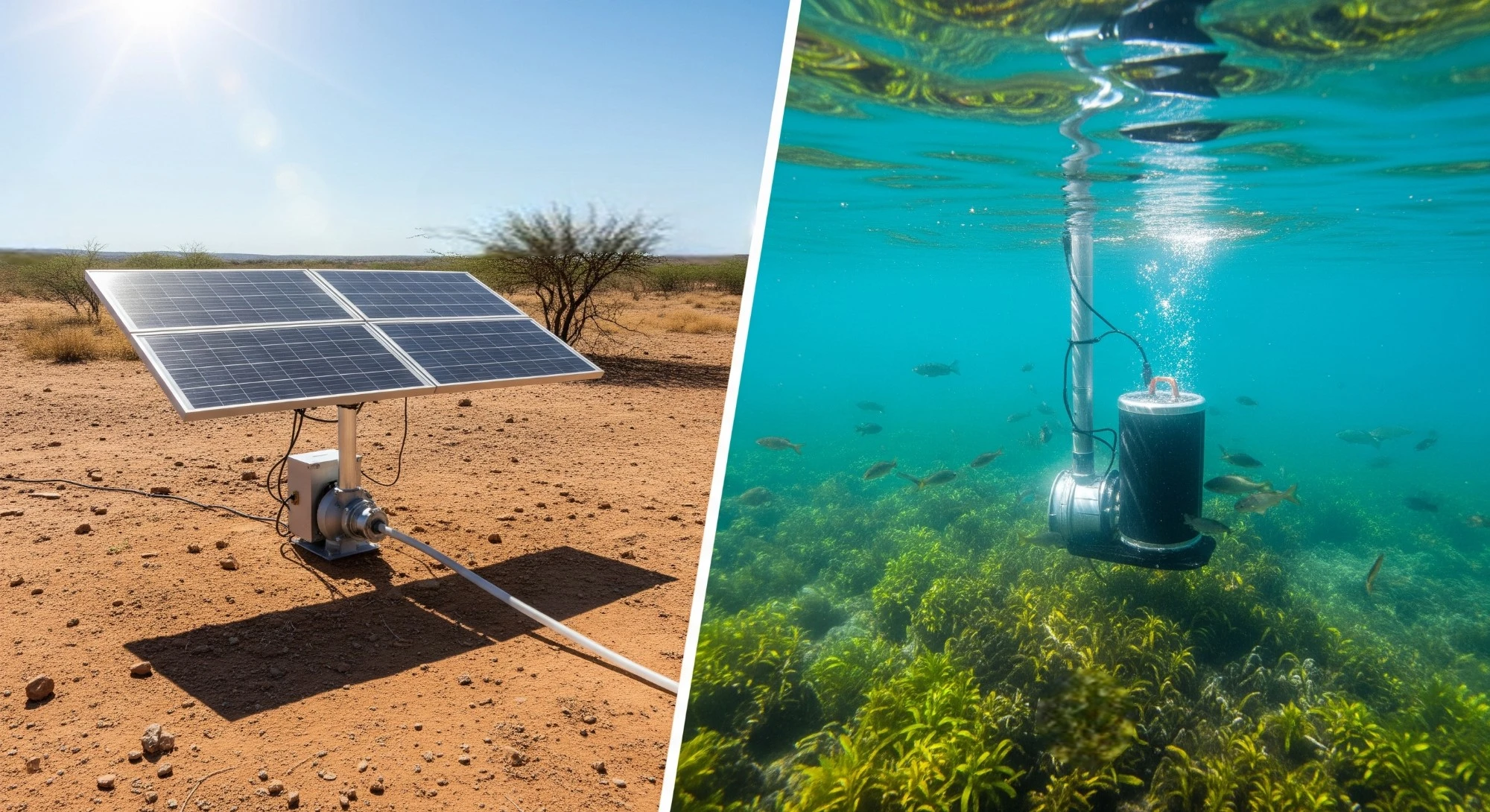
Shallow Well Pumps: Surface-mounted solar well pumps work great for wells up to 25 feet deep. These pumps are easier to install and maintain since all components stay above ground.
Deep Well Solar Pumps: Submersible solar well pumps handle deep wells from 50 to 500+ feet. These systems can deliver higher water pressure and flow rates needed for larger irrigation projects.
Solar Well Pump Kits: Complete solar well pump kits include everything needed for installation – solar panels, pump, controller, and mounting hardware. Kits simplify system design and ensure component compatibility.
Getting the Right Flow
Gallons Per Minute (GPM): Solar irrigation pumps range from 1-2 GPM for small gardens to 20+ GPM for large agricultural applications. Higher GPM pumps need more solar panel wattage and larger controllers.
Daily Water Output: Calculate daily pumping capacity by multiplying the GPM rating by hours of peak sun. A 5 GPM pump with 6 hours of peak sun delivers about 1,800 gallons daily.
Pressure Requirements: Consider water pressure needs for your irrigation system. Drip irrigation needs 15-30 PSI, while sprinkler systems typically require 30-60 PSI for proper operation.
Popular Solar Pump Applications
Agricultural Irrigation: Large-scale crop irrigation using solar pumps ranging from 1-20 HP for fields from 10 to 500+ acres.
Livestock Watering: Smaller solar pump systems (0.5-3 HP) provide reliable water for cattle, sheep, and other livestock in remote pastures.
Garden and Residential: Small solar pump kits (100-500 watts) for garden irrigation, pond circulation, and residential water features.
Pool Circulation: Solar pool pumps provide energy-efficient circulation and filtration for swimming pools, reducing electric bills significantly.
Benefits of Solar Irrigation Pump Systems
Cutting fuel costs is just the start. Over time, a well-planned solar irrigation system can return more than it costs to install.
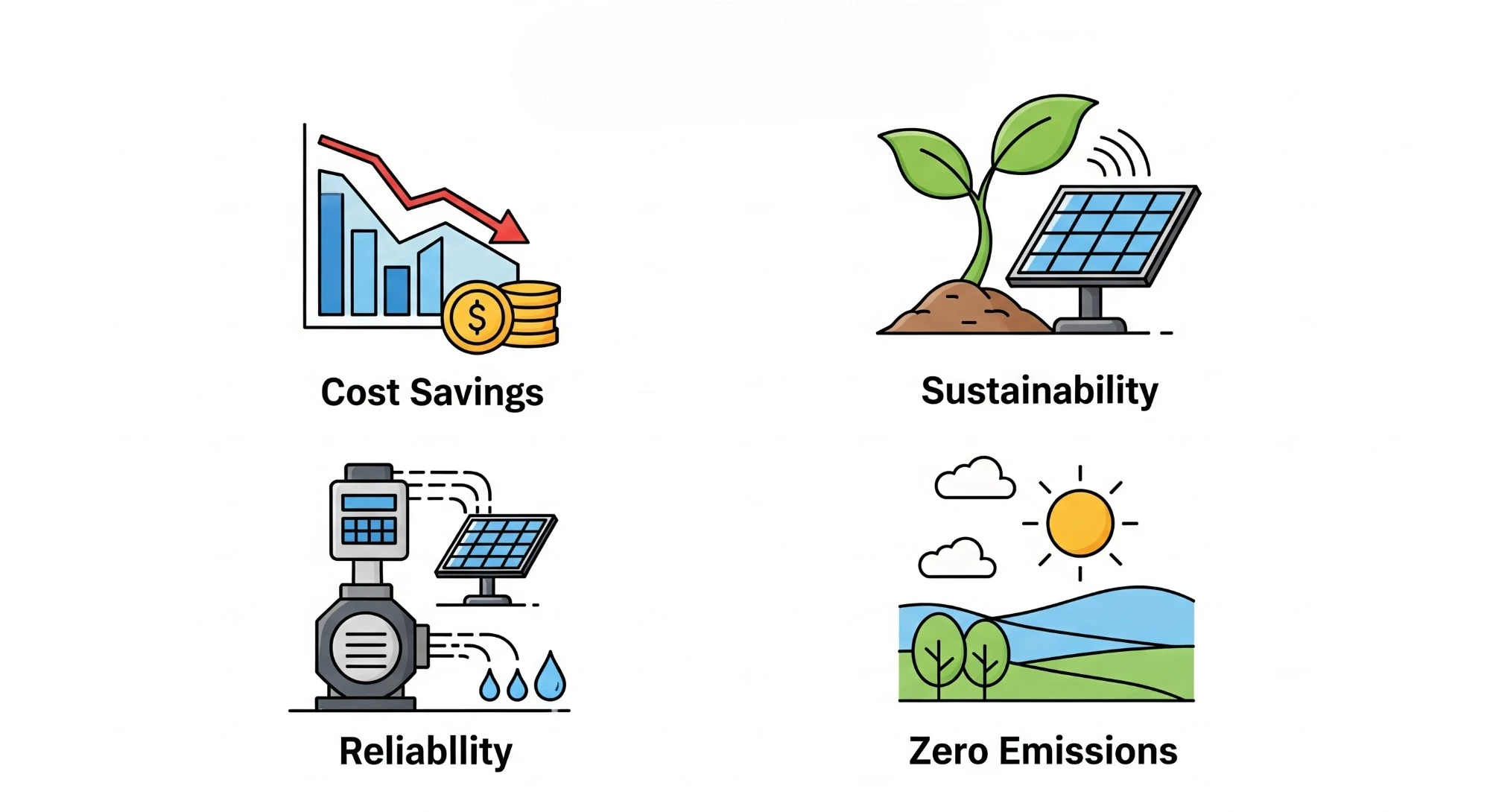
1. Cost Savings and Economics
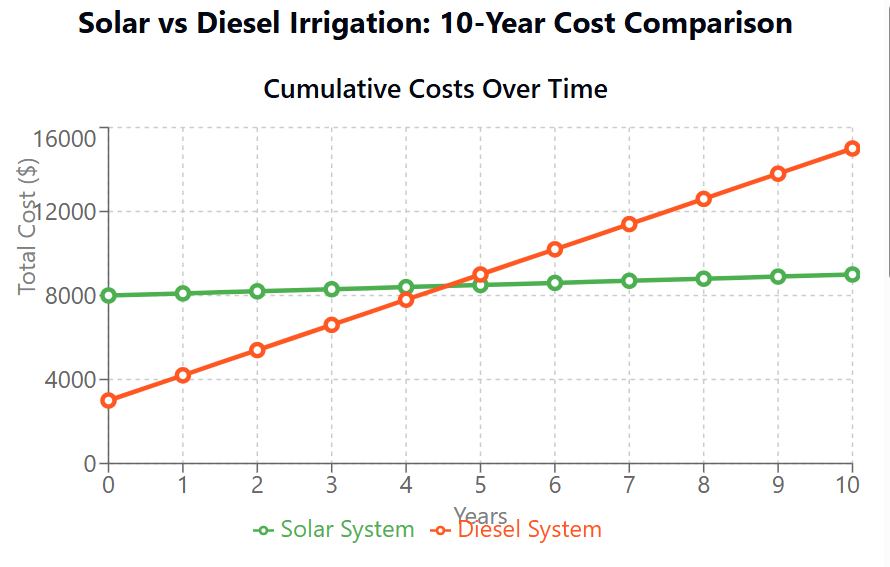
Fuel Cost Elimination: Solar pumps eliminate diesel fuel costs that can range from $0.10-$0.30 per 1,000 gallons pumped. Over 20 years, fuel savings often exceed the initial system cost.
Low Operating Costs: After installation, solar water pump systems operate essentially free. No fuel purchases, minimal maintenance, and a 25+ year system life provide an excellent return on investment.
Grid Independence: Solar irrigation systems work in remote places without power lines. This opens up land use possibilities and eliminates monthly electric bills for irrigation.
TheFood and Agriculture Organization reports that “Solar-powered irrigation can reduce water pumping costs by up to 95% compared to diesel systems while improving food security in rural areas.”
2. Environmental and Sustainability Benefits
Zero Emissions: Solar water pumps produce no emissions during operation, unlike diesel generators that contribute to air pollution and greenhouse gases.
Renewable Energy: Solar pumps use renewable energy that’s available anywhere with adequate sunlight. This supports sustainable agriculture and reduces dependence on fossil fuels.
Water Conservation: Many farmers using solar irrigation become more conscious of water use since they’re pumping with “free” solar energy. This often leads to more efficient irrigation practices.
3. Reliability and Performance
Weather Independence: Solar pumps work reliably in most weather conditions. Even partly cloudy days provide enough power for pumping, and battery backup systems handle extended cloudy periods.
Low Maintenance: Solar irrigation systems have few moving parts and require minimal maintenance. Annual cleaning of solar panels and periodic pump inspection typically handle most maintenance needs.
Long Lifespan: Quality solar panels last 25+ years, pumps typically run 10-20 years, and controllers last 15+ years. This longevity provides decades of reliable water delivery.
Installation and System Components
Proper installation should ensure that your solar irrigation system runs perfectly:
Solar Panel Array Sizing
Wattage Requirements: Calculate solar panel needs based on pump power requirements and daily water goals. Most irrigation pumps need 100-2,000 watts of solar panels, depending on pump size and duty cycle.
Panel Configuration: Solar panels can be wired in series (higher voltage) or parallel (higher current) depending on pump controller requirements. Most modern controllers accept wide voltage ranges for flexible panel configuration.
Mounting Options: Ground-mounted systems are easier to install and maintain but require more space. Pole-mounted arrays save space and can be adjusted seasonally for optimal sun exposure.
Pump Controllers and MPPT Technology
Controller Functions: Solar pump controllers regulate power flow, protect pumps from damage, and often include features like dry-run protection, automatic start/stop, and system monitoring.
MPPT Benefits: Maximum Power Point Tracking controllers extract 15-30% more power from solar panels compared to basic controllers. This increased efficiency means smaller solar arrays can power larger pumps.
System Protection: Quality controllers protect against overvoltage, undervoltage, motor overload, and dry running. These features extend pump life and prevent costly damage.
Storage and Distribution Systems
Storage Tank Sizing: Size storage tanks for 1-3 days of irrigation water needs. Larger tanks provide more flexibility but cost more and require stronger support structures.
Irrigation Distribution: Connect storage tanks to drip irrigation, sprinkler systems, or flood irrigation depending on crop needs. Include pressure tanks or booster pumps if needed for adequate water pressure.
System Controls: Add timers, pressure switches, and float switches to automate irrigation scheduling and protect pumps from running dry.
How to Choose the Right Solar Water Pump System for You
Choosing the best solar irrigation system requires matching the pump capacity to your specific water needs and conditions:
Long-Term Reliability and Maintenance
Component Quality: Invest in quality components from reputable manufacturers. Cheap pumps or controllers often fail prematurely and cost more in the long term through replacements and lost productivity. For reliable solar irrigation equipment, The Solar Store provides quality pumps, controllers, and complete system packages all in one place, simplifying the process of getting the right setup for your irrigation needs.
Maintenance Planning: Plan for routine maintenance, including annual solar panel cleaning, pump inspection, and controller checks. Budget for pump replacement every 10-15 years.
System Monitoring: Consider systems with remote monitoring capabilities that alert you to problems via smartphone apps. Early problem detection prevents crop loss and expensive repairs.
Sizing for Your Water Requirements
Calculate Daily Water Needs: Determine the number of gallons per day your crops, livestock, or irrigation system require. Factor in seasonal variations and peak demand periods.
Well and Water Source Assessment: Measure well depth, static water level, and recovery rate. Test water sources for flow capacity and seasonal variations that affect pump sizing.
Solar Resource Evaluation: Use tools like NREL’s solar maps to assess your location’s solar resource. Areas with 4-6+ hours of peak sun daily work best for solar irrigation.
System Costs and Return on Investment
Initial Investment: Complete solar irrigation systems typically cost $3,000-$15,000+ depending on pump size, solar array, and installation complexity. Larger systems often provide better cost per gallon pumped.
Payback Period: Most solar irrigation systems pay for themselves within 3-7 years through eliminated fuel costs. Systems in areas with expensive diesel fuel or high electric rates pay back faster.
Financing Options: Many areas offer grants, rebates, or low-interest loans for renewable energy irrigation systems. Research local incentives before purchasing equipment.
What Makes Solar Pumps Worth It
Solar-powered irrigation provides a reliable way to move water where it’s needed without relying on the grid or paying for diesel. It’s a good fit for places where the sun shines and water demand rises during the day.
The technology has come far. It now supports everything from small gardens to full-scale farms. With the right setup, a system like this can run for decades with little maintenance and nearly no running cost.
Consider solar irrigation if you need reliable water in remote locations, for cutting energy bills, or for switching to a cleaner, more sustainable water solution.
Frequently Asked Questions
How much water can a solar-powered pump deliver daily? Solar pump output depends on pump size and solar array capacity. Small systems pump 500-2,000 gallons daily, while larger agricultural systems can pump 10,000+ gallons per day.
Do solar water pumps work on cloudy days? Yes, solar pumps work on cloudy days but at reduced capacity. Most systems pump 20-40% of normal output on overcast days. Battery backup systems provide full pumping during extended cloudy periods.
How much does a solar irrigation system cost? Complete solar irrigation systems cost $3,000-$15,000+ depending on pump size, solar array, and installation requirements. Small garden systems start around $1,500 while large agricultural systems can exceed $25,000.
What maintenance do solar water pumps require? Solar pumps need minimal maintenance – annual solar panel cleaning, periodic pump inspection, and controller checks. Most pumps run 10-20 years before needing replacement.
Can solar pumps provide enough pressure for sprinkler irrigation? Yes, properly sized solar pumps can provide 60+ PSI needed for sprinkler systems. Submersible pumps typically provide higher pressure than surface pumps.
Solar rebates are among the most economical ways homeowners can invest in renewable energy and reduce their environmental footprint. These financial incentives offset installation costs and make solar energy more accessible.
Being aware of the different types of rebates, such as the Solar Power Rebate Victoria program, will make the process easier to understand and maximize your savings. This guide provides all the important information you need to know about solar rebates.
Understanding Solar Rebates and How They Work
Rebate incentives from state agencies and utilities in support of renewable energy technologies are cost-effective financing options. This would offset the high initial costs of installing solar panels, making it an increasingly attractive option for a lot of homeowners.
These rebates differ from state to state, and even utilities have theirs, especially in states where the load off the grid is imperative.
Utility rebates are those provided by utility companies and are a great resource for homeowners interested in solar energy. Local government rebates can be for equipment, installation, or both.
How to Qualify for Solar Rebates
Solar rebates include some eligibility criteria that range from the ownership of property to installation criteria. Rebate credit, given from the federal tax credit system, applies only to newly residentially-generated solar panels, while state-run programs such as the Solar Power Rebate Victoria requires compliance from state guidelines in regard to the installation standard.
Different details might come with changing locations, the specific aspects of a particular program, or different energy-efficient equipment. This being the case, early application can ensure eligibility upon consultation with a solar installer.
Steps to Apply for Solar Rebates
Homeowners who want to get solar rebates will have to research the available incentives, garner the required documents, and make a submission. Some of the rebates are meant to be applied for through government websites or utility portals.
When your application has been submitted, there can be a pending review process that could go so far as verification by the provider or an inspection to actually see that the work was correctly done. Rebates are usually issued as checks or direct deposits; some utility companies apply rebates as a credit on future bills.
Maximizing Savings with Stacked Rebates and Incentives
Combining federal, state, and utility-level rebates and incentives maximizes savings on solar. Regional programs, such as the Solar Power Rebate Victoria, and property tax exemptions further reduce the payback period for solar installations when you work with a reputable installer.
Solar Rebates and the Long-Term Value of Your Home
Solar panels not only reduce energy costs but also improve property value. Renewable energy installations are in demand because buyers seek long-term utility savings and sustainability. Solar rebates make it easier to invest in solar, adding value to a property.
Solar installations sell more quickly and at a higher price, with any remaining incentives possibly passed along to the buyer. The immediate and future benefits can be availed from investing in solar.
Solar Rebates for a Greener Future
Solar rebates keep the solution quite affordable for household owners in switching to clean energy, with little or no significant upfront cost.
The solar installations will also be accessible and more importantly very affordable since such schemes as the Solar Power Rebate Victoria, among many others, make these renewable energies quite viable and well-appreciated. Together, combining rebates with incentives with good installation can assure substantial savings.