Tag: Realtor commissions

  • Pricing Strategies That Attract Serious Buyers

    Image Source: gettyimages.com

    Real estate professionals continually tweak their pricing strategies to attract serious buyers. There’s much more to a real estate transaction than meets the eye. Beyond simple supply and demand, motivated buyers are driven by the value they see in the deal. Pricing, terms, interest rates, down payments, fees, commissions, other costs, and long‑term value all play a role. Depending on the target market, tailored pricing strategies often appeal to serious buyers. In today’s feature, we explore several buyer groups and how pricing strategies can benefit them.

    First-time homebuyers are an interesting group because they’re just entering the property market. Typically, this group is familiar with the rental market and understands that the transition to homeownership offers clear long-term benefits. Realtors often appeal to first-time homebuyers by talking about the equity they can build by owning a home. For homeowners, every mortgage payment helps build ownership in a real asset. Early on, much of each payment goes toward interest rather than principal, but that balance shifts over time.

    The Psychology of the Number

    The “Search Bridge” Strategy

    80% of buyers search using price filters with $25k or $50k increments (e.g., “Max $500k” or “Min $500k”).

    If you price at $499,900, you are INVISIBLE to the buyer searching “$500k to $600k”. If you price at $500,000, you appear in results for buyers looking up to $500k AND buyers looking from $500k.

    When to use this:

    Use this when your home is “on the fence” of a major price point (e.g., $400k, $500k, $750k, $1M) and is in good condition.

    Odd Numbers ($X99k) vs. Round Numbers ($X00k)

    Your pricing format sends a subconscious signal to buyers before they even click the listing.

    • $499,000 (The “Bargain” Signal)
      Triggers the “left-digit effect.” Implies value, urgency, and a deal. Best for: Standard suburban homes, fixer-uppers, high-inventory areas.
    • $500,000 (The “Prestige” Signal)
      Round numbers imply quality, luxury, and “firm” pricing. Best for: Luxury properties (Park Cities), unique architecture, turnkey homes.

    Equity is a powerful tool. Homeowners often use the difference between their home’s market value and their remaining loan balance to fund renovations, education, investments, big purchases, or even bucket-list experiences. Putting down roots with real estate is a serious commitment to building wealth. For most people, a home is the largest investment they’ll ever make. It can become the foundation for stability, growth, and long-term prosperity.

    [wpchtmlp id=522460]

    Veterans, service members, and eligible family members represent another important group in the homebuying market. There are tens of millions of veterans across the United States, spanning as far back as World War II, the Korean War, the Gulf War, Afghanistan, and other conflicts. Veterans are unique; they have put country and duty above self.

    Their sacrifice helps ensure that the rest of us can live free and enjoy the benefits of our way of life. As a gesture of gratitude for their service, society pays it forward in VA loan requirements. Because the government partially backs these loans, lenders are often more willing to extend credit to veterans.

    Realtors often highlight these veteran-focused programs because they’re backed by the VA. The homeownership benefits for veterans are substantial. For starters, veterans are not required to make a down payment when applying for a VA mortgage. Other buyers using conventional loans often need as much as 20% down to avoid private mortgage insurance (PMI).

    Eligible veterans are exempt from this requirement, which makes the prospect of homeownership a whole lot easier. Equally important are the interest rates and terms associated with VA loans. VA home loans often carry interest rates that are slightly lower than, or at least on par with, many non‑VA loans. Even a small reduction in the rate can translate into significant long-term savings.

    Home warranties, homeowners’ association (HOA) dues, realtor fees, and commissions can all add up to serious extra costs on top of the mortgage. Given that the median home price in the United States is $430,000, monthly mortgage payments are already high. Additional expenses like insurance, warranty coverage, HOA dues, and realtor fees or commissions can eat into a buyer’s disposable income. Savvy realtors can appeal to motivated buyers by addressing these concerns in several ways.

    For example, some agents include a one‑year home warranty with the purchase as a simple thank‑you. HOA dues aren’t the realtor’s responsibility, but buyers appreciate it when agents share information about how stable those dues have been and how quickly they’ve tended to increase. Realtor fees and commissions are also negotiable in many situations. All of these steps can tip the scales in favor of buyers and help move the deal forward.

    The Curtain Call

    Savvy real estate professionals understand that the perceived all‑in cost really matters. Often, it’s the extra expenses that complicate a deal. By being proactive about these costs especially realtor fees and commissions, offering a complimentary one‑year home warranty, or providing clear information about HOA dues, they can put buyers at ease and tilt the decision in their favor.

    In the end, it’s less about one specific number and more about whether buyers feel the home is worth the overall value. It’s a balance of fair pricing and smart concessions and that’s how realtors consistently close deals.


  • Realtor Commission Rates: What Sellers and Buyers Need to Know in Columbus, Ohio

    Real Estate commission shifted significantly following the 2024 NAR settlement. Understanding Realtor commission changes is crucial for any homeowner navigating today’s market. Commission rates will vary by state and local area. Real estate commissions are completely negotiable.

    Commission rates are no longer standardized and can vary by state, city, and even individual agents. All commissions are negotiable, but the way they’re handled has changed.

    • Listing Agent Commission: When you hire a listing agent to market and manage your sale, you’ll agree on a percentage of the sale price, typically between 1% and 4%.
    • Buyer’s Agent Compensation: This is where the biggest change occurred.
      • Buyer agent fees are no longer automatically displayed in MLS listings.
      • Buyers must sign a written agreement with their agent before touring homes.
      • Buyers are responsible for negotiating and paying their own agent fees.
      • Sellers may still choose to offer buyer-agent compensation, but it must be handled outside the MLS listing.

    How Commissions Work in Practice Today

    Let’s say you sell a $400,000 home:

    • Listing Agent Fees: At 2.5%–3%, you’ll owe $10,000–$12,000.
    • Buyer Agent Fees: Sellers are not required to pay, but many still do to make the property more appealing. This compensation might be:
      • Offered as a concession during negotiations,
      • Built into the sale price if requested by the buyer, or
      • Paid directly by the buyer.

    In total, while combined commissions often remain 4%–6%, the negotiation process is different. Buyers now take more responsibility for their agent’s pay, which can influence how offers are structured.

    Typical Costs to List with a Realtor

    • National Commission Average: Historically between 3% and 6% of the final sale price. On a $400,000 home, that’s $12,000–$24,000.
    • Flat-Fee and Discount Brokerages: Some sellers choose flat-fee or discount models. These can lower upfront costs, though services are often more limited compared to full-service brokerages.
    • Administrative or Transaction Fees: Many brokerages add extra charges ranging from $200 to $600.

    Negotiating When Listing Your Home

    Everything about commission and service is negotiable:

    • Commission Rates: Many agents are open to adjusting their fees, especially in competitive markets or on higher-value homes.
    • Service Packages: Agents may provide options ranging from basic MLS listings to full-service marketing campaigns, including staging, open houses, and online advertising.
    • Buyer-Agent Compensation: Sellers can decide whether to contribute to the buyer’s agent fee. While some fear this may limit showings, NAR guidance notes that agents are not supposed to steer clients based on commission offered.

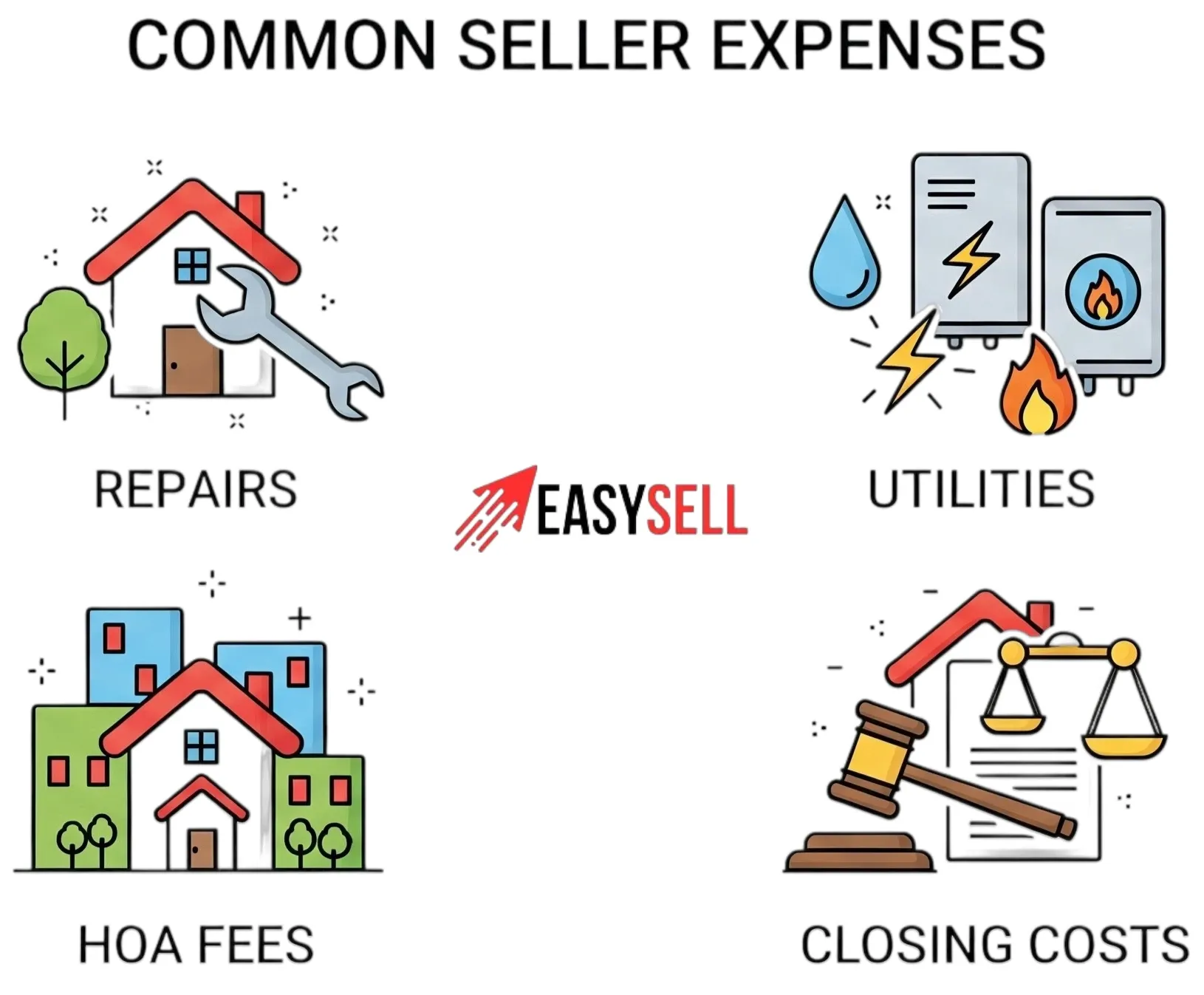
    Seller Costs Beyond Commission

    Aside from commissions, you’ll also need to budget for closing costs and other expenses:

    • Title, Escrow, and Transfer Taxes: Depending on your state, these can total several thousand dollars.
    • HOA Transfer Fees and Local Charges: If your property is in an HOA, there may be transfer or document preparation fees. Local governments may also charge recording fees.
    • Average Seller Closing Costs: Typically 1%–4% of the sale price, not including commission.

    Other Costs Sellers Often Overlook

    • Repairs and Upgrades: Roof repairs, HVAC service, or plumbing work may be expected before listing. These expenses can add up quickly.
    • Carrying Costs While on Market: You’ll still be responsible for mortgage payments, property taxes, insurance, and utilities until the home closes. Depending on how long it takes, this could mean several thousand dollars per month.

    How to Save on Realtor Costs

    • Interview Multiple Agents: Speak with at least three agents. Compare not only their commission rates but also their marketing strategies and track records.
    • Consider FSBO or Direct Sale: Selling your home yourself or directly to a buyer can reduce or eliminate commissions, but it often requires more effort and market knowledge.
    • Using a “Sell My House Fast” Alternative: If you need to avoid repairs, staging, and lengthy market time, a direct cash offer can be an option. Google Sell my house fast to explore this approach.

    Weighing Realtor Commissions Against Value

    The cost to list your house with a Realtor is more than just the commission. Closing costs, repairs, carrying costs, and other expenses all will reduce your net proceeds. Understanding each potential cost, negotiating these cost where possible, and comparing selling options, you can make a decision that aligns with your goals.

    Author:

    Marc Van Steyn is a licensed REMAX Realtor with 21 years of experience helping buyers and sellers in Columbus, Ohio. He also runs a YouTube channel sharing tips and market insights for those relocating to the Central Ohio.

  • US Housing Market Crash: Why So Many Realtors Are Quitting

    The slowdown in the housing market, mostly caused by the COVID-19 pandemic five years ago, has taken a toll on real estate agents. The rising mortgage rates and economic hardships drove most potential buyers away from buying homes, causing agents, who live on commissions, to struggle to keep their businesses afloat.

    According to the Federal Reserve Bank of St. Louis, the number of full-time real estate agents and brokers was around 543,000 before the pandemic in 2019. That figure declined to 524,000 by 2021 and 512,000 by 2022. The decline accelerated in 2023 with only 440,000 agents remaining, and by 2024, that number dropped again to 398,000. These are the lowest levels since 2013, far from the over 504,000 agents at the start of the financial crisis.

    In addition to economic factors, AI is changing the real estate industry. More people are using websites and apps to buy and sell homes without real estate agents, the industry is being disrupted. Online platforms offering home valuations, virtual tours, and market analysis are becoming more popular and downplaying the role of real estate agents as intermediaries.

    Accordingly, the number of brokers and agents that are full-time has declined from its pandemic-era peak. Both regulatory reforms and tech disruption are responsible for this transformation.

    Adding to the pressure, dozens of lawsuits have been filed against the National Association of Realtors (NAR). NAR settled with plaintiffs in March 2024 for $418 million for complaints that it required home sellers to offer big commissions to agents representing the buyers under the “cooperative compensation” practice of NAR. NAR changed rules under the settlement terms that forbade sellers from including the offer of commissions for agents representing the buyers within the terms of the property for sale.

    Emily Oster, Founder of DALTX Real Estate, says this is part of a larger industry trend. “It’s the new era that agents have to be more flexible and focus more on niche areas,” she said. She cited the necessity for agents to leverage tools like AI for finding leads and processing transactions as the most vital tools for future agents.

    Real estate agents need to adapt and thrive in the changing real estate market. With so many property websites available now, sellers and buyers are increasingly able to find homes on their own, without needing an agent. Agents who don’t keep up with the changes will be left behind. Future agents will need to specialize in market analysis, finance, and developing strong negotiation skills. While the tech streamlines the transactions’ process, agents are still valuable trusted advisors.