Tag: Real Estate Transactions

  • Comprehensive Guide to IRS Form 1099-S for Real Estate Professionals

    Before closing on your home, don’t forget about IRS Form 1099-S. It’s used to report real estate sales over $600 to the IRS. Sellers should know about possible tax implications, and agents need to understand what counts as “real property” to help avoid surprises. This guide explains when the form is needed, who files it, and common mistakes to watch for, and a checklist to keep things on track. Ensure your closings are done the right way.

    Understanding Form 1099-S in Real Estate Transactions
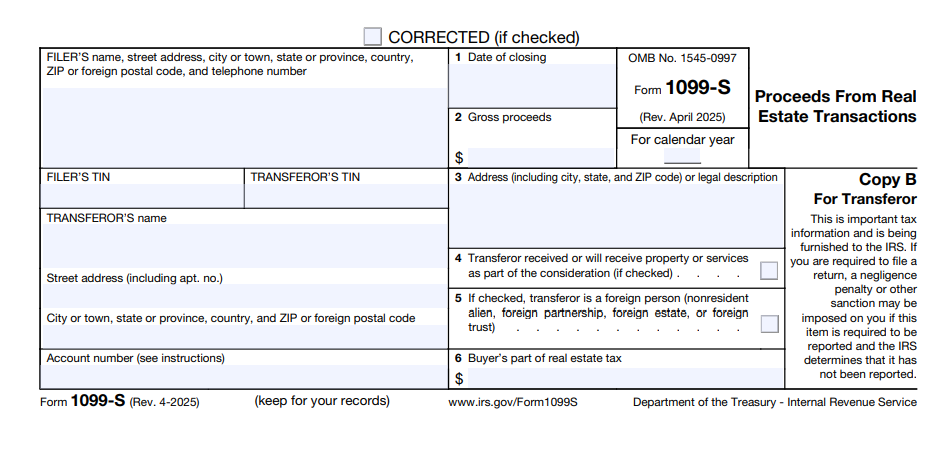
    IRS Form 1099-S

    Form 1099-S, officially called Proceeds From Real Estate Transactions, is an important document used to report property sales or exchanges to the IRS. If you work in real estate closings as a broker, attorney, title agent, or escrow officer, you might be the one responsible for filing it. Put simply, the IRS wants to make sure income from real estate sales is properly reported and taxed.

    The form covers various types of property, including:

    • Land: This includes both developed and undeveloped land, as well as airspace rights.
    • Permanent Structure: Residential, commercial, or industrial buildings that are considered inherently permanent. 
    • Condominium Units: This includes the unit itself, its fixtures, and any shared interest in common areas or land.
    • Cooperative Housing Stock: If a buyer purchases shares in a cooperative housing corporation (as defined under Internal Revenue Service Section 216), the transaction must be reported.
    • Standing Timber: Sales involving full ownership of standing timber must be reported.

    When Is Form 1099-S Needed?

    Form 1099-S must be filed for most real estate sales or exchanges considered reportable transactions under federal tax rules. Examples include:

    • Sale of a principal residence (even if the gain may be excluded under Section 121).
    • Sales made through land contracts.
    • Forced sales due to foreclosure risk.
    • Deals involving full ownership, leases longer than 30 years, or permanent easements.

    However, there are key exceptions:

    • Principal Residence Exclusion: Form 1099-S is not required if the property sold was the seller’s principal residence and the gain is fully excluded under Section 121 of the Internal Revenue Code.
      Here’s what qualifies:
      1. The sale price must be ≤ $250,000 for individuals or ≤ $500,000 for married couples filing jointly.
      2. The seller must certify that the property was their principal residence and that there was no disqualifying use after December 31, 2008.
      3. The seller must get this certification by January 31 of the next year and keep it for four years.

      Even if Form 1099-S is issued, the seller may still exclude the gain on their tax return. In such cases, the transaction should be reported on Schedule D, and the exclusion claimed accordingly.
    • Corporate or Government Transfers: Sales by corporations, government entities, foreign governments, or international organizations are exempt.
    • Non-Sale Transactions: Like inheritances, gifts, or refinancing that doesn’t involve buying property.
    • Transfers to satisfy debt: This includes foreclosures, deeds in lieu of foreclosure, or when a property is abandoned.
    • Small Transactions: If the total amount is under $600.

    Real estate professionals must evaluate each transaction to determine whether an exception applies, especially for principal residence sales, to avoid over-reporting or non-compliance.

    IRS Form 1099-S Deadlines and Penalties

    The IRS has strict deadlines, and missing them can lead to serious penalties.

    Here are the key dates to keep in mind:

    • February 17 – Provide the seller with their copy of Form 1099-S. This gives the seller enough time to include the proceeds on their tax return.
    • March 31 – Deadline to e-file Form 1099-S with the IRS. Most filers are required to e-file. If filing by mail, the deadline is typically February 28.

    Missing these deadlines can result in costly penalties, anging from $60 to $660 per form. Depending on how late you file and how many forms are involved. The longer the delay, the higher the penalty, so it’s important to stay on top of these dates.

    Who Is Responsible for Filing Form 1099-S?

    The responsibility for filing usually falls on the person handling the closing, often the closing agent such as a title company, as listed on the Closing Disclosure.

    Let’s break it down and see who is required to e-file 1099-S with the IRS If there’s no closing agent, responsibility follows this order:

    1. Buyer’s attorney (if involved in document preparation or fund transfer)
    2. Seller’s attorney
    3. Title or escrow company disbursing funds
    4. Mortgage lender with the primary lien
    5. Seller’s real estate broker
    6. Buyer’s real estate broker
    7. Buyer (if no other party qualifies)

    This responsibility can be reassigned with a written agreement made before or at closing. The agreement must include names and addresses of the parties, be signed and dated, and retained for four years. Only one party is required to file for each transaction, and employees or agents may act on behalf of their company or principal.

    In transactions without a title company (e.g., internal closings), real estate professionals ensure  the form gets filed. Practical strategies include:

    • Requesting the seller to complete Form W-9 for buyer submission
    • Including a designation clause in the purchase agreement
    • Giving the seller a pre-filled and addressed form to send to the IRS

    How to Complete Form 1099-S, Step by Step

    Filling out Form 1099-S accurately is crucial if you want to avoid penalties. Here’s what you’ll need to complete the form:

    • Filer’s name, address, and TIN: Identifies the reporting party
    • Seller’s name, address, and TIN: Must be obtained via Form W-9 (U.S. persons) or Form W-8 (foreign persons), with certification under penalty of perjury. Keep these records on file for at least four years.
    • Closing date: The official date the transaction is finalized
    • Gross proceeds: This includes the total amount received including cash, notes, and assumed liabilities. If the payment depends on future events like earnouts, report the highest amount that can reasonably be determined. Don’t deduct seller-paid expenses like commissions, report the full amount.
    • Property address or legal description: Specific identification of the property sold
    • Foreign seller indicator: Check if the seller is a nonresident, which may trigger withholding (see IRS Publication 515)
    • Buyer-paid real estate tax: If the buyer paid any real estate taxes, include that amount here.

    Real estate professionals should verify all the details at closing to make sure everything’s accurate and compliant.

    How to Report Real Estate Sales on Your Tax Return

    If a sale is reported on Form 1099-S, it must also be reported on the seller’s tax return, with reporting methods depending on the property type:

    • Principal Residence: If the gain qualifies for the exclusion ($250,000 for individuals, $500,000 for joint filers), it may be tax-free. But if a 1099-S is issued, the sale still needs to be reported, usually on Schedule D.
    • Investment Property: Use Schedule D and Form 8949 to report any gains or losses.
    • Rental Property: Use Form 4797 and Schedule D to report the sale, and be sure to account for depreciation recapture.
    • Business Property: Similar to rental property, use Form 4797 and Schedule D, including depreciation if applicable.

    Real estate professionals should help clients navigate the reporting process to make sure everything’s filed correctly and all exclusions or deductions are claimed.

    Beyond the basics, there also a few special situations that require extra attention:

    • Multiple Sellers: You’ll need to file a separate 1099-S for each seller. Be sure to allocate the gross proceeds clearly, and make a reasonable effort to contact all parties.
    • Foreign Sellers: These sales still need to be reported, and they may be subject to withholding under FIRPTA. (See IRS Publication 515 for details.)
    • Contingent Payments: Report the highest amount that can reasonably be determined at the time of sale.

    Avoid These Common 1099-S Filing Mistakes

    Form 1099-S may seem straightforward, but small missteps can lead to costly consequences. Here are some of the most common errors real estate professionals make and how to avoid them:

    • Verify Taxpayer Identification Numbers (TINs): Ensure the seller’s TIN is accurate and complete to avoid backup withholding or automatic penalties.
    • Complete All Required Fields: Include the seller’s full name, address, TIN, property address, gross proceeds, and closing date.
    • Use the Right Form: Don’t mix up Form 1099-S with other types like 1099-MISC or 1099-NEC.
    • Meet IRS Deadlines: Provide the seller’s copy by February 17 and file electronically with the IRS by March 31.
    • Keep Records: Hold onto copies of the form and any supporting documents for at least four years.
    • Assign Responsibility: Add a clause in the purchase agreement to clearly state who’s filing the form—this helps prevent duplicate submissions.

    To stay compliant, real estate professionals should:

    • Add a clause to the purchase agreement designating the Form 1099-S filer.
    • Use Form W-9 to obtain the seller’s TIN to avoid backup withholding issues.
    • Be aware of non-filing penalties, starting at $250 per violation, up to $565,000 annually.

    Final Thoughts

    If you’re in real estate, chances are you’ve run into Form 1099. It’s not the flashiest part of closing a deal, but it’s important to get it right. Knowing when it’s required, who needs to file it, and how to avoid common mistakes can save you from costly penalties. The right e-file provider can make the process a lot easier and help keep your transactions moving forward.

  • Unwritten Agreements: How Implied Contracts Shape Texas Real Estate Transactions

    In the bustling world of Texas real estate, contracts are the backbone of every transaction. Buyers, sellers, landlords, tenants, brokers, and investors all rely on agreements to define their rights and obligations. But what happens when a deal moves forward without a formal, signed document? Can a handshake or a string of emails create legally binding commitments? In many cases, the answer is yes, thanks to something called an implied contract.

    While written contracts are preferred for clarity and legal security, implied contracts can and do influence real estate outcomes across the state. Understanding how these unwritten agreements work and how to protect yourself when they arise is essential for anyone navigating Texas real estate.

    What Is an Implied Contract?

    An implied contract is an agreement formed not by explicit written or spoken terms, but by the conduct, actions, or circumstances of the parties involved. In Texas, courts recognize two types of implied contracts:

    • Implied-in-fact contracts, where the behavior of both parties suggests a mutual intention to form a contract.
    • Implied-in-law contracts (also called quasi-contracts), which are imposed by courts to prevent one party from unjustly benefiting at another’s expense, even if no mutual intent existed.

    In the context of real estate, implied-in-fact contracts are more commonly encountered. For example, if a real estate agent provides services and a client accepts and benefits from those services, a court may find that an implied contract existed, even if no formal agreement was signed.

    Real Estate Scenarios Where Implied Contracts Arise

    In Texas, the high stakes and fast pace of real estate deals often lead to situations where implied contracts come into play. Here are a few common examples:

    Brokerage Agreements Without Formal Contracts

    Imagine a situation where a real estate agent assists a buyer in locating a property, provides market insights, and facilitates negotiations, all without a signed buyer representation agreement. If the buyer then completes the transaction, the agent may claim entitlement to a commission based on an implied contract.

    While Texas law typically requires written agreements for broker commissions under the Texas Real Estate License Act (TRELA), there are circumstances where an implied contract may still be considered, especially if the client knowingly accepted the agent’s services.

    Lease Agreements Based on Conduct

    A tenant moves into a rental property and begins paying rent, but there’s no signed lease. If the landlord accepts the rent and continues to provide services such as maintenance, an implied month-to-month tenancy may be established. Even in the absence of a lease, both parties have obligations: the tenant must pay rent and follow reasonable rules, and the landlord must uphold property standards.

    Texas courts have upheld such arrangements as implied-in-fact leases, provided that the actions of both parties are consistent with a typical rental relationship.

    Purchase Agreements and Verbal Commitments

    While the Texas Statute of Frauds generally requires that contracts for the sale of real estate be in writing, disputes sometimes arise when verbal promises lead one party to act. For example, if a seller verbally agrees to sell a property, and the buyer makes improvements or puts money into the deal based on that assurance, a court may examine whether an implied contract or equitable estoppel applies.

    This area is legally tricky, and courts are cautious, but under specific circumstances, implied legal principles may be used to enforce fairness.

    Legal Considerations and Limitations

    Despite their validity, implied contracts in real estate can be problematic. Unlike written agreements, they lack precise terms, which can make enforcement difficult. Disputes often hinge on conflicting interpretations of behavior, verbal statements, or email exchanges.

    Texas courts will look for certain factors when determining whether an implied contract exists:

    • The intent of the parties, as inferred from conduct
    • Whether services or benefits were knowingly accepted
    • The presence of a reasonable expectation of compensation
    • The clarity and consistency of communications or actions

    Importantly, implied contracts cannot override statutory requirements, such as the need for written agreements under the Statute of Frauds. However, courts may sometimes use doctrines like quantum meruit (payment for services rendered) or promissory estoppel (enforcing a promise that induced reliance) to provide a remedy when fairness demands it.

    Best Practices for Real Estate Professionals

    To avoid unintended implied contracts and the disputes they can cause, real estate professionals and clients should:

    1. Put agreements in writing whenever possible. Even a basic email confirming key terms can help reduce ambiguity.
    2. Use clear communication to define roles, responsibilities, and compensation before services begin.
    3. Document performance or services rendered, especially if a formal agreement is delayed.
    4. Avoid relying on handshake deals or informal assurances when engaging in significant transactions.
    5. Consult with legal counsel if there’s uncertainty about whether a contract exists or needs to be formalized.

    Being proactive about contract documentation is far more efficient (and less expensive) than resolving disputes in court.

    A Written Word Is Still King, But Actions Matter

    In Texas real estate, actions can speak just as loudly as contracts. While the law favors clarity and written documentation, courts are willing to recognize implied contracts when fairness and logic demand it. For investors, landlords, agents, and homebuyers alike, understanding how these unwritten agreements work is vital.

    Navigating implied contracts doesn’t mean you should abandon formality—it’s a reminder that how you behave in a transaction can create real obligations. The safest strategy is to align your actions with clear, written agreements, leaving no room for misunderstanding.

    Because in a market as dynamic as Texas real estate, assuming the deal is sealed without putting it in writing could leave you relying on the court’s interpretation of your intent—and that’s a gamble no smart investor wants to take.

  • 5 Ways Dental Business Lawyers Help in Dental Real Estate Transactions

    Source: linkedin.com

    For every kind of business, location is key. Especially when it comes to running a dental practice, the right location is important. Whether moving to your first office, expanding your service, or negotiating a lease renewal, real estate transactions are a major part of your business.

    Dental business lawyer help dentists navigate real estate transactions, offering legal expertise and guidance in 5 important ways. The dental business lawyer can legally assist a dentist in a complex real estate transaction by drawing from his breadth of experience in five ways.

    1. Negotiating Lease Terms and Conditions

    Securing the right lease terms is primary in dental real estate transactions. Whether renting a space for your practice or negotiating a long-term lease renewal, a dental business lawyer can help you negotiate favorable terms that protect your financial interests.

    They’ll ensure you understand critical lease components such as:

    • Rent and escalation clauses
    • Maintenance and repair responsibilities
    • Renewal options and termination clauses
    • Sublease rights and transfer of the lease

    An attorney will be able to help you evade hidden costs: unexpected repairs or maintenance; potential future issues that may lead to disputes about what had been agreed in a lease, how space was zoned for, or uses for the property; and more-secure positioning of your company for long-term success.

    2. Ensuring Zoning and Compliance Issues are Addressed

    There are certain restrictions on zoning that dentists must follow, and they vary greatly depending on the jurisdiction one falls under. A dental business lawyer may find problems in the zoning ordinance that could be affecting your ability to run your clinic in a specific location.

    They can:

    • Confirm that local authorities have zoned the property for medical or dental use.
    • Investigate whether the area is subject to any restrictions or special permits.
    • Ensure that your practice complies with local healthcare regulations.

    Your lawyer may help you prevent fines, delays, and future legal disputes that might disrupt your company operations.

    3. Reviewing and Drafting Purchase Agreements

    If you are purchasing property for your dental practice, you will be signing a lot of documents. These include purchase agreements and contracts. An attorney will help in reviewing and drafting these important documents to ensure the terms align with your best interests.

    They will:

    • Ensure the purchase price and payment terms are clearly defined.
    • Review contingencies, such as financing or property inspections.
    • Address environmental concerns and title issues.
    • Protect against any hidden liabilities from previous owners.

    A lawyer guarantees that the transaction is legally valid and protects your rights from any post-purchase difficulties by meticulous attention to detail.

    4. Managing Due Diligence and Property Inspections

    Before closing any real estate transaction, a complete due diligence procedure is required. It involves analyzing the property’s physical condition, legal history, and possible threats.

    A dental business lawyer will guide you through this process by:

    • Reviewing property title and ownership records.
    • Ensuring there are no liens or encumbrances on the property.
    • Advising on required inspections, such as environmental assessments or structural evaluations.
    • Verifying that the property meets safety and accessibility standards.

    You can decide whether you want to go ahead with the deal or bargain for better terms.

    5. Assisting with Financing and Loan Documents

    Some dental offices have to finance their real estate purchases. However, getting the right loan terms can be hard. A dental company attorney will help you with the process through the review of loan documents and negotiating with lenders.

    They will:

    • Review the terms and conditions of the loan agreement.
    • Ensure the loan amount and repayment terms are clear and manageable.
    • Advise on collateral requirements or personal guarantees.
    • Identify any clauses that could jeopardize your practice’s future financial stability.

    Doing this step with your attorney will help you ensure that the financing arrangement for the investment matches the goals and financial status of your practice.

    Conclusion:

    Dental real estate transactions are complex. Having a dental business lawyer may make all the difference. From negotiations of lease terms to due diligence and review of loan documents, a dental business attorney can walk you through the legal process to protect your investment and the future of your practice.