Tag: Passive Income

  • Why Foreigners Choose Bangkok Real Estate Over Singapore & HK

    Image Source: freepik.com

    For decades, cities like Singapore and Hong Kong held the title of premier hubs for Asian real estate investment. However, as property prices in these financial giants reach stratospheric heights, a shift is occurring. Savvy international investors are turning their eyes toward Thailand’s capital.

    Foreigners favor Bangkok for real estate investments due to its unbeatable combination of affordability, high rental yields, and strategic location in Southeast Asia. Compared to its pricier neighbors, Bangkok offers a lower barrier to entry while providing a lifestyle that is hard to match. Whether for capital appreciation or passive income, Bangkok has become a magnet for global capital.

    Here is why Bangkok is outperforming its regional competitors in the eyes of foreign buyers.

    Premium Luxury at a Lower Cost

    The most immediate draw for foreign investors is the sheer value for money. When comparing prime city-center real estate, the price differential between Bangkok and other major Asian hubs is staggering.

    Current market data indicates that prime Bangkok properties average around $465 per square foot ($5,000 per sqm). In stark contrast, comparable properties in Singapore average $2,275 per square foot, while Hong Kong remains the most expensive at roughly $2,880 per square foot.

    For an investor, this means a budget that buys a small studio in Hong Kong could secure a luxury two-bedroom penthouse with concierge services in Bangkok’s upscale Sukhumvit district. This pricing structure not only makes high-end living accessible but also leaves significant room for growth.

    In fact, despite global economic fluctuations, Bangkok condo prices have seen a steady appreciation of approximately 9.39% in recent years, rewarding early adopters with substantial capital gains.

    High Rental Yields and Passive Income

    While capital appreciation is a long-term play, rental yield is the immediate cash flow engine, and this is where Bangkok truly shines.

    Investors can typically expect gross rental yields of 6–8% on central Bangkok apartments. This significantly outpaces the 2–3% yields common in Singapore and the 3–4% often seen in Hong Kong.

    This buy-to-let strength is driven by robust demand from two key demographics:

    • International Workers: Bangkok hosts a massive community of expats working for multinational corporations who require high-quality housing in the CBD.
    • Tourism Recovery: As one of the most visited cities in the world, the short-term rental market remains lucrative.

    Smaller units in prime business districts like Silom or Sathorn are particularly high-performing assets, generating reliable monthly income. For investors looking to capitalize on this demand, browsing properties for rent in Bangkok reveals a vibrant market with low vacancy rates in premium buildings.

    Strategic Location as the Crossroads of ASEAN

    Bangkok isn’t just a holiday destination; it is the logistical and economic heart of the Association of Southeast Asian Nations (ASEAN).

    Since the implementation of the ASEAN Economic Community (AEC), Bangkok has benefited from tariff-free trade and streamlined visa policies, solidifying its status as a regional HQ for global firms. This economic vibrancy sustains housing demand even when other markets cool down.

    Infrastructure Boom

    The city is currently undergoing a massive transformation in mass transit. The expansion of the BTS Skytrain and MRT networks has revolutionized connectivity.

    • The Yellow Line: Recently opened, connecting the Lat Phrao area to the eastern suburbs.
    • The Pink Line: Improving access to the northern government complex and non-CBD business hubs.

    These infrastructure projects open up previously “local” neighborhoods to foreign renters, increasing the potential for property value growth in areas just outside the traditional core.

    Favorable Policies for Foreign Buyers

    Unlike some Asian nations where foreign ownership is strictly prohibited or heavily taxed, Thailand offers a transparent path to ownership.

    The Condominium Act allows foreigners to own condo units 100% freehold, provided that the foreign ownership quota in a single building does not exceed 49%. This legal structure gives buyers a title deed (Chanote) in their own name, offering security and ease of resale.

    Recent trends show that foreign confidence in this system is high, with Greater Bangkok accounting for 74% of all foreign real estate transactions in Thailand. Furthermore, 2025 has seen discussions regarding new incentives to further ease the process for high-net-worth individuals and long-term visa holders, making the market even more attractive.

    Lifestyle and Amenities

    Investment metrics aside, the lifestyle Bangkok offers is a major “soft factor” in investment decisions. The city blends hyper-modern amenities with traditional culture.

    • World-Class Shopping: From IconSiam to Siam Paragon, the retail experience rivals Tokyo or New York.
    • Healthcare: Thailand is a global leader in medical tourism, offering international-standard hospitals at a fraction of US or European prices.
    • Education: A wide selection of top-tier international schools makes it a viable long-term home for expat families.

    Investment Opportunities and Expert Support

    Foreigners primarily focus on the condominium market due to the freehold ownership laws. However, opportunities also exist in the luxury leasehold villa market or through setting up Thai Limited Companies for landed property investments.

    Navigating these options requires local expertise. Engaging a reputable บริษัทนายหน้าอสังหา (Real estate agents in Bangkok) is essential for navigating the legalities, conducting due diligence, and finding units that offer the best ROI.

    Risks and Challenges

    No market is without risk. Potential investors should be aware of:

    • Currency Fluctuation: The Thai Baht is generally stable but subject to global forex trends.
    • Oversupply: Certain suburban areas have seen a glut of new condo launches. It is vital to stick to prime locations along mass transit lines.
    • Legal Complexity: While buying condos in Bangkok is straightforward, landed property ownership remains complex for non-citizens.

    Future Outlook for 2026 and Beyond

    Looking ahead, the outlook for Bangkok real estate remains bullish. As the extensive transit lines reach full completion and the Eastern Economic Corridor (EEC) initiative brings more industry to the region, the demand for residential property in the capital will likely increase.

    For foreign investors priced out of Singapore or Hong Kong, or those simply seeking better yield performance, Bangkok represents the smart money move in Asia. Whether you are looking for a vacation home that pays for itself or a serious portfolio addition, the time to enter the market is now.Start your search today and view the latest properties for sale in Bangkok.

  • Real Estate: Definition, Types, How It Works, Investment, and Key Terms

    Real estate touches almost every part of our lives, from where we sleep, to how local schools get funded, to where businesses decide to grow. If you’re thinking about buying a home, adding a rental to your portfolio, or just trying to make sense of all the jargon, this guide breaks down the basics in plain English.

    We’ll walk through what real estate really is, the main types of properties, how a deal actually goes from offer to closing, some popular ways to invest (both hands-on and hands-off), and a quick glossary of terms you’ll run into again and again.

    What Is “Real Estate,” Exactly?

    Real estate refers to land and anything permanently attached to it including homes, buildings, improvements, and the rights that come with ownership.

    In everyday use, you’ll hear “real estate” and “real property” used interchangeably. (That’s different from personal property, like your car or furniture, which isn’t affixed to land.)

    Ownership typically includes a “bundle of rights,” such as the right to use, lease, sell, or improve the property within the limits of law and zoning. Those rights have value; how much value depends on location, local demand, condition, allowed uses, and broader economic forces like interest rates.

    Etymology & First Use:

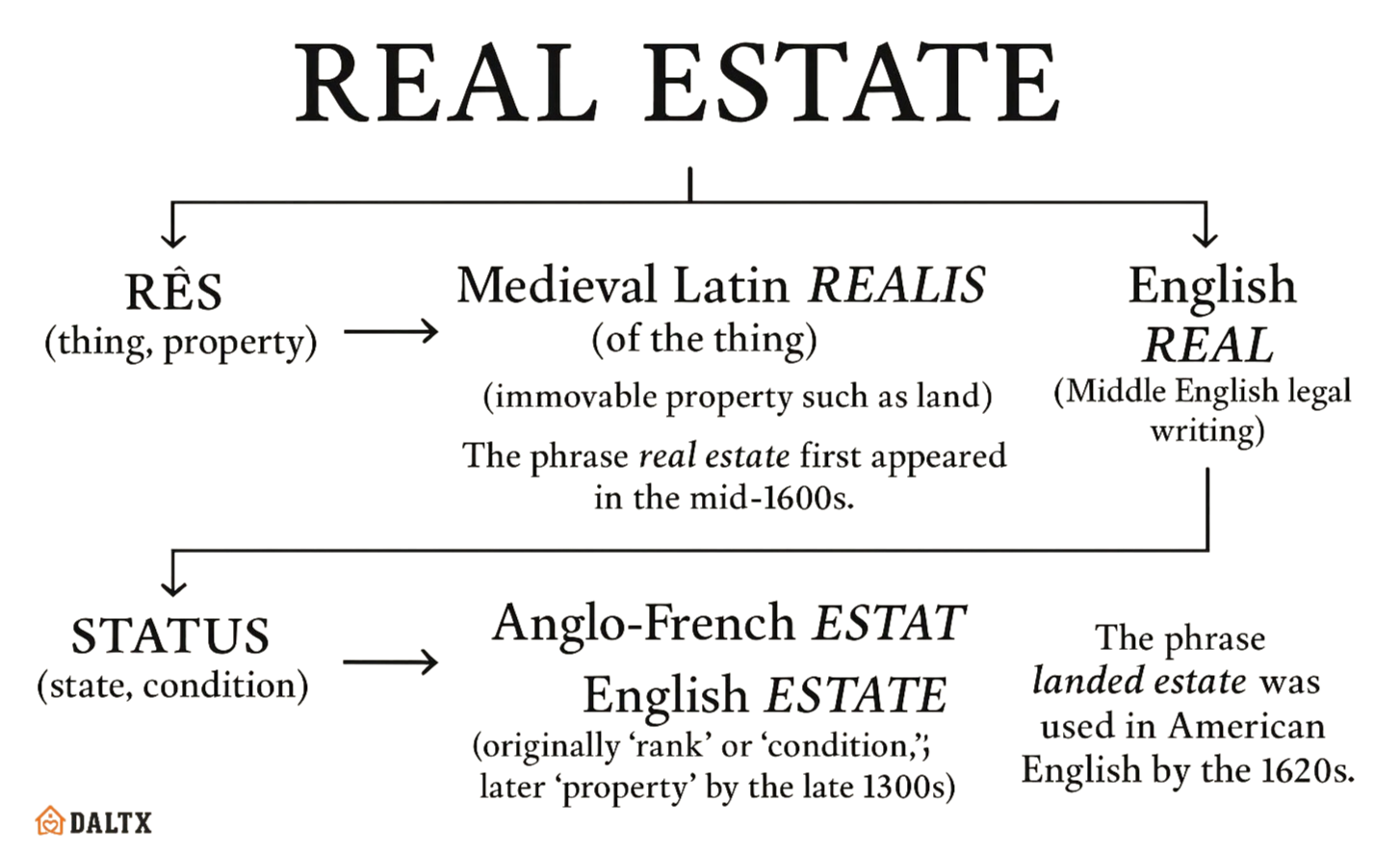
    • Real” comes from the Medieval Latin realis (“of the thing”), which itself comes from the Latin rēs (“thing” or “property”). In English legal writing dating back to Middle English, real referred to “things” in the legal sense, especially immovable property like land, as opposed to personal (movable) goods. The exact phrase real estate first appeared around the mid-1600s.1
    • Estate” comes from the Anglo-French estat, which comes from the Latin status meaning “state” or “condition.” In English, it originally meant “rank” or “condition,” and by the late 1300s, it also came to mean “property.” The phrase “landed estate” was already used in American English by the 1620s.2

    The earliest recorded use of “real estate” dates back to the mid-1600s. Merriam-Webster lists its first known use around 1642, while the Online Etymology Dictionary traces it to the 1660s. Either way, the term clearly entered English in the 1600s and has kept its legal tone ever since.3

    The Main Types of Real Estate

    Understanding the different categories helps you compare apples to apples when buying, investing, or analyzing the market.

    • Residential: Includes single-family homes, townhomes, condos, duplexes, triplexes, fourplexes, and manufactured homes.
    • Commercial: Covers offices, retail spaces, hotels, and other properties that mainly generate business income.
    • Industrial: Includes warehouses, distribution centers, manufacturing facilities, and flex spaces.
    • Land: Refers to raw land, infill lots, farmland, and parcels set aside for future development.
    • Special purpose & mixed‑use: Properties like self-storage facilities, medical and educational buildings, or developments that combine residential, retail, and office spaces.

    How Real Estate Really Works

    To understand real estate, it helps to start with what actually drives value in the market.

    What Actually Drives Property Value

    Three big levers influence property values:

    1. Location & land use: Zoning, school districts, commute times, and neighborhood amenities.
    2. Supply and demand: How many homes are for sale or lease versus the number of qualified buyers or tenants.
    3. Money & macroeconomics: Mortgage rates, employment, local growth, insurance costs, and property taxes.

    Who’s Involved When You Buy a Home

    • You and the seller
    • Real estate agents/brokers representing each side
    • A lender (if you’re financing) and an appraiser
    • A home inspector and sometimes specialists (e.g., roof, sewer)
    • A title/escrow company or real estate attorney (varies by countries and state)

    The Step-by-Step Purchase Timeline

    1. Budget and preapproval
      Get preapproved to understand how much home you can afford and to make your offer stronger.
    2. Home search & pricing
      Your agent will use comparable sales (comps) and a Comparative Market Analysis (CMA) to help you decide on a fair offer price.
    3. Offer, earnest money & contingencies
      Your written offer usually includes an earnest money deposit (typically around 1–3% of the purchase price) and contingencies for financing, appraisal, and inspection. The home inspection contingency gives you time to inspect the property and renegotiate or cancel if serious issues surface. This window is usually 7–10 days, as agreed in the contract.
    4. Appraisal & underwriting
      The lender orders an appraisal to confirm the property’s value. Meanwhile, underwriters review your income, assets, debts, and details about the property before final approval.
    5. Title search & escrow (two meanings)
      • Escrow in the transaction: A neutral third party holds funds and documents and coordinates closing once the title is cleared.
      • Escrow account for taxes/insurance: After you buy the home, many lenders collect part of your annual property taxes and homeowners insurance with each mortgage payment, then pay those bills for you. Some borrowers who qualify can request an escrow waiver and handle those lump-sum payments themselves, though eligibility, fees, and rules vary by lender, loan type, state law, and borrower profile.
    6. Closing
      You’ll sign the final documents, pay your closing costs and down payment, and get the keys once the transaction is officially recorded.

    Paying for Your Home and the Help That May Be Available

    • Conventional, FHA, VA, USDA and other mortgages are common choices. Some lenders and programs allow down payment assistance (DPA) through grants or second‑mortgage options (forgivable, deferred, or low‑interest), or matched‑savings programs, to help cover your down payment and/or closing costs. Many programs look for a minimum credit score (often ~620), income limits, and completion of a home buyer education course; specifics differ by state and program.
    • After you build equity, some owners tap a home equity line of credit (HELOC) for renovations or debt consolidation. Many HELOCs offer a draw period followed by a repayment period, and some lenders provide options to fix the rate on a portion of what you draw, useful when rates are rising. Remember: your home is collateral, so borrow carefully.

    Real Estate as an Investment

    Real estate can provide cash flow, appreciation, and potential tax benefits, but it also comes with market, maintenance, and regulatory risks.

    Here are common ways Americans invest, from hands‑on to fully passive.

    Hands-On Ways to Invest

    • Buy‑and‑hold rentals (single‑family or small multifamily)
      You purchase a property and rent it to long‑term tenants. Key metrics:
      • Net Operating Income (NOI) = rent & other income − operating expenses (excluding mortgage).
      • Cap rate = NOI ÷ purchase price.
      • Cash‑on‑cash return = annual pre‑tax cash flow ÷ total cash invested.
        Quick example: If rent is $2,200/month, annual gross rent is $26,400. After a 5% vacancy allowance ($1,320) and $8,000 in annual expenses, NOI is $17,080. On a $280,000 purchase, the cap rate is about 6.1%.
        If you buy a property with tenants in place, you’ll step into landlord duties immediately and must honor existing leases and local landlord‑tenant laws; rent control or “just cause” rules in some areas may limit rent increases or eviction without cause.
    • Short‑term rentals (STRs) / Airbnb
      STRs can earn a higher nightly rate than long‑term leases, but occupancy is less predictable and operating costs (furnishings, utilities, cleanings, property management) are higher. Expect more day‑to‑day involvement and be sure you understand local STR rules before you buy.
    • House hacking
      Live in one unit and rent out the others (or rooms) to offset the mortgage. It’s a popular on‑ramp to investing.
    • Fix‑and‑flip / BRRRR (Buy, Rehab, Rent, Refinance, Repeat)
      You add value through renovations. Success hinges on accurate ARV (after‑repair value) estimates, rehab budgets, holding cost assumptions, and a realistic timeline.
    • Foreclosures and REOs
      You can buy at auction (generally as‑is and often cash‑heavy) or purchase bank‑owned (REO) homes through agents after they don’t sell at auction. Preforeclosures and short sales are additional paths, though lender approvals can lengthen timelines. With any distressed property, insist on a careful inspection when possible and budget for repairs.
    • Tax lien investing
      Instead of buying the house, you may purchase a tax lien certificate when an owner falls behind on property taxes. The investor pays the delinquent taxes and then collects repayment (plus interest/penalties) from the owner, or in rare cases, by foreclosing if the owner doesn’t redeem in time. Rules, rates, and timelines vary widely by state, and due diligence is critical.
    • Partnerships and small syndications
      Partnering lets you combine cash, credit, skills, and time. It can also split profits and introduce differences in work styles, so set roles and expectations in writing. You’ll find potential partners via local investor clubs, online communities, crowdfunding platforms, and your professional network.

    More Passive or Low-Maintenance Options

    • REITs (Real Estate Investment Trusts)
      Public or private companies that own or finance real estate; investors buy shares and receive dividends.
    • MBS (Mortgage‑Backed Securities)
      Bonds backed by pools of mortgages; investors earn from borrowers’ payments. Like all bonds, MBS carry interest‑rate and credit risks.
    • Crowdfunding & real estate funds
      Platforms pool investor capital into specific projects or portfolios; read the fine print on fees, lockups, and sponsor track records.

    Financing and Managing Risk as an Investor

    • Financing: Investment properties often require larger down payments and stronger reserves than primary homes. If you’re buying a personal residence, down payment assistance may help you bridge the gap; confirm that your lender works with the program you’re targeting and review whether funds are a grant or a second loan (forgivable, deferred, or amortizing).
    • Due diligence: Use inspections, rent rolls, service records, and a title review to avoid surprises. If you waive the inspection contingency (common in auctions), build in a bigger repair budget.
    • Landlord‑tenant law & leases: Honor current leases when you buy a property with tenants; understand notice periods, just‑cause rules, and local limits on rent increases. Plan for vacancy and CapEx.
    • Operations & sustainability: Strategic “green” upgrades like energy-efficient HVAC systems, better insulation, solar, and water‑saving fixtures, can lower expenses and may qualify for energy‑efficient mortgage options or tax credits, depending on your loan and location.
    • Cash management: Decide whether to keep an escrow account for taxes/insurance or request an escrow waiver (if eligible) and save for those bills yourself; weigh convenience versus control and any waiver fees.
    • Capital for improvements: Some owners tap a HELOC to fund renovations; compare fixed‑rate locks versus variable draws and confirm fees and conversion rules before you borrow.

    Common Terms Every Buyer, Seller, and Investor Should Know

    [table id=3 /]

    Smart Upgrades: Sustainability and Resilience

    Green upgrades aren’t just about doing the right thing; they can also improve comfort and cut operating costs. Owners frequently pursue solar panels, high‑efficiency HVAC, better insulation/windows, or water‑saving systems.

    Depending on your loan type and where you live, energy‑efficient mortgage options and federal/state incentives may help pay for qualifying improvements.

    Bottom Line

    Learn the process, set a budget, and surround yourself with pros like your agent, lender, and inspector. If you’re planning to invest, it’s also smart to have a dependable contractor and property manager on your side. Go for the type of property and investment style that fit your timeline, how much risk you’re okay with, and what you want for cash flow.

    Once you’ve got a solid plan and you actually understand terms like escrow, contingencies, and NOI, you’ll feel way more confident making decisions in today’s housing market.

    1. Source: etymonline ↩︎
    2. Source: etymonline ↩︎
    3. Source: Merriam-Webster ↩︎
  • Turning Military Service Into Multi-Unit Property Ownership

    Turning Military Service Into Multi-Unit Property Ownership

    When veterans return from service, many find themselves navigating a new battlefield, which is the challenge of civilian life. One of the most empowering transitions a veteran can make is moving from renting to owning, and for those with a vision for financial stability and long-term wealth, purchasing a multi-unit property can be a powerful step. What many veterans don’t realize is that they may be able to take that step with no money down.

    Owning a multi-unit property isn’t just about having a place to call home. It’s also about creating a passive income stream and taking charge of your financial future. For veterans, the opportunities are even better than for most people.

    Just like an individual took advantage of a purchasing a duplex, living in one unit and then years later, having the property quadruple in value.

    The VA Loan Advantage – More Than Just a Single Family Home

    The U.S. Department of Veterans Affairs (VA) loan is one of the most powerful tools available to eligible service members, veterans, and some surviving spouses. The hallmark of the VA loan is the ability to purchase a home with a zero-down payment and no private mortgage insurance (PMI). One point that’s often overlooked is that the VA loan isn’t just for single-family homes.

    Many are unaware that VA loans can be used to purchase properties with up to four residential units, as long as the veteran intends to live in one of them. That opens the door to acquiring a duplex, triplex, or even a fourplex with no down payment required.

    Think about what that means in practice. A veteran could purchase a fourplex, live in one unit, and rent out the other three. The rental income from those units could potentially cover the mortgage, taxes, insurance, and even provide additional cash flow. It’s a classic real-estate investing strategy called “house hacking,” and the VA loan makes it uniquely accessible to veterans without needing to first accumulate tens of thousands of dollars in savings.

    Requirements and Realities

    Of course, there are still rules and requirements. The property’s gotta be your primary residence, meaning you’ll need to live in one of the units for at least a year. It also has to pass the VA appraisal for safety, livability, and resale value.

    Another important consideration is debt-to-income ratio (DTI). While the VA is generally flexible compared to conventional lenders, a veteran’s DTI still needs to be within acceptable limits.

    If you’re purchasing a multi-unit property and can show that it will generate rental income, that income can be used to help qualify for the loan. VA guidelines allow a portion of the projected rental income from the other units to be counted toward your income, which may help you qualify for a larger loan amount.

    This gives veterans a strong foundation for entering the world of real estate investing, allowing them to live affordably while building equity in a property that also generates income.

    Already Own a Home? There’s Another Path

    What about veterans who already own a primary residence? 

    This is where alternative financing options come into play. One of the most relevant tools for veterans (or anyone) looking to grow their real estate portfolio is the Debt Service Coverage Ratio (DSCR) loan.

    Unlike traditional mortgages that focus on tax returns, pay stubs, and employment history, a DSCR loan looks at the property’s income potential. If the projected rent covers the monthly mortgage (usually a DSCR of 1.0 or higher), you’re in business, even without W-2 income.

    For veterans who already have a home but want to build a rental portfolio, this can be a game changer. It opens the door to buying single-family rentals or multifamily properties without jumping through all the hoops of conventional lending. That’s especially valuable for vets who are retired, self-employed, or relying on pension income.

    Building Wealth with a Mission

    For many veterans, there’s a desire not just to live securely but to thrive. That starts with financial freedom. Real estate is one of the most proven vehicles for building long-term wealth, and veterans have a serious head start thanks to the VA loan.

    Imagine a scenario where a veteran purchases a four-unit property with no down payment. They move into one apartment, rent out the other three, and within a few years have built up equity, improved the property, and perhaps even used the income to fund another investment. Thanks to the VA loan, and later shifting into DSCR or other investor-friendly financing, that same veteran can move from simply living in the property to owning a portfolio of them over time.

    Points to Keep in Mind

    • Do your homework on the local rental market. Not all multi-unit properties are good investments.
    • Partner with a lender and real estate agent who understand VA loans and DSCR loans. Experience matters.
    • Factor in maintenance and vacancies. Even with multiple units, there will be unexpected costs and income gaps.
    • Get preapproved early so you understand your borrowing power and what properties make sense for your situation.

    Veterans have given so much through their service. It’s only fitting that they have access to tools that help them create stable, prosperous futures. Whether it’s buying a fourplex to live in with no money down or leveraging rental income through a DSCR loan for an investment property, the pathway to real estate success is wide open.

    The first step is recognizing that these opportunities exist and then taking action. With the right strategy and support, real estate can become more than a dream for veterans, and turn into a reality that pays dividends for decades to come.

  • What Is Real Estate Crowdfunding and How Does It Work in the UAE?

    Source: linkedin.com

    The UAE’s property landscape has gone through a noticeable shift. For a long time, getting into real estate here meant needing a lot of capital and, in many cases, connections. But that’s changing. With the rise of licensed crowdfunding platforms and a more flexible investment model, people now have a way to enter the market without having to buy a full property on their own.

    This setup allows multiple investors to contribute smaller amounts toward the purchase of high-value properties—residential or commercial. In return, they each get a share of the returns, whether that’s rental income or gains from a future sale. Some platforms let you start with as little as AED 1,000, which puts ownership of premium UAE real estate within reach for a much wider group of people.

    Real estate crowdfunding doesn’t replace traditional ownership, but it gives you an alternative, one that’s passive, lower-risk, and managed professionally. And because the platforms are regulated, there are safeguards in place to protect your money and keep the process transparent from start to finish.

    If you’re looking for a way to build long-term wealth through real estate, and want something more flexible than buying a unit outright, this model might be worth a closer look.

    Understanding Real Estate Crowdfunding in the UAE

    In simple terms, real estate crowdfunding gives you a way to invest in property without having to buy the whole thing yourself. Instead, a group of investors, maybe dozens or even hundreds, pool their money together to purchase a property, and each one owns a small portion.

    You won’t be getting the keys to a front door, but your name will still be tied to the investment. That’s because your share is recorded through a structure set up specifically for this purpose.

    Once a property is fully funded, the platform usually forms a Special Purpose Vehicle, often called an SPV. This legal entity is what actually holds the property title.

    All of this happens through platforms that are regulated locally. In the UAE, that means oversight from authorities like the Dubai Land Department or the DFSA, depending on where the platform is based. So while you may never set foot in the unit, your share and your rights are protected.

    What makes this model appealing for a lot of people is how hands-off it is. You’re not the one dealing with tenants, calling plumbers, or collecting rent checks. The platform does all of that. Your job, really, is to choose the property, make the investment, and track how it performs. Everything else runs in the background.

    How the Crowdfunding Process Works

    Source: coretitle.com
    1. Platform Onboarding
      You begin by signing up on a regulated real estate crowdfunding platform. This includes submitting your identity and financial documentation for KYC and AML compliance. The platform will also assess your risk profile to match you with suitable investments.
    2. Property Listings and Investment
      Once approved, you can browse investment opportunities across different asset types, luxury villas, branded residences, commercial towers, and more. Each listing includes a detailed breakdown of the property, rental yield projections, location analytics, and legal documents.
    3. Special Purpose Vehicle (SPV) Formation
      When enough capital is raised, the platform sets up an SPV to purchase the property. This legal entity holds the title, ensuring transparency and safeguarding your ownership rights.
    4. Returns and Portfolio Management
      As a shareholder in the SPV, you’ll receive quarterly or annual income distributions, depending on the platform’s model. You’ll also be able to monitor your portfolio’s performance through a dashboard showing earnings, occupancy rates, and property value trends.
    5. Exit Options
      Some platforms offer secondary markets where you can resell your shares before the investment term ends, giving you greater flexibility than traditional real estate investing.

    Key Benefits of Crowdfunded Real Estate in the UAE

    • Lower Entry Point: Buying into Dubai’s real estate scene used to mean setting aside a large chunk of money. For most people, that just wasn’t realistic. But crowdfunding changes that. You don’t need to come in with hundreds of thousands, some platforms let you start with just a few thousand dirhams. It’s a way to get in early, even if your budget is modest, and gradually grow your exposure as you go.
    • Portfolio Diversification: Instead of putting all your money into one unit in one location, this model lets you spread things out. You could have a small share in a luxury apartment downtown, part of a commercial property near the marina, and maybe even a short-term rental somewhere more tourist-focused. That kind of variety helps reduce risk if one sector or area cools down.
    • Professional Oversight: You don’t need to be a landlord, and you won’t be managing tenants or chasing rent. That’s handled by the platform, along with property maintenance, legal paperwork, and financial reporting. It’s a passive setup, which makes it a lot easier to stay invested without turning it into a second job.
    • Regulatory Safeguards: Since platforms are licensed and work under UAE regulations, you’re not just handing over your money blindly. There are rules in place, around transparency, data, and reporting, that are meant to keep things fair and clear. You’ll get updates on performance and know exactly where your money’s tied up.
    • Improved Liquidity: Traditional real estate often means waiting years for a sale before you see any returns. Some crowdfunding platforms now give you an option to exit earlier by selling your shares to another investor. It’s not guaranteed or instant, but it’s a welcome option if you want more flexibility with your timeline.

    Legal and Regulatory Considerations

    Real estate crowdfunding in the UAE operates under a robust legal framework:

    • Platform Licensing: All platforms must be licensed by the DFSA or similar bodies and undergo regular audits.
    • Escrow and SPV Use: Your funds go into escrow and are only released once the investment target is met. The SPV model ensures your share of ownership is clearly defined.
    • Ongoing Reporting: Platforms are required to provide regular updates on investment performance, financials, and property health.

    This framework ensures that your interests as an investor are protected while supporting a transparent market environment.

    The Future of Real Estate Crowdfunding in the UAE

    Source: metavsummit.com

    The sector is evolving rapidly, with three key trends driving growth:

    • Smart Technology Integration: Platforms are leveraging AI, blockchain, and predictive analytics to identify high-performing properties, automate operations, and enhance transparency.
    • Wider Market Access: The UAE is attracting more international investors seeking exposure to high-yielding Middle Eastern assets. As a result, crowdfunding platforms are expanding their portfolios across Dubai, Abu Dhabi, Sharjah, and Ras Al Khaimah.
    • Regulatory Innovation: Authorities are actively updating policies to encourage fintech innovation while ensuring investor security. Expect new frameworks that support tokenization, secondary markets, and cross-border investing.

    Getting Started with Real Estate Crowdfunding

    Thinking about getting into real estate crowdfunding? Start by checking out a few platforms, not just the first one you see. You’ll want to make sure they’re licensed to operate in the UAE, of course, but also take a look at how long they’ve been around. If a platform’s been through a few market cycles and still going strong, that usually tells you something..

    A solid track record goes a long way in giving you peace of mind before you commit your money. Dig into how they work, how transparent their fee structure is, and whether the dashboard makes it easy for you to keep an eye on your money.

    What you’re doing here isn’t just buying into a property, it’s positioning yourself to earn from one of the most active real estate markets in the region. The added benefit? You’re doing it without the typical headaches that come with being a landlord.

    And since many of these platforms are designed to make onboarding easy, your entry point might be lower than you expect. With the right research and a bit of planning, you could be just a few clicks away from starting your first investment and laying the groundwork for longer-term growth.

  • Condos As An Entry Point To Real Estate Investing

    Entering the real estate market can feel like navigating a maze, especially for first-time investors seeking a balance between profitability, practicality, and lower risk. Often overlooked in favor of single-family homes or commercial property, condominiums provide a more accessible starting point with lower upfront costs, easier maintenance, and access to high-demand locations.


    Photo by allPhoto Bangkok on Unsplash

    Yet within the broader condo category lies an often more profitable subset: luxury condominiums. High-end units can deliver premium rental yields, capital appreciation, and prestige that attracts discerning tenants or buyers.

    The Value Proposition Of Luxury Condominiums

    Luxury condominiums stand apart as a class of their own—designed not just for comfort but as vehicles of status, exclusivity, and solid returns in select markets.

    High Demand In Prime Locations

    Luxury condos are typically located in prime urban centers, waterfronts, or prestigious enclaves—places where land scarcity boosts value. In cities like Miami, Toronto, New York, and Dubai, these properties remain in high demand among international buyers and high-income tenants. 

    This persistent demand contributes to lower vacancy rates and stronger rental income. For new investors, acquiring a one-bedroom luxury unit in a rising neighborhood may cost less than a detached home while still offering excellent cash flow potential.

    Amenities That Justify Premium Pricing

    From rooftop pools and concierge services to spa facilities, co-working spaces, and biometric security systems, luxury condos justify their elevated pricing by offering a complete lifestyle. 

    These amenities not only attract renters, but also help maintain strong resale value and reduce seasonal vacancy—offering long-term advantages for investors in cities with year-round demand.

    Entry Flexibility For Investors

    Many luxury condos are available in buildings that allow short-term rentals or extended stays, letting investors experiment with different rental strategies—from monthly executive leases to Airbnb-style bookings. 

    This flexibility is particularly valuable in uncertain markets, where the ability to pivot rental models can protect income streams. Some developments even offer rental programs managed by in-house teams, reducing the burden for remote or first-time investors.

    Why Condos Are A Practical Starting Investment

    Not every investor starts with a luxury unit. While high-end condos offer prestige and strong returns, standard condominiums remain a more accessible first step, combining lower costs with long-term growth opportunities.

    Lower Cost Of Entry Compared To Other Property Types

    In most markets, condominiums are significantly more affordable than detached homes or multifamily buildings. For instance, in metro areas like Dallas or Houston, condos can cost 20–40% less than similarly located houses. 

    This makes them attractive to younger investors with limited capital or those seeking to diversify existing portfolios with minimal risk exposure. Lower down payments and shared maintenance expenses via homeowner association (HOA) fees allow new entrants to get started without the overhead of traditional property ownership.

    Streamlined Maintenance Responsibilities

    HOAs handle major exterior maintenance, landscaping, and often include services like trash removal, snow clearing, and even building insurance. While HOA fees can be high, they eliminate the hassle and cost of managing multiple service providers. 

    For a first-time investor, this simplicity removes many of the day-to-day burdens that come with self-managed properties, allowing focus on tenant satisfaction and rental returns.

    Built-In Community Regulations Reduce Risk

    Condos typically come with community guidelines and financial rules that create a more stable environment. These covenants limit undesirable behavior, help preserve property values, and may even restrict the number of rental units per building—ensuring a balanced mix of owners and tenants. 

    This creates a more predictable environment for income and appreciation. In markets like Vancouver and Singapore, strict condo rules have actually helped prevent rental market crashes during economic downturns.

    Risks To Watch For When Investing In Condos

    Despite their appeal, condos aren’t a risk-free investment. First-time buyers should be vigilant about several key factors.

    HOA Health And Special Assessments

    While HOAs simplify ownership in many ways, they’re not without risk. Poor management, rising fees, or surprise assessments can significantly affect returns. HOA fees can eat into returns, especially if they increase over time or are mismanaged.

    Investors should carefully review the HOA’s financials, reserve funds, and history of special assessments, unexpected charges for large repairs or upgrades like elevator replacements or roof fixes. A poorly funded HOA can destabilize your investment or even lead to legal disputes between owners.

    Rental Restrictions

    Some condominiums limit or prohibit rentals entirely. Others allow rentals only after the owner has occupied the unit for a certain period, which can delay returns. Before purchasing, it’s essential to understand the community’s rental policy. 

    Failing to do so could result in an asset you can’t legally monetize. Look for “investor-friendly” buildings—those with a transparent rental policy and a significant percentage of investor-owned units.

    Market Liquidity And Resale Challenges

    Condos, particularly in overbuilt markets, can be harder to resell quickly compared to freehold homes. Units within large developments may also compete with identical floor plans and layouts, making it harder to differentiate your property. 

    When considering resale, buyers should factor in not just the unit’s features but also the building’s reputation, location trends, and upcoming developments in the area.

    Photo by Francesca Tosolini on Unsplash

    Tips For Maximizing ROI On A Condo Investment

    Understanding how to extract the most value from a condo investment will separate casual speculators from serious portfolio builders.

    Target Buildings With High Owner-Occupancy Rates

    Buildings with a high percentage of owner-occupied units tend to be better maintained and experience less tenant turnover. This can reduce wear and tear and attract better renters. Lenders also favor these buildings, which can be critical if you plan to refinance or use equity for future investments.

    Optimize The Rental Strategy For The Location

    In urban areas near universities or hospitals, long-term rentals may perform better. In tourist-heavy locations like coastal cities or ski towns, short-term rentals may yield higher income despite greater management complexity. 

    Understanding the neighborhood’s demographics, transit options, and economic drivers will help you select the right unit and tailor your rental approach accordingly.

    Buy Into Emerging Neighborhoods

    The best ROI often comes not from the most glamorous zip codes but from the ones gaining momentum. Look for signs of gentrification: new cafes, transit lines, infrastructure upgrades, or school district improvements.

     A condo bought in an emerging area can appreciate rapidly while still being affordable. Investors who get in early benefit from rising rents and resale prices driven by neighborhood transformation.

    Photo by Nadine E on Unsplash

    Endnote

    When chosen wisely, condominiums offer more than just a way in. They provide a path toward long-term wealth, reliable income, and a portfolio that grows with you. For many investors, they’re not the end goal, but the beginning of something much bigger.

  • Property Management Mistakes to Avoid in Florida’s Competitive Rental Market

    Managing rental properties in a fast-moving, high-demand market like Florida can be incredibly rewarding, but also full of pitfalls for those who aren’t prepared. With rising rents, an influx of new residents, and increased competition, the stakes are higher than ever. A few missteps in your management approach can lead to costly consequences, from tenant turnover to legal trouble.

    Whether you’re a seasoned investor or a first-time landlord, here are the most common property management mistakes to avoid, and how to set your rental business up for long-term success.

    1. Poor Tenant Screening

    A property manager carefully reviewing tenant screening documents.

    It’s easy to rush when a unit’s sitting empty, especially in a hot market. But screening tenants too quickly is where many landlords go wrong. A single bad fit can lead to missed rent, damaged walls, or even costly evictions.

    Instead, slow down and do it right. Run background checks. Look at credit. Verify employment. Talk to past landlords. Yes, it takes time, but it’s time well spent. Finding the right tenant now is always better than dealing with the wrong one later.

    2. Ignoring Preventative Maintenance

    Technician performing routine maintenance on rental property.

    Putting off maintenance might seem harmless in the moment, but it usually ends up costing more—both in repairs and in tenant satisfaction. People notice when things are neglected, and that can be the difference between a lease renewal and a moving truck.

    Schedule regular inspections, create a seasonal maintenance checklist, and address small issues before they turn into major problems. Not only will this preserve the value of your property, but it will also build trust with tenants.

    3. Failing to Understand Local Laws and Regulations

    Florida has specific landlord-tenant laws that protect both parties, and failure to comply can result in fines or lawsuits. From security deposit handling to notice periods and fair housing requirements, you need to know the rules.

    What to do instead:
    Stay up to date on state and municipal regulations or hire MAGASI Management for a knowledgeable property management company that does. Legal missteps can be more than just inconvenient, they can be financially devastating.

    4. Overpricing or Underpricing Units 

    Setting the wrong rent can result in extended vacancies or lost revenue. It’s a delicate balance: set the rent too high, and you risk driving away potential tenants; set it too low, and you leave money on the table.

    To make informed decisions, conduct a thorough market analysis. Consider factors such as property size, amenities, location, and current rental rates of comparable units. While online tools provide useful data, local market knowledge often offers a significant advantage.

    5. Treating Property Management as Passive Income

    Landlord managing rental property with the help of a property management company.

    Yes, rental income can be passive, but only if the systems behind it are solid. Many landlords underestimate the time and attention it takes to manage leases, respond to tenant requests, and keep financials in order.

    If you’re managing on your own, build out processes and stay organized. If you’d rather be hands-off, hire a reliable property management company that can handle everything from rent collection to tenant communications.

    Final Thoughts

    Florida’s rental market is full of opportunity, but it rewards those who are proactive, knowledgeable, and detail-oriented. By avoiding these common property management mistakes, you’ll not only protect your investment but also enhance tenant satisfaction and maximize returns. Smart management isn’t just about keeping up, it’s about staying ahead.

  • 7 Smart Tips For Finding An Investment Property in North America

    Real estate can be a great way to build long-term wealth—if you know what you’re doing. Whether you’re eyeing your first rental or adding to a growing portfolio, picking the right property matters. North American markets, ranging from major cities like Toronto, Vancouver, New York, and Los Angeles to emerging mid-sized communities, offer a variety of opportunities, but also come with risks and complexities.

    So how do you avoid a money pit and find a place that actually fits your goals and your budget? Here are seven practical tips to help you make a smarter move.

    1. Define Your Investment Goals

    Before you even begin your property search, clearly define what you’re hoping to achieve. Are you looking for steady cash flow through monthly rent, long-term appreciation, or perhaps a fix-and-flip opportunity?

    Your goals will determine the type of property you should focus on:

    • Cash Flow: Multi-family homes or properties in high-rent-demand areas.
    • Appreciation: Up-and-coming neighborhoods with strong development potential.
    • Fix and Flip: Properties that are undervalued and need cosmetic or structural renovations.

    Understanding your “why” will help you stay focused and avoid making emotionally driven decisions.

    2. Research Local Markets

    Not all real estate markets are created equal. Look beyond your immediate neighborhoods or city and research various North American markets that align with your goals. Some key factors to evaluate include:

    • Population growth: Are more people moving in or moving out?
    • Jobs: Are new businesses popping up, or is the local economy slowing down?
    • Rental demand: Are units sitting empty, or getting snapped up fast?
    • Price-to-rent ratio: Does the rent actually justify the price tag?
    Source: news18.com

    Online tools like Zillow, Realtor.com, and regional MLS (Multiple Listing Service) platforms offer valuable data. Also, consider networking in investor forums or attending local real estate investment meetups to gather firsthand insights.

    3. Build a Reliable Team

    One of the most underrated but essential components of property investing is having a dependable team. Even if you’re experienced, having professionals in your corner can streamline the process and protect you from costly mistakes.

    Key team members might include:

    • A trusted realtor who understands investment properties, local zoning laws, and emerging neighbourhoods.
    • A mortgage broker who can offer flexible financing options.
    • A property manager, if you’re investing out of town or prefer hands-off management.
    • An attorney familiar with local real estate laws and tenant regulations.

    A trustworthy team will help you make smarter decisions faster and with greater confidence.

    4. Do the Math—Twice

    Successful investing is rooted in the numbers. Before making an offer on a property, perform a thorough financial analysis. Use conservative estimates to account for unforeseen expenses and market fluctuations.

    Key numbers to calculate:

    • Cash flow: Monthly rent minus all expenses (mortgage, taxes, insurance, maintenance, etc.)
    • Cap rate: Net operating income divided by property value.
    • ROI (Return on Investment): Profitability in relation to your initial cash investment.

    Also, factor in vacancy rates and repair reserves to get a more realistic view of potential returns.

    5. Start with a Modest First Investment

    If you’re new to real estate investing, start small. Jumping into a big project or an expensive multi-unit property right away can be risky. A single-family home or a duplex can be a manageable starting point.

    Starting modestly lets you learn the ropes—tenant screening, rent collection, maintenance issues—without overwhelming yourself financially or emotionally.

    You can always scale up as you gain more experience and confidence in managing investment properties.

    6. Inspect Thoroughly Before Buying

    Never skip the inspection. A property may look good on the surface, but structural issues, outdated electrical systems, or plumbing problems can turn your investment into a money pit.

    Hire a certified home inspector to evaluate:

    • Foundation and roof condition.
    • HVAC, electrical, and plumbing systems.
    • Pests or water damage.
    • Safety hazards or code violations.

    This upfront diligence could save you thousands of dollars down the line—and even help you negotiate a better deal.

    7. Have an Exit Strategy

    Smart investors always plan for the unexpected. Market conditions can shift, personal circumstances may change, or a neighborhood may stop appreciating. Before you buy, consider how easily you could sell or repurpose the property if needed.

    Some common exit strategies include:

    • Selling the property after appreciation.
    • Refinancing to pull out equity.
    • Converting a short-term rental to a long-term lease.
    • 1031 exchange (in the U.S.) to defer capital gains taxes by reinvesting.

    Knowing your options in advance allows for more strategic decision-making under pressure.

    Source: linkedin.com

    Real estate investment isn’t about luck—it’s about research, strategy, and execution. By setting clear goals, understanding your market, working with a trusted realtor, and crunching the numbers carefully, you’ll be in a strong position to make informed, profitable decisions.

    Every successful investor started somewhere, and with these practical tips, you’ll be better equipped to navigate the competitive North American property market. Stay informed, remain patient, and always keep learning—the real returns come not just from properties, but from the experience you gain with each investment.

  • Top Tips for Renting Out Your Spare Room for the First Time

    If you’ve got a spare room at home, why not rent it out and make some extra money on the side? Maybe it used to be your “home office,” which now just holds a defunct printer and a graveyard of tangled cords. Or maybe it’s the guest room that hasn’t seen a guest since pre-pandemic life. Either way, you’ve looked at that space and thought, “Shouldn’t this be doing something useful?

    You’re not wrong.

    In a country where mortgage rates have been dancing like they’re on something, and rents in many cities are outpacing paychecks, homeowners are getting scrappy. A 2025 Eye on Housing report found that over one-third of U.S. adults have lived in a shared household at some point—and the number’s trending up. Means.. shared housing isn’t just a last resort anymore. It’s becoming a financial strategy.

    But don’t let HGTV fool you—renting out a spare room is not as simple as tossing some throw pillows on the bed and waiting for passive income to roll in.

    Here’s what you actually need to know before you hand someone a key to your house.

    1. The Room Has to Look Like Someone Wants to Live There

    Imagine you show up to a hotel and the room smells like wet socks and looks like someone’s storage unit exploded. You wouldn’t stay there. So don’t expect a stranger to pay rent for your “spare” room if it feels like an afterthought.

    Here’s what to do before you even think about listing:

    • Clear out all personal junk. No one wants to sleep under your old diploma or next to a stack of tax returns from 2010.
    • Add fresh, neutral linens. Think “IKEA catalog meets minimal effort.”
    • Make sure it has the basics: a bed (that doesn’t creak like a haunted ship), a nightstand, a lamp, and a desk if you’ve got the space.
    • Install a lock on the door. This isn’t optional—it’s called respecting privacy.

    According to DALTX listings with clear, well-lit, clutter-free photos get 2.4x more inquiries. Why? Because people like living in clean places that don’t look like serial killer lairs. Shocking, right?

    2. Boundaries Are Sexy. Make Some

    Source: tenor.com

    You’re not just leasing space—you’re letting someone into your home. Your fridge. Your Netflix recommendations. Your weird Sunday routines. If you don’t lay out ground rules, you’re just setting the stage for passive-aggressive Post-it notes.

    Ask yourself:

    Are overnight guests cool? (Or only if they’re hot? Kidding. Kind of.)

    What’s your noise tolerance? Midnight blender? Acoustic guitar in the living room?

    Who’s scrubbing the bathroom—and how often?

    45% of roommate conflicts come from unclear expectations around chores, guests, or noise. That’s nearly half. Don’t wing it.

    Write the rules down. Share them upfront. It’s not about being a control freak—it’s about avoiding future drama.

    3. Choose the Right Platform (Hint: Not All Are Created Equal)

    So, you’re ready to list. Now where?

    Some of the options out there are solid. Others are like the Craigslist version of Russian roulette. Here’s the lowdown:

    • Facebook Marketplace/Groups: Free and fast but chaotic. Expect lots of “Is this available?” messages from people who vanish mid-sentence.
    • Craigslist: Still kicking, but scams abound. Don’t meet anyone unless it’s in public and during daylight hours.
    • SpareRoom.com: A rising favorite. Think Tinder but for roommates—except with ID checks and fewer shirtless mirror selfies.

    The National Multifamily Housing Council reports that more renters today prioritize security and transparency over price. That means your listing should feel legit—not sketchy

    4. Don’t Catfish Your Listing

    Yes, marketing matters. But don’t be the person who posts angelic, filtered photos of a “sun-drenched studio” that turns out to be a converted broom closet.

    Be upfront. Be boringly honest. Your listing should include:

    • Rent, due date, and what’s included (utilities, Wi-Fi, parking, etc.)
    • Clear photos of both the room and common areas
    • Move-in date and lease length (month-to-month? long-term?)
    • A short vibe check—are you quiet, social, a full-time gamer?

    A 2025 Zillow study found that renters were 3x more likely to engage with listings that had both photos and a personal description. Why? Because “$900/month – no weirdos” doesn’t exactly scream “warm and welcoming.”

    5. Screen Like You Mean It

    This isn’t just a roommate, it’s someone who’ll share your Wi-Fi, your bathroom, and maybe your cereal if you’re not careful.

    So yes, background checks, references, and gut instincts are fair game.

    Here’s how to keep it chill (but thorough):

    • Have them fill out a short questionnaire. Ask about lifestyle, work schedule, pets, allergies—basic “Can we live together without silently hating each other?” stuff.
    • Do a video or in-person chat. If anything feels off, trust that little voice in your head.
    • Use legit platforms like RentSpree or Avail to run background checks (with consent, of course).

    Our tip: The wrong person will cost you far more in stress than any “vacancy.” Take your time.

    6. Don’t Skip the Legal Stuff

    Just because it’s a room doesn’t mean you get to skip contracts. Verbal agreements and good vibes are not a legal safety net.

    You’ll need a simple lease that includes:

    • Rent amount, payment due date, and method
    • Security deposit details
    • Notice required to end the agreement
    • Rules around shared utilities, guests, or damages

    Depending on where you live, you might also need a permit or have zoning restrictions to deal with. For example, in New York City, it’s illegal to rent out a room for fewer than 30 days unless the host lives there too. Big cities have big rules. Check with your local housing authority—or better yet, an attorney.

    This Isn’t Just About Money

    Sure, the extra income’s great. In many cities, renting out a room can bring in $700 to $1,500+ a month, depending on location. That’s real cash for paying off debt, saving for renovations, or just surviving inflation.

    But it’s not just about money.

    It’s about using your space intentionally. About adapting to a housing market that’s shifting fast. And maybe—if you do it right—it’s even about building a more flexible, sustainable way of living.

    So clean up the room. Set some boundaries. Be honest. And maybe—just maybe!—your spare room will become the most valuable square footage in your house.

  • Is Dallas a Good Place to Invest in Real Estate?

    If you’re thinking about diving into the real estate market, Dallas should definitely be high on your list. This Texas powerhouse isn’t just growing—it’s booming. From rapid job creation to major population growth, Dallas is proving to be one of the hottest real estate markets in the U.S.

    There are plenty of opportunities to invest in all kinds of properties in this city. It’s a great fit for experienced investors or anyone just getting started. But why is Dallas the right place to put your money in real estate? Let’s get into it.

    Why Dallas Real Estate Keeps Getting Attention

    Dallas is one of the fastest-growing housing markets in the U.S. Here’s why:

    • Rapid Job Growth: Since 2020, job growth in Dallas has climbed over 11%—well above the national average. The city’s a major business hub, home to companies like Toyota, AT&T, Southwest Airlines, and 23 other Fortune 500 names. No surprise Dallas keeps expanding and catching the eye of more and more investors. As more businesses set up shop here, demand for housing—both rentals and homes for sale—continues to rise.
    • Massive Population Growth: The Dallas–Fort Worth metro area welcomed over 170,000 new residents in just one year, making it one of the fastest-growing regions in the U.S. More people means more demand for housing—and that spells more investment opportunity. It’s simple real estate math.
    • Still More Affordable Than Other Major Cities: The median home price in Dallas is approximately $399,000, not exactly low, but still well below what you’d pay in San Francisco, Los Angeles, or New York. For investors, this represents an ideal situation for saving, given the prospects for appreciation in value and rental income.

    Best Dallas Neighborhoods for Real Estate Investment

    Not every area of Dallas offers the same kind of potential, so it’s important to choose a neighborhood that aligns with your investment goals.Depending on what you’re looking for.

    • Highland Park: This is an upscale neighborhood, one of the most prestigious in Dallas. It’s a great place to invest in a luxury home or to target long-term appreciation.
    • Deep Ellum: Eclectic, artsy, and close to downtown. Ideal for short-term rentals, especially for younger renters and weekend visitors.
    • North Dallas: More of a suburban vibe—quiet, family-friendly, and relatively stable. Great for buy-and-hold rental properties.
    • Oak Lawn & Lower Greenville: Lively at night, walkable, and popular with young professionals and couples. Great for single-family homes or small multi-family investments.

    Also, don’t forget to consider things like upcoming developments, nearby school ratings, walkability, and planned infrastructure. All of these factors can have a major impact on your property’s value.

    In Summary, Dallas Has What Investors Are Looking For

    If you’re looking for a great place to invest in real estate, Dallas really does check all the boxes:

    ✓ Population is on the rise
    ✓ The economy is strong and diverse
    ✓ Home prices are still competitive compared to other major cities
    ✓ Rental demand is solid
    ✓ Potential for property appreciation is strong

    Whether you’re buying and holding, flipping, or building out a rental portfolio, Dallas is a market that can offer long-term upside for investors.

    Pro Tip: Landscaping is important everywhere, yet in such a competitive market as in Dallas, it can truly add worth to your home. Smart investors often turn to landscaping services not just for aesthetics, but for actual value. A well-maintained yard can improve curb appeal and help properties move faster—whether for sale or for lease. In fact, using landscaping services strategically can raise property value by 5–15%, with some upgrades offering up to a 100% return on investment.

  • How to Generate Passive Income with Real Estate in Cyprus (2025 Edition)

    Cyprus is a great spot for real estate investors looking to make passive income. The island has a strong tourism industry, solid real estate investments, and favorable tax laws, which offer plenty of opportunities for those wanting to earn passive income through rental properties, long leases, or house-flipping.

    Many investors are drawn to Cyprus because of its business-friendly environment, warm weather, and easy access to Europe. These factors appeal to tourists, expats, and digital nomads. The real estate market in Cyprus has been growing steadily every year, with high occupancy rates in coastal cities like Limassol, Paphos, and Larnaca, making it easier to get consistent rental income.

    Why Cyprus Real Estate is a Smart Choice for Passive Income

    Over the past decade, property prices in Cyprus have been steadily going up, thanks to tourists, retirees, and foreign professionals. In 2023, the country welcomed over 3 million tourists, with demand for short-term rentals hitting 80-90% occupancy during peak seasons.

    The tax benefits in Cyprus are really appealing. The country has low property taxes, no inheritance tax, and a relatively low tax rate on rental income. Plus, non-EU investors can get permanent residence through property investment, which makes the market even more attractive.

    Property Investment Strategies for Passive Income

    1. Short-term Rentals (Airbnb and Vacation Rentals)
    • Rentals in top tourist spots like Ayia Napa and Limassol can bring in an ROI of 10-12% per year.
    • However, this strategy needs active management or a property management service.
    1. Long-term Rentals for Expats and Retirees
    • A good option for investors wanting a steady income stream with an ROI of 5-7%.
    • Cities like Nicosia and Paphos are popular with expats and retirees.
    1. Buy-to-Sell (Property Flipping)
    • This strategy is suited for growing areas such as Larnaca and the suburbs of Limassol.
    • It’s important to think about renovation costs and the timing of the sale.

    Best Locations for High Rental Yields

    1. Limassol

    Limassol is the most developed city in the country and a business hub, with professionals, digital nomads, and high-income expats flocking to it. Rent can be expensive, but you get good value for your money. Short-term and long-term rentals are promising, especially for newly built apartments in the business district and near the marina.

    2. Paphos

    Paphos is in high demand for short- and long-term rentals among British and European retirees, with a steady stream of visitors throughout the year, making it a very promising market. Property in Paphos is cheaper than in Limassol, making it a great option for investors with a limited budget.

    3. Larnaca

    Larnaca offers more affordable property prices. The government is still investing in the infrastructure, which makes the property market prospect more favorable. Long-term investors can be enticed by the excellent profit opportunities in the property market in Larnaca.

    4. Ayia Napa & Protaras

    Famous for their stunning beaches and vibrant nightlife, Ayia Napa and Protaras are top destinations for seasonal travelers. Short-term rentals here can be highly profitable, especially during peak season. While occupancy rates tend to drop in winter, peak season earnings are usually enough to cover operating costs for the entire year.

    Investment Risks and How to Minimize Them

    1. Seasonal Fluctuations: Choose locations with strong year-round rental demand.
    2. Maintenance and Management Costs: Hire a reliable property management service.
    3. Economic and Market Trends: Invest in well-established areas with consistent demand.

    Conclusion:

    Cyprus is a great option for investors looking to earn passive income in real estate. From affordable property prices, strong rental demand, and favorable tax incentives, the island is becoming more appealing as an investment destination. With careful planning, you can secure consistent profits by investing in real estate in Cyprus.