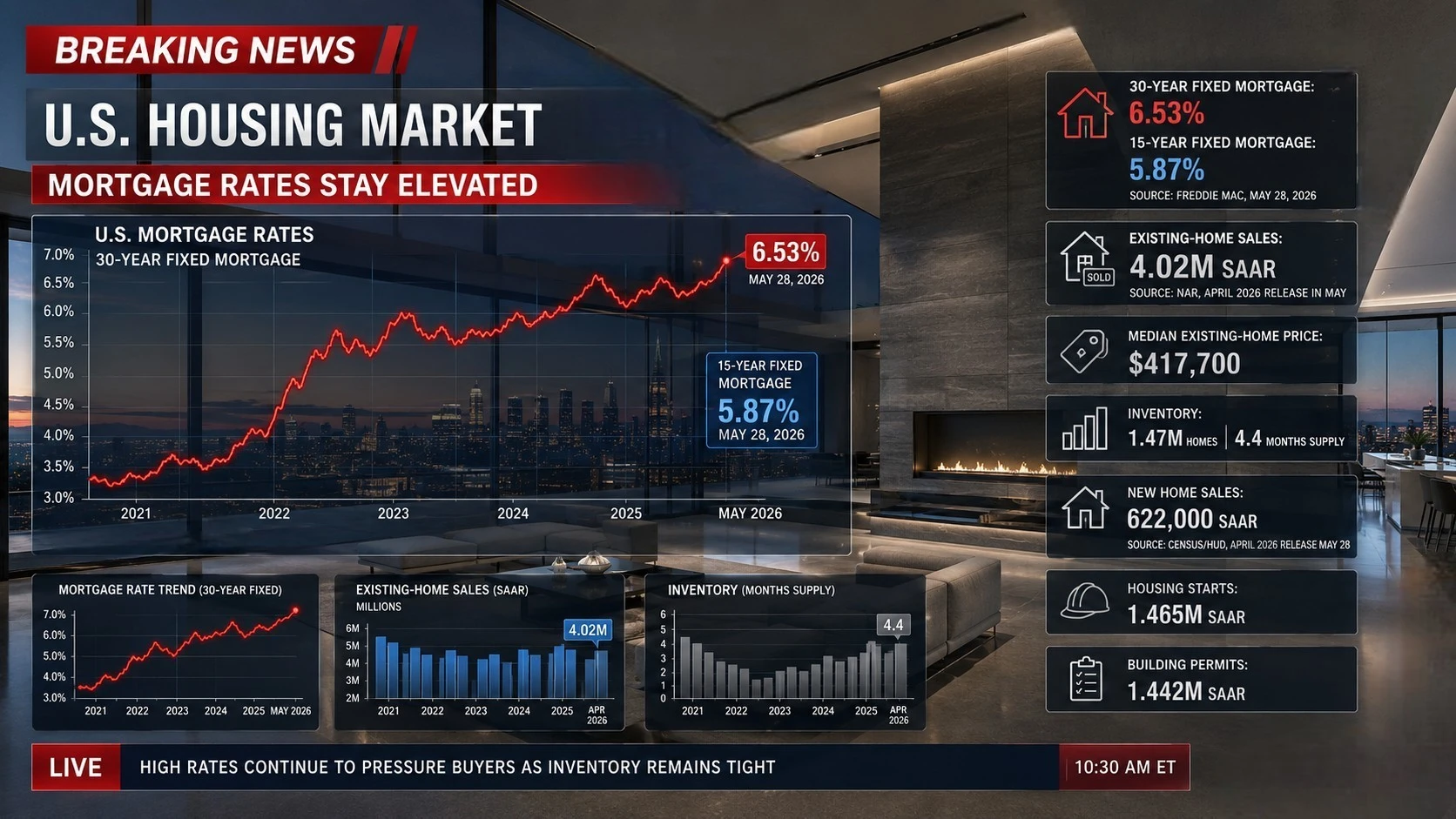
Mortgage rates have climbed to their highest level in nine months, adding fresh pressure to an already strained U.S. housing market. The average rate on a 30-year fixed mortgage rose to 6.53% as of May 28, 2026, while the average 15-year fixed rate increased to 5.87%.
The pressure is starting to show up in mortgage demand, especially among homeowners looking to refinance. Mortgage applications fell 8.5% in the week ending May 22, as the average contract rate for a standard 30-year fixed loan rose to 6.65%. Refinance applications dropped 18%, while purchase applications slipped just 0.4%, suggesting buyers have pulled back only slightly even as borrowing costs have moved higher.
Inflation remains one of the main forces keeping mortgage rates elevated. The Consumer Price Index rose 3.8% in the 12 months ending in April, with energy prices up 17.9% and gasoline prices surging 28.4%.
The current economic uncertainty is being fueled by the U.S.-Israeli military operation against Iran launched on February 28, 2026. The U.S. Energy Information Administration said global oil markets are facing heightened volatility because of the de facto closure of the Strait of Hormuz, a key transit route that carried nearly 20% of global oil supply before the conflict.
That leaves the Federal Reserve in a difficult position. In April, policymakers kept the federal funds rate target range at 3.5% to 3.75% and reiterated their commitment to bringing inflation back to the Fed’s 2% goal.
For the housing market, the Fed’s stance cuts both ways. Higher interest rates can help slow inflation, but they also make monthly mortgage payments more expensive and push some would-be buyers to the sidelines. Lower rates would improve affordability and could bring more buyers back into the market, but they could also risk adding more fuel to inflation.
The latest housing data points to a market under pressure, but not one in free fall. Existing-home sales rose just 0.2% in April. Inventory increased to 1.47 million homes, equal to a 4.4-month supply, while the median existing-home sales price rose 0.9% from a year earlier to $417,700.
Listings are also building. Realtor.com reported that active listings rose 4.6% year over year in April, while the national median list price fell 1.4% to $425,000. Price cuts are becoming more common as well, with 16.7% of active listings seeing reductions. Those cuts were more widespread in the South and West than in the Midwest and Northeast.
Redfin’s data showed a similar pattern. The brokerage reported that 35.4% of U.S. home sellers cut their asking prices in April. In San Antonio, Austin, Phoenix, and Dallas, more than half of sellers lowered their prices.
Concerns about a housing market crash have not gone away, but the current data still do not suggest a repeat of 2008. ATTOM reported that 42,430 U.S. properties had a foreclosure filing in April, up 18% from a year earlier. Even so, foreclosure activity remained well below pre-pandemic levels.
Homeowner equity is also cooling, though it remains relatively strong at the national level. In the first quarter, 43.3% of mortgaged homes were equity-rich, while 3.2% were seriously underwater, meaning the loan balance was at least 25% higher than the property’s estimated market value.
Taken together, the data points to a housing market that is becoming more fragile, especially in parts of the South and West where inventory is rising and price cuts are spreading. But for now, the stress looks more like a gradual correction than the start of a nationwide collapse.
Dallas-Fort Worth is one of the fastest-growing housing markets in the country, yet thousands of would-be buyers here are sitting on the sidelines. Buyers are watching the market for clues, checking rate trackers multiple times a day, and await the moment when rates drop back down to a level they can manage.
However, according to a recent Clever Real Estate Survey, about 42% of potential homebuyers expect mortgage rates to fall below 5% in 2026. This is not a realistic expectation based on current forecasts. The gap between buyers’ expectations and expert predictions could end up costing you money.
Major forecasting companies agree that mortgage rates won’t drop to the levels suggested by the 5% headline. Instead, 30-year fixed mortgage rates will continue to range between roughly 5.99% and 6.3% in 2026.
Morgan Stanley believes rates won’t get as low as some other forecasting organizations expect. Still, the firm has moderate optimism, forecasting 30-year fixed mortgage rates averaging between 5.5% and 5.75%. Morgan Stanley also believes any drop will only be temporary compared to an overall upward trend in the latter part of 2026 and into 2027.
Some policy discussions state that Fannie Mae and Freddie Mac may implement a $200 billion mortgage-backed securities purchasing program. Some analysts predict this will only drop rates by 10 to 15 basis points. For context, a basis point is one-hundredth of a percentage point. A 10-point reduction on a $400,000 mortgage saves about $25 a month, which isn’t enough to move the needle on affordability.
The bottom line is that no credible forecasters expect a return to 5% mortgage rates in 2026, and any minor dips will likely provide less relief than buyers are hoping for.
Why Buyers Keep Getting It Wrong: The Fed Misconception
One of the most persistent misunderstandings in housing right now is the belief that when the Federal Reserve cuts interest rates, mortgage rates fall in lockstep. They do not.
According to the U.S. News, 30-year fixed mortgage rates track the 10-year Treasury yield, not the federal funds rate. The Clever survey found that only 9% of consumers correctly attributed rate-setting to the Fed. The majority blamed either inflation (29%) or the current administration (27%).
Think of it this way: the Fed controls the overnight lending speed limit for banks borrowing from each other. Mortgage rates are set on a different, longer highway: one that responds to bond market demand, inflation expectations, and investor sentiment about long-term economic stability.
This distinction matters because buyers who are waiting for Fed rate cuts to automatically unlock better mortgage terms may be waiting for the wrong signal entirely. Even meaningful Fed action does not guarantee proportional relief on 30-year fixed rates.
The bottom line: understanding what actually drives mortgage rates helps you make smarter decisions rather than reactive ones.
The Real Math: What a Half-Point Rate Change Does to Your Payment
Here is what rate differences look like on a representative Dallas-area home priced at $400,000, with 20% down on a 30-year fixed loan:
Interest Rate
Home Price
Down Payment (20%)
Monthly P+I
6.50%
$400,000
$80,000
$2,023
6.00%
$400,000
$80,000
$1,919
5.75%
$400,000
$80,000
$1,867
Going from 6.5% to 5.75% saves you $156 per month, roughly $1,872 per year. That is real money. But here is the other side of that math: Fannie Mae, NAR, and Morgan Stanley all forecast home price appreciation of 2% to 3% in 2026. On a $400,000 home, 3% appreciation adds $12,000 to the purchase price. Even at a lower rate, you are paying more principal, and your monthly savings from the rate drop get swallowed by a higher loan balance.
U.S. News data reinforces this dynamic: home prices have appreciated roughly 16% since early 2022, even as rates climbed. Buyers who waited for lower rates during that period did not avoid price increases; they just paid more when they eventually bought.
Waiting for a half-point rate improvement is a reasonable goal. Waiting indefinitely while prices keep rising is a strategy that can cost you more than the rate savings are worth.
The Dallas Opportunity Most Buyers Are Overlooking: Builder Rate Buydowns
Here is something the national headlines are not telling DFW buyers. Major homebuilders across the Dallas suburbs are actively offering rate buydowns on new construction, and the numbers are significant.
A rate buydown is when a builder pays upfront to permanently or temporarily reduce your interest rate. Right now, builders in Frisco, Prosper, Celina, McKinney, Fate, and Mansfield are offering buydowns of 100 to 200 basis points, meaning one to two full percentage points off your rate. At a market rate of 6.25%, a 200-basis-point buydown brings you to 4.25%. No forecast from any major institution projects open-market rates reaching that level in 2026.
The contrast with waiting is striking. A buyer who sits on the sidelines for six months might capture a 0.25% organic rate improvement if forecasts hold. A buyer who negotiates a 1.5% builder buydown today is already three times ahead on rate, and they are buying before any spring price increases.
Builder concessions exist because builders need to move inventory. When that inventory tightens, as it tends to do when spring buying activity picks up, the leverage shifts. Analysts watching the DFW market suggest that the window could narrow as 2026 progresses.
The opportunity is real, and it is local. It just requires knowing where to look.
Should You Buy Now or Wait? A Framework for Dallas Buyers
Every buyer has a different answer to the question of when to buy. We have set out a framework based on your own circumstances.
You are likely to want to move forward if you:
have already found your ideal home or community
are being offered a builder incentive to purchase
plan on living in your new home for five or more years
can refinance if interest rates drop
The market is also expected to continue appreciating in value, so time will be against you on the price you’re going to pay for your home while waiting for interest rates to decline.
You may prefer to wait if:
Your financial situation is not ready (e.g., credit score, down payment, or debt ratios). You have flexible timing and location.
You are monitoring the resale market in relation to size (which may create additional better opportunities if you wait).
It’s important to note that many buyers who have purchased a home with a 7% or greater mortgage rate in 2022 or 2023 are now refinancing at a 5%-plus rate. Buying a home at 6% today with a planned refinance in 18 months at 5.5% is a sound strategy; it does not mean you are compromising on quality.
In addition, the equity build-up between now and the refinance date will likely exceed the costs incurred by waiting.
Stop Waiting for Perfect Rates. Start Looking for the Right Deal.
The buyers likely to do well in Dallas in 2026 are not the people who correctly timed the market; they are those who recognized the tools at their disposal: builder buydowns, negotiating leverage, and price appreciation vs. rate savings analysis.
Many experts agree that when the numbers work for you now, you have a compelling reason to move forward. Stop optimizing for a headline rate and start optimizing for your total monthly payment and long-term equity position. Those figures are what will determine whether purchasing was a good decision.
To determine what will work for your unique situation,consider speaking with a local DFW buyer’s agent or mortgage representative who can calculate your actual numbers against today’s market.
About the Author
Elena Novak leads estate agency research and analysis at PropertyChecker.com, where she digs into housing trends, tracks property data, and unpacks investment strategies for house flippers and beginner investors.
With a background in flipping homes and a degree in Business and Estate Agency Development, she brings a practical, hands-on approach to market analysis
Tariffs and evolving trade policies play a huge part in shaping real estate trends across the United States. While housing markets are usually discussed in terms of interest rates, population growth, or lending standards, global trade dynamics quietly influence the underlying costs of building, renovating, and ultimately purchasing or selling a home.
Understanding these forces helps explain why some regions experience sharper price shifts, construction slowdowns, or inventory constraints following changes in tariffs and trade.
In the current market, buyers and sellers increasingly rely on local expertise to interpret these signals. Working with the best real estate agent can help you translate national and international economic changes into practical insights about pricing, timing, and negotiation within a specific US local market.
This article examines how tariffs and trade policy shifts affect construction costs, housing supply, consumer confidence, and broader economic conditions, and how these factors interact to influence real estate trends nationwide.
Tariffs and trade policies directly affect the cost of key construction materials used in residential and commercial development. When tariffs are applied to imported goods, domestic prices often rise due to reduced competition or higher input costs.
Here are the common materials influenced by tariffs and trade:
Lumber and wood products used for framing and finishes
Steel which is used in structural components and reinforcements
Aluminium used in windows, siding, and roofing
Manufactured components such as fixtures, appliances, and HVAC systems
Even when materials are sourced domestically, tariffs can still affect pricing by altering supply chains or increasing demand for local substitutes. These higher material costs may be passed through to builders and contractors and, eventually, to consumers.
Effects on New Construction Pricing
Rising material costs directly affect the pricing of new homes. Builders must account for higher expenses when estimating project budgets, which often leads to specific outcomes like:
Increased list prices for newly built homes
Reduced profit margins for developers in competitive markets
Delays in project starts while costs stabilize
Greater emphasis on value engineering or design changes
In some US local market areas, especially those experiencing rapid population growth, these price pressures can be absorbed more easily. In gradual-growth regions, higher construction costs may discourage new development altogether, affecting local real estate trends.
Renovation Costs and Timelines
Tariffs and trade policies also influence renovation and remodeling activity. Homeowners facing higher prices for imported materials may postpone upgrades or scale back project scope. Contractors may experience longer lead times if supply chains are disrupted.
Renovation impacts typically include:
Higher bids for kitchen and bathroom remodels
Extended project timelines due to material availability
Increased demand for alternative materials
Greater cost uncertainty for fixed price contracts
These dynamics affect resale values and inventory quality, particularly in markets where older housing stock relies heavily on renovations to remain competitive.
Housing Supply, Builder Activity, and Affordability
As construction costs fluctuate, builder decisions and regional constraints directly shape housing supply and affordability across the local market.
Impact on Housing Supply Levels
When construction costs rise, housing supply growth slows. Developers may delay or cancel projects if projected returns no longer meet financial thresholds. Over time, reduced new construction can tighten inventory, especially in high-demand areas.
Limited supply can contribute to:
Upward pressure on home prices
Fewer entry-level housing options
Increased competition among buyers
Greater regional divergence in real estate trends
These effects are rarely uniform. Some cities with strong employment growth may continue building despite higher costs, while others see noticeable slowdowns.
Regional Differences Across the US Local Market
The influence of tariffs and trade varies by geography. Coastal markets, manufacturing hubs, and areas dependent on imported materials may feel stronger effects than regions with more localized supply chains.
Regional variations depend on:
Proximity to ports and trade infrastructure
Local labor availability and costs
Zoning and regulatory environments
Existing housing stock age and type
Understanding these differences is essential when evaluating real estate trends at the city or state level.
Affordability and Buyer Constraints
Higher construction and renovation costs can reduce affordability, particularly for first-time buyers. As prices rise faster than incomes, some households delay homeownership or shift preferences toward smaller homes or different locations.
Affordability pressures may lead to outcomes like:
Increased demand for townhomes and condos
Migration toward lower-cost metro areas
Longer search times for buyers
Greater sensitivity to interest rate changes
Economic Conditions, Confidence, and Housing Demand
Image Source: pexels.com
Housing demand does not operate apart from the broader economy. Employment stability, inflation, and borrowing conditions interact with tariffs and trade to influence buyer behavior and market momentum.
Interaction With Interest Rates and Inflation
Tariffs and trade policies can contribute to broader inflationary pressures by increasing the cost of goods. In response, monetary policy adjustments may affect mortgage rates, which directly influence housing demand.
Higher rates result in consequences such as:
Reduced purchasing power for buyers
Slower price appreciation
Increased importance of negotiation
Shifts toward renting in some markets
This interaction among tariffs, trade, inflation, and interest rates highlights how global policy decisions filter into everyday housing decisions.
Employment Trends and Consumer Confidence
Trade policy changes can affect employment levels in sectors such as manufacturing, logistics, and construction. Job stability and wage growth play a significant role in consumer confidence, which in turn shapes housing demand.
When confidence is strong you typically see that:
Buyers are more willing to commit to long-term purchases
Sellers may list homes at higher price points
Transaction volumes tend to increase
When confidence weakens, markets may experience longer listing times and greater price sensitivity.
Market Volatility and Short-Term Uncertainty
Periods of trade uncertainty can introduce volatility into housing markets. Buyers and sellers may adopt a wait and see approach, leading to temporary slowdowns.
Short-term effects are:
Fluctuating inventory levels
Wider pricing ranges between similar properties
Increased importance of local data
Greater reliance on professional guidance
Navigating these conditions requires careful analysis of both national indicators and local market behavior.
What Buyers and Sellers Should Watch For
Image Source: freepik.com
Both buyers and sellers benefit from tracking indicators that reflect shifting economic and construction dynamics.
Inventory Shifts and Price Stability
Changes in construction activity and demand can alter inventory levels.
Buyers and sellers should monitor indicators such as:
New listings versus completed sales
Price adjustments on comparable homes
Time on market trends
These indicators provide early signals of changing real estate trends within a specific local market.
Negotiation Dynamics in Changing Markets
As cost pressures and economic uncertainty evolve, negotiation strategies may shift. In some markets, buyers gain leverage through increased inventory, while in others, limited supply sustains seller advantages.
The following are key negotiation considerations:
Seller concessions or credits
Flexibility on closing timelines
Inspection and appraisal contingencies
Housing Type and Location Sensitivity
Different housing types and locations are shaped by cost pressures not just from tariffs but from broader construction cost increases, with construction expenses representing a record 64.4 percent of the average new home price in 2024 which is up from 60.8 percent in 2022.
This directly influences how single-family, condo, and multifamily markets respond to pricing and demand pressures.
Interpreting Real Estate Trends in a Complex Environment
Tariffs and trade policy shifts influence US housing markets through construction costs, supply constraints, affordability pressures, and broader economic conditions. While these forces operate at the national and global levels, their effects are ultimately felt locally, shaping neighborhood outcomes and long-term real estate trends.
Buyers and sellers benefit from understanding how tariffs and trade interact with interest rates, employment, and consumer confidence. Inventory changes, pricing behavior, and negotiation dynamics reflect these underlying factors before they become widely visible in headline data. Because impacts vary by region, housing type, and timing, broad generalizations can be misleading.
In periods of economic uncertainty, informed decision-making becomes more important than prediction. Interpreting market signals accurately requires local context, historical perspective, and ongoing analysis.
For many, partnering with the best real estate agent provides a structured way to assess shifting conditions, understand the nuances of a specific local market, and respond thoughtfully to evolving real estate trends.
The Dallas housing market, which appreciated rapidly over the past few years, is finally showing some early signs of cooling. While the fundamentals that fueled that growth remain strong (rising population, job creation, and business expansion), the market appears to be moving toward a more balanced state. This could be good news for prospective buyers, who may see more opportunities in 2026.
Why Dallas Prices Rose So Fast
So how did we get here? Why did housing prices in Dallas shoot up so quickly?
Over the last decade, Dallas-Fort Worth (DFW) has been one of the fastest-growing markets in the country. Reports show that home values soared 19.6% in 2021 and 22.4% in 2022.
A combination of factors drove this increase. For one, rapid population growth, as both companies and individuals relocated to the region, boosted demand. More companies mean more job opportunities, particularly in the fields of tech, logistics, finance, and healthcare, which have been growing rapidly in DFW for years. There’s also the issue of tight supply and construction delays, which often mean bidding wars and price hikes well above historical norms.
In short, the conditions in DFW created a highly competitive environment that made buying particularly challenging for first-time buyers, even for those with strong finances. But that explosive growth started to wane in 2023 through 2025, and it looks like that trend will continue into 2026.
Current Indicators Pointing to Market Moderation
If we take a look at Dallas housing market trends, all indicators point to the market entering a cooler, more stable phase.
Here are a few:
Slower price growth. Data from Movoto shows that the median sale price in DFW has stabilized in recent months at around $425,000. Compared with the massive increases in the early 2020s, this is a much more reasonable rate of growth.
Homes are also sitting longer on the market, 65 days on average, compared with 54 days at the same time last year. Longer listing times indicate that buyers are no longer rushing to beat rising prices, which means sellers will have to set more realistic expectations when it comes to home prices in Dallas.
More inventory is coming to market, with additional active listings and new construction. An increase in supply gives buyers more choices, which tips negotiations in their favor.
It’s important to note that “cooler” Dallas home prices don’t mean a downturn or a crash, they simply indicate the market is shifting from an overheated seller’s market toward a more balanced market.
What’s Influencing Dallas Home Prices in 2026?
With that in mind, what are the key factors that will influence the housing market heading into 2026?
First, mortgage rates: as of this writing they are still high but easing. Higher interest rates from 2023 to 2025 reduced the affordability of Dallas housing, and thus buyer demand. But many analysts expect rate cuts in 2026, which will improve borrowing power, bring more buyers back into the market, while still supporting moderate price growth. Until then, however, affordability is likely to remain a problem for first-time buyers.
There’s also the reality of more homes and new construction coming onto the DFW housing market. After years of underbuilding, the construction industry in DFW is finally catching up, with many new developments and active listings coming online. More supply means fewer bidding wars, more realistic pricing, and more negotiation room for buyers.
Dallas remains one of the country’s most economically prosperous metropolitan areas, with the tech and engineering sectors, financial services, healthcare, biotech, and logistics. It’s likely that job growth and in-migration will remain strong, which means demand for housing will stay elevated.
What to Expect in the Dallas Market in 2026
With all that in mind, based on current trends, what can we expect for 2026?
The most likely outcome is moderate, rather than explosive, growth. Prices will likely continue to rise, but slowly, perhaps low to mid-single-digit appreciation. It’s also possible that newly developed suburbs may see small price declines or softer negotiation terms, especially if inventory climbs faster than projected buyer demand.
This all adds up to better conditions for buyers, while sellers will need to temper expectations. These conditions will give buyers more negotiating power, more listings to choose from, and more room to breathe when it comes to decision-making. Meanwhile, sellers will need to price their homes competitively, invest time in staging and repairs, focus on good presentation when showing homes, and avoid assuming their listings will go under contract instantly.
It’s unlikely that Dallas will see a crash in 2026, but signs point toward a cooler, more predictable housing market. The future of Dallas housing is stable, even if it’s no longer red‑hot.
Every housing market runs on the same two forces: supply and demand. They’re what push prices up or down, decide how fast homes sell, and influence whether it feels like a buyer’s market or a seller’s market. Once you get a handle on how these forces play out where you live, you’ll be in a much better spot to make the right move, whether you’re a homebuyer, seller, or real estate professional, understanding local market dynamics helps you make smarter decisions.
Right now in 2025, the U.S. housing market is shifting toward balance. Listings are climbing, price growth has cooled, and buyers have more options than they did in the past couple of years. For sellers, it means setting the right price and standing out matters more than ever. For buyers, it opens the door to better choices and more negotiating power.
Analyzing Local Market Dynamics
The easiest way to look at supply and demand is to think about it in plain terms. Supply is the number of homes for sale. Demand is how many people want to buy and how much they can afford. When buyers outnumber listings, sellers usually get multiple offers and higher prices. When there are plenty of homes sitting on the market, buyers have the upper hand and can push harder on price.
The numbers from mid-2025 tell the story. By July, inventory had gone up for 21 months in a row — almost 29% higher than the year before. Homes were also staying on the market about five days longer. That’s a big change from the fast-paced market of the last few years and shows things are shifting toward balance. Still, some regions like the South, Northeast, and Midwest are seeing more sales compared to a year ago.
You don’t need to be an expert to track this. Your local MLS or national sites like Realtor.com make it easy to see how many homes are listed, what the median price looks like, and how long homes are sitting before they sell.
Right now, many listings are sitting on the market without offers, and price growth has slowed to about 1% year over year. For buyers, that means more time and more choices. For sellers, it means pricing your home right and making sure it stands out.
Key Economic Factors Influencing Supply and Demand
What happens in your local economy plays a huge role in housing. When jobs are growing, new businesses are opening, or big projects are underway, more people move in and demand for homes goes up. When the economy slows, buyers can get nervous and hold back.
Mortgage rates also carry a lot of weight. This year, they’re not exactly cheap, but they’ve leveled off. A 15-year loan sits around 5.5%. That steadiness matters. Buyers may stretch their budgets, but they can at least plan without rates jumping week to week.
Other signs are worth tracking. Builder confidence slipped this year, hinting that fewer new homes could hit the market. Rental households are also growing faster than owner-occupied ones, showing that some people are choosing flexibility over long-term commitment.
Then there are the local shifts you notice close to home. A new highway interchange, a big employer setting up shop, or even new schools can drive fresh demand. On the flip side, more “price reduced” signs or delistings in your neighborhood are usually a sign that sellers are testing the market and not finding enough takers.
Leveraging Digital Tools for Market Insights
You don’t have to rely only on monthly reports to know what’s going on in your market. Digital tools give you a way to check the pulse almost in real time.
Start with housing sites. Zillow, Realtor.com, and Redfin all have dashboards that update daily. You can see how many homes are on the market, how prices are trending, and even how long houses are sitting before they sell. Google’s search data is another quick tool, if more people in your area are searching “homes for sale,” demand is picking up.
Social media platforms (Facebook, Instagram, and LinkedIn) can tell a story as well. Local Facebook groups often buzz when a new subdivision breaks ground. Instagram posts can show which neighborhoods buyers are excited about. On LinkedIn, agents share quick market takes that give you a feel for how competitive things are. If you share your own updates, maybe a short note about price cuts in your town or photos of a growing neighborhood, people start seeing you as someone in the know.
Even online ads give away clues. When searches in your zip code spike, it usually means more buyers are circling. Paying attention to those patterns helps you spot shifts before they’re obvious in the headlines.
Mastering Supply and Demand for Success
There isn’t a single formula that works for every market, but keeping tabs on supply and demand gives you a big advantage. Growth is just slower around 3% or less nationwide, which means balance is the theme.
For buyers, that balance shows up as more choices and a little more breathing room. You don’t always have to rush an offer the first weekend a house hits the market. For sellers, it’s about staying realistic. Pricing competitively and making your home stand out online matters more now than it did a couple of years ago.
The key is to check in often. Watch the data from housing sites, pay attention to what’s happening in your own neighborhood, and lean on digital tools and community input to see where interest is heating up. Mix those pieces together and you’ll have a clearer picture of where things are heading. That way, whether you’re buying, selling, or helping others, you’ll be making decisions based on what’s really happening not just headlines.
A lot of Canadians are asking the same question: should I rent or buy? Maybe you’ve compared rent listings with mortgage payments and still aren’t sure which path makes more sense.
Image Source: pexels.com
The mortgage vs rent equation is complicated by homeownership costs and shifting interest rates, and whether you will stay put long enough to make buying worth it.
The real question is how each choice fits your finances, job stability, and plans for the next decade. That is what we will unpack here without repeating the same generic tips.
Rent vs. Buy: The Financial Reality Check
Before deciding between renting vs buying, look beyond the headline monthly payment. Both come with a set of costs that kick in before you even settle in.
Buying a Home
Upfront: Down payment (minimum 5 percent on the first $500,000 in Canada), closing costs, inspection fees, and land transfer tax (which varies by province). On a $600,000 home, that’s often $35,000 to $50,000 just to get started.
Ongoing: Principal and interest mortgage payments, property taxes, insurance, and maintenance. These homeownership costs can shift, especially if interest rates change.
The benefit: Long-term equity and the chance for real estate investment gains if property values climb.
Renting a Home
Upfront: Security deposit, first and last month’s rent, plus moving expenses.
Ongoing: Monthly rent, utilities (if not included), and occasional renter’s insurance.
Potential upside: Flexibility, lower financial commitment, and fewer unexpected bills.
The real choice comes down to affordability and your plans for the next five to ten years. If you are not sure where you stand, a quick conversation with a mortgage advisor can give you a clear, personalized breakdown based on facts.
Housing Market Trends in 2025
In May 2025, the average asking rent in Canada was about $2,129 per month. That is slightly lower than last year, but still well above pre-2020 levels.
Now compare that to owning, the average monthly mortgage payment is $3,500 to $5,500, based on current home prices and interest rates. The gap is wide, and it’s not just about the monthly bill. Buying adds property taxes, insurance, and maintenance costs, while renting avoids those but may come with rent increases over time, and you’re not building equity.
Lifestyle Factors to Consider
Money matters, but so does how you want to live. The renting vs buying choice can shape your day-to-day life more than you might think.
When Renting Makes Sense
Mobility: If you see yourself changing cities or even just switching neighborhoods in the next few years, renting keeps you flexible.
Low upkeep: Broken appliance? That’s your landlord’s problem. You avoid the surprise repair bills that come with homeownership costs.
Lower commitment: A lease usually lasts a year, while a mortgage ties you down much longer.
When Buying Works Better
Stability: You don’t have to worry about a landlord deciding to sell or raising the rent.
Customization: Paint the walls, knock down a wall, plant a garden, homeownership lets you renovate or customize as you like.
Long-term planning: If you plan to stay put for 5+ years, you start building equity instead of paying someone else’s mortgage.
In the end, financial planning for homebuyers or renters is about whether you value the freedom to move or the security of staying. The right answer changes depending on your career, relationships, and how much risk you’re willing to manage.
How to Know Which Side You’re On
When you simplify the decision, your choice between renting vs buying comes down to three questions:
How Long Will You Stay Put?
Less than 3 years? Renting usually wins.
Five years or more? Buying starts to make sense, especially if your market is trending upward and you’re thinking about real estate investment as part of your long-term wealth plan.
How Stable is Your Income?
If your paycheck could take a hit or your job might move you, renting keeps you flexible.
If your income is steady and you’ve built an emergency fund, you can handle the surprise costs that come with homeownership. That stability also makes it easier to work through the financial planning for homebuyers process with confidence.
What’s Your Debt-to-income Ratio?
Mortgage lenders will look closely at your debts before approving you. If your debt-to-income ratio is high, you may want to rent while lowering it, using that time to plan for a smarter entry into real estate later.
These answers will point you toward the choice that fits your financial capacity and your life stage, not just what the headlines suggest.
Your Next Move Starts Here
In 2025, renting vs buying isn’t a universal math problem with one correct answer. It’s a personal calculation that blends your finances, stability, willingness to commit, and see it as a long-term investment. Others will rent, protect their flexibility, and wait for the market to shift.
What matters is making the call based on real numbers and a plan that fits your situation, not your neighbor, not the market chatter, and not some outdated rule of thumb.
Amid the economic uncertainty of 2025, many people are wondering: is it better to rent or buy a home? Because fluctuating interest rates and an unstable housing market make it difficult to choose between renting or buying a home.
We try to help you with some comparisons below to help you choose the right option for your financial situation.
1. The Current US Housing Market
Home prices in most areas in the U.S. are starting to level off following years of rapid appreciation. The U.S. median home value, for instance, is 2.1% higher than one year ago at $361,263. Home prices are still out of reach in most major U.S. cities, including San Francisco, Miami, and particularly in Los Angeles.
Texas is still relatively affordable compared to expensive cities like LA or SF, but in some urban areas like Austin, home prices are still steep for local buyers.
The median rents in major U.S. cities continue to rise. In New York City, for instance, the median apartment is being rented for $3,926 per month, an increase of 0.9% year-over-year. Growing rental demand and low availability of rental properties have led landlords to raise their prices considerably.
For 2025, we project 30-year mortgage rates at approximately 6.83%. This is lower compared to 2023 but still higher compared to before the pandemic. This renders mortgage payments on a monthly basis an important aspect to consider for future homebuyers.
Buying a home is a long-term investment, particularly if it’s for a residence. Owning property is much to contend with but has numerous advantages over being a renter.
Source: har.com
Pros:
Builds Home Equity: Each mortgage payment helps you build ownership of a valuable asset.
Predictable Housing Costs: A fixed-rate mortgage makes it clear what your monthly payment will be. This is in contrast to renting a home, where rent can increase each year.
Design Your Own Home: As a homeowner, you have the freedom to renovate, remodel, or make improvements to suit your needs.
Cons:
High Initial Costs: You’ll need to budget for a down payment, closing costs, and annual maintenance costs.
Emergency Fund: If you need cash quickly and want to sell your home, it can take time to find a buyer.
Market Risk: Real estate values can decline depending on the state of the economy or local market.
But owning a home can act as a hedge against inflation—your mortgage payments are fixed, but rents increase over time. If you’re going to be in one location for the long haul, we suggest buying.
3. Why Renting Remains Popular for So Many
One of the aspects of the “American Dream” is owning a house. But renting is not without its advantages. Renting offers greater financial flexibility, which, for most individuals, is an appealing choice.
Pros:
Flexibility: Renting is a good option if you’re not planning to stay in one location for an extended period or want to explore another city or neighborhood.
Low Upfront Expenses: The deposit is usually much smaller compared to making a down payment on a home.
Fewer Responsibilities: Routine repairs and maintenance are typically handled by the property manager or landlord.
Cons:
No Investment Value: Monthly rent payments don’t build equity like homeownership does.
Rent Increases: Rent can increase at short notice, depending on the landlord.
Limited Control: You don’t have the freedom to renovate or modify the space as you wish due to the lease agreement.
Renting is an excellent choice for remote workers or individuals working in occupations that have frequent relocating, like traveling nurses. House rental is also an option for individuals saving to purchase their own home in the future.
4. So, Which Is Right for You?
No one answer is right for everyone. The choice between renting and buying has a lot to do with your budget, career path, personal style, and duration of stay. Some prefer to rent for their flexibility, while others purchase homes as an investment in their future.
Source: freepik.com
If you’re still unsure, it is best to speak to an agent who is knows the local market. They can discuss numbers with you and provide guidance that in relation to your objectives, not trends.
You might also use an online ‘rent vs. buy’ calculator or consult with a mortgage advisor to figure out which option is more financially savvy in terms of affordability. Renting and buying both have their pros and cons. What’s most important is knowing your goals and, based on that, making an informed decision.