Tag: Investment Strategies

  • Real Estate: Definition, Types, How It Works, Investment, and Key Terms

    Real estate touches almost every part of our lives, from where we sleep, to how local schools get funded, to where businesses decide to grow. If you’re thinking about buying a home, adding a rental to your portfolio, or just trying to make sense of all the jargon, this guide breaks down the basics in plain English.

    We’ll walk through what real estate really is, the main types of properties, how a deal actually goes from offer to closing, some popular ways to invest (both hands-on and hands-off), and a quick glossary of terms you’ll run into again and again.

    What Is “Real Estate,” Exactly?

    Real estate refers to land and anything permanently attached to it including homes, buildings, improvements, and the rights that come with ownership.

    In everyday use, you’ll hear “real estate” and “real property” used interchangeably. (That’s different from personal property, like your car or furniture, which isn’t affixed to land.)

    Ownership typically includes a “bundle of rights,” such as the right to use, lease, sell, or improve the property within the limits of law and zoning. Those rights have value; how much value depends on location, local demand, condition, allowed uses, and broader economic forces like interest rates.

    Etymology & First Use:
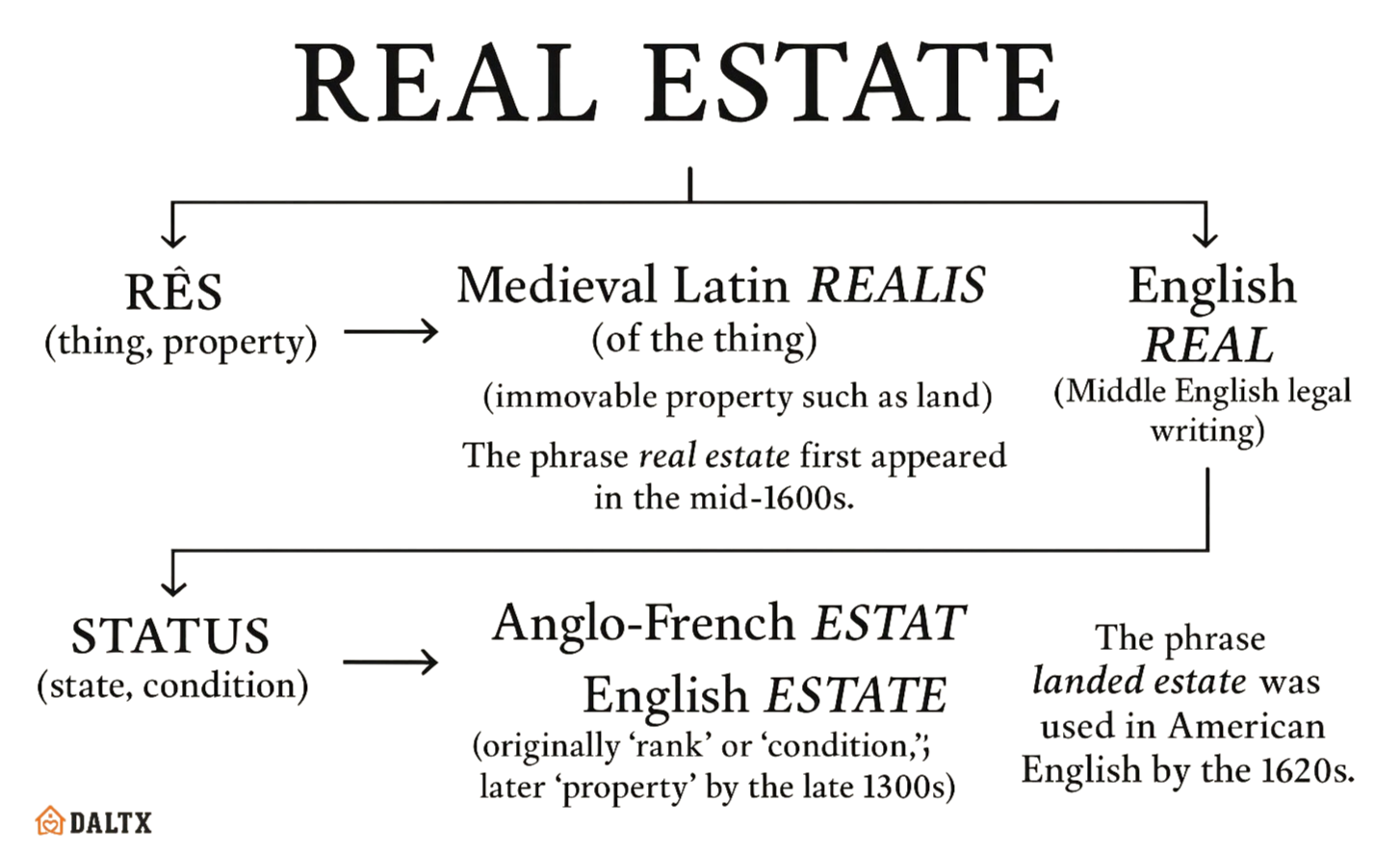
    • Real” comes from the Medieval Latin realis (“of the thing”), which itself comes from the Latin rēs (“thing” or “property”). In English legal writing dating back to Middle English, real referred to “things” in the legal sense, especially immovable property like land, as opposed to personal (movable) goods. The exact phrase real estate first appeared around the mid-1600s.1
    • Estate” comes from the Anglo-French estat, which comes from the Latin status meaning “state” or “condition.” In English, it originally meant “rank” or “condition,” and by the late 1300s, it also came to mean “property.” The phrase “landed estate” was already used in American English by the 1620s.2

    The earliest recorded use of “real estate” dates back to the mid-1600s. Merriam-Webster lists its first known use around 1642, while the Online Etymology Dictionary traces it to the 1660s. Either way, the term clearly entered English in the 1600s and has kept its legal tone ever since.3

    The Main Types of Real Estate

    Understanding the different categories helps you compare apples to apples when buying, investing, or analyzing the market.

    • Residential: Includes single-family homes, townhomes, condos, duplexes, triplexes, fourplexes, and manufactured homes.
    • Commercial: Covers offices, retail spaces, hotels, and other properties that mainly generate business income.
    • Industrial: Includes warehouses, distribution centers, manufacturing facilities, and flex spaces.
    • Land: Refers to raw land, infill lots, farmland, and parcels set aside for future development.
    • Special purpose & mixed‑use: Properties like self-storage facilities, medical and educational buildings, or developments that combine residential, retail, and office spaces.

    How Real Estate Really Works

    To understand real estate, it helps to start with what actually drives value in the market.

    What Actually Drives Property Value

    Three big levers influence property values:

    1. Location & land use: Zoning, school districts, commute times, and neighborhood amenities.
    2. Supply and demand: How many homes are for sale or lease versus the number of qualified buyers or tenants.
    3. Money & macroeconomics: Mortgage rates, employment, local growth, insurance costs, and property taxes.

    Who’s Involved When You Buy a Home

    • You and the seller
    • Real estate agents/brokers representing each side
    • A lender (if you’re financing) and an appraiser
    • A home inspector and sometimes specialists (e.g., roof, sewer)
    • A title/escrow company or real estate attorney (varies by countries and state)

    The Step-by-Step Purchase Timeline

    1. Budget and preapproval
      Get preapproved to understand how much home you can afford and to make your offer stronger.
    2. Home search & pricing
      Your agent will use comparable sales (comps) and a Comparative Market Analysis (CMA) to help you decide on a fair offer price.
    3. Offer, earnest money & contingencies
      Your written offer usually includes an earnest money deposit (typically around 1–3% of the purchase price) and contingencies for financing, appraisal, and inspection. The home inspection contingency gives you time to inspect the property and renegotiate or cancel if serious issues surface. This window is usually 7–10 days, as agreed in the contract.
    4. Appraisal & underwriting
      The lender orders an appraisal to confirm the property’s value. Meanwhile, underwriters review your income, assets, debts, and details about the property before final approval.
    5. Title search & escrow (two meanings)
      • Escrow in the transaction: A neutral third party holds funds and documents and coordinates closing once the title is cleared.
      • Escrow account for taxes/insurance: After you buy the home, many lenders collect part of your annual property taxes and homeowners insurance with each mortgage payment, then pay those bills for you. Some borrowers who qualify can request an escrow waiver and handle those lump-sum payments themselves, though eligibility, fees, and rules vary by lender, loan type, state law, and borrower profile.
    6. Closing
      You’ll sign the final documents, pay your closing costs and down payment, and get the keys once the transaction is officially recorded.

    Paying for Your Home and the Help That May Be Available

    • Conventional, FHA, VA, USDA and other mortgages are common choices. Some lenders and programs allow down payment assistance (DPA) through grants or second‑mortgage options (forgivable, deferred, or low‑interest), or matched‑savings programs, to help cover your down payment and/or closing costs. Many programs look for a minimum credit score (often ~620), income limits, and completion of a home buyer education course; specifics differ by state and program.
    • After you build equity, some owners tap a home equity line of credit (HELOC) for renovations or debt consolidation. Many HELOCs offer a draw period followed by a repayment period, and some lenders provide options to fix the rate on a portion of what you draw, useful when rates are rising. Remember: your home is collateral, so borrow carefully.

    Real Estate as an Investment

    Real estate can provide cash flow, appreciation, and potential tax benefits, but it also comes with market, maintenance, and regulatory risks.

    Here are common ways Americans invest, from hands‑on to fully passive.

    Hands-On Ways to Invest

    • Buy‑and‑hold rentals (single‑family or small multifamily)
      You purchase a property and rent it to long‑term tenants. Key metrics:
      • Net Operating Income (NOI) = rent & other income − operating expenses (excluding mortgage).
      • Cap rate = NOI ÷ purchase price.
      • Cash‑on‑cash return = annual pre‑tax cash flow ÷ total cash invested.
        Quick example: If rent is $2,200/month, annual gross rent is $26,400. After a 5% vacancy allowance ($1,320) and $8,000 in annual expenses, NOI is $17,080. On a $280,000 purchase, the cap rate is about 6.1%.
        If you buy a property with tenants in place, you’ll step into landlord duties immediately and must honor existing leases and local landlord‑tenant laws; rent control or “just cause” rules in some areas may limit rent increases or eviction without cause.
    • Short‑term rentals (STRs) / Airbnb
      STRs can earn a higher nightly rate than long‑term leases, but occupancy is less predictable and operating costs (furnishings, utilities, cleanings, property management) are higher. Expect more day‑to‑day involvement and be sure you understand local STR rules before you buy.
    • House hacking
      Live in one unit and rent out the others (or rooms) to offset the mortgage. It’s a popular on‑ramp to investing.
    • Fix‑and‑flip / BRRRR (Buy, Rehab, Rent, Refinance, Repeat)
      You add value through renovations. Success hinges on accurate ARV (after‑repair value) estimates, rehab budgets, holding cost assumptions, and a realistic timeline.
    • Foreclosures and REOs
      You can buy at auction (generally as‑is and often cash‑heavy) or purchase bank‑owned (REO) homes through agents after they don’t sell at auction. Preforeclosures and short sales are additional paths, though lender approvals can lengthen timelines. With any distressed property, insist on a careful inspection when possible and budget for repairs.
    • Tax lien investing
      Instead of buying the house, you may purchase a tax lien certificate when an owner falls behind on property taxes. The investor pays the delinquent taxes and then collects repayment (plus interest/penalties) from the owner, or in rare cases, by foreclosing if the owner doesn’t redeem in time. Rules, rates, and timelines vary widely by state, and due diligence is critical.
    • Partnerships and small syndications
      Partnering lets you combine cash, credit, skills, and time. It can also split profits and introduce differences in work styles, so set roles and expectations in writing. You’ll find potential partners via local investor clubs, online communities, crowdfunding platforms, and your professional network.

    More Passive or Low-Maintenance Options

    • REITs (Real Estate Investment Trusts)
      Public or private companies that own or finance real estate; investors buy shares and receive dividends.
    • MBS (Mortgage‑Backed Securities)
      Bonds backed by pools of mortgages; investors earn from borrowers’ payments. Like all bonds, MBS carry interest‑rate and credit risks.
    • Crowdfunding & real estate funds
      Platforms pool investor capital into specific projects or portfolios; read the fine print on fees, lockups, and sponsor track records.

    Financing and Managing Risk as an Investor

    • Financing: Investment properties often require larger down payments and stronger reserves than primary homes. If you’re buying a personal residence, down payment assistance may help you bridge the gap; confirm that your lender works with the program you’re targeting and review whether funds are a grant or a second loan (forgivable, deferred, or amortizing).
    • Due diligence: Use inspections, rent rolls, service records, and a title review to avoid surprises. If you waive the inspection contingency (common in auctions), build in a bigger repair budget.
    • Landlord‑tenant law & leases: Honor current leases when you buy a property with tenants; understand notice periods, just‑cause rules, and local limits on rent increases. Plan for vacancy and CapEx.
    • Operations & sustainability: Strategic “green” upgrades like energy-efficient HVAC systems, better insulation, solar, and water‑saving fixtures, can lower expenses and may qualify for energy‑efficient mortgage options or tax credits, depending on your loan and location.
    • Cash management: Decide whether to keep an escrow account for taxes/insurance or request an escrow waiver (if eligible) and save for those bills yourself; weigh convenience versus control and any waiver fees.
    • Capital for improvements: Some owners tap a HELOC to fund renovations; compare fixed‑rate locks versus variable draws and confirm fees and conversion rules before you borrow.

    Common Terms Every Buyer, Seller, and Investor Should Know

    [table id=3 /]

    Smart Upgrades: Sustainability and Resilience

    Green upgrades aren’t just about doing the right thing; they can also improve comfort and cut operating costs. Owners frequently pursue solar panels, high‑efficiency HVAC, better insulation/windows, or water‑saving systems.

    Depending on your loan type and where you live, energy‑efficient mortgage options and federal/state incentives may help pay for qualifying improvements.

    Bottom Line

    Learn the process, set a budget, and surround yourself with pros like your agent, lender, and inspector. If you’re planning to invest, it’s also smart to have a dependable contractor and property manager on your side. Go for the type of property and investment style that fit your timeline, how much risk you’re okay with, and what you want for cash flow.

    Once you’ve got a solid plan and you actually understand terms like escrow, contingencies, and NOI, you’ll feel way more confident making decisions in today’s housing market.

    1. Source: etymonline ↩︎
    2. Source: etymonline ↩︎
    3. Source: Merriam-Webster ↩︎

  • Can You Create Your Own Mortgage Note? A DIY Guide

    Creating a mortgage note can be a powerful financial tool, allowing you to structure private lending agreements for real estate transactions. A mortgage note is a legally binding document that outlines a borrower’s promise to repay a loan, typically secured by property.

    This document formalises the terms including the interest rate, repayment schedule, and the length of the loan for the security of both the lender and the borrower under the law.

    Private mortgage notes also differ from bank loans by being flexible when structuring the terms of the loan for extraordinary circumstances. To make the note legally binding, the note will need to be correctly drawn up and adhere to state and federal lending regulations.

    Source: linkedin.com

    Steps to Creating a Mortgage Note

    Creating a legally sound mortgage note requires careful planning. Here’s how to get started:

    1. Define the Loan Terms
      • Principal amount: The total loan amount.
      • Interest rate: The cost of borrowing.
      • Repayment schedule: Frequency and structure of payments.
      • Late payment penalties: Fees for overdue payments.
    2. Understand State Laws
      Lending regulations vary by state and can affect the enforceability of the note. Researching these laws ensures compliance.
    3. Secure the Loan with Collateral
      The property being financed typically serves as collateral, reinforcing the lender’s legal standing.
    4. Include Default Provisions
      Clearly state what happens if the borrower fails to meet their obligations, including lender recourse options.
    5. Consider Selling the Mortgage Note
      • A mortgage note buyer can convert future payments into a lump sum for immediate liquidity. Buy Mortgage Note provides a hassle-free solution in this process.
      • Evaluating the resale value helps ensure a smooth and profitable sale if needed.

      Legal Considerations and Compliance

      To ensure your mortgage note is legally enforceable, follow these legal procedures:

      1. Compliance with Federal Laws: Federal regulations including the Dodd-Frank Act and the Truth in Lending Act (TILA) require regulations for interest rates, disclosures for the borrower, and fair lending. Non-compliance can result in penalties or render the note void.
      2. Legal Review: Permit the lawyer to check the mortgage note for conformity with all the relevant legislations and for the security of your interests.
      3. Recording the Document: Record the mortgage or the deed of trust with the local county office. This will provide public notice of the lien and protect the lender’s interest in the property.

      Pros and Cons of a DIY Mortgage Note

      Creating your own mortgage note offers advantages such as customized terms, higher potential returns compared to traditional investments, and the ability to bypass banks. This option is particularly useful for real estate investors, family members providing private loans, or individuals exploring alternative financing solutions.

      However, there are risks, including borrower default, legal complications, and liquidity challenges. Private mortgage notes differ from bank-originated mortgages by being subject to the lender’s capacity for judging the borrower’s creditworthiness and the value of the property. Conducting thorough background checks and requiring a substantial down payment can help mitigate these risks.

      Best Practices for a Secure Mortgage Note Agreement

      To maximize the value and security for your mortgage note, the following is worth consideration:

      • Use clear and concise terms in the agreement.
      • Conduct proper due diligence regarding the financial health of the borrower.
      • Ensure compliance with federal and state regulations by using the promissory note template for your state.
      • Utilize escrow for payments and property tax payments, avoiding potential disagreements.
      • Maintain detailed payments and letters for the security of your interests against potential legal troubles or sale of notes.
      • Work with your attorney for real property or your financial representative to make the note legally sound and profitable.

      Is a DIY Mortgage Note Right for You?

      Creating your own mortgage note can also prove to be a profitable and flexible form of financing, given you pay close attention and adhere legally. If you are aware of the lending regulations and can deal with the risk associated, your DIY mortgage note can also serve as a good passive income source or even for financing property deals.

      However, it is best to seek professional advice beforehand for assurance and security against loss. Complying with best practice and being informed about the relevant legislation will allow you to set up and maintain a mortgage note for your desired financial objective.

    • How to Price Your Chicago Rental Property to Maximize Profit

      Credit: Wirestock via gettyimages.com

      Chicago’s rental market operates differently from cities like Dallas, with diverse neighborhoods and fluctuating demand influencing pricing strategies. Getting the price right for your rental is key to attracting tenants, keeping vacancies low, and making the most of your investment. Set your price too high, and it may sit vacant, especially in areas with lower demand. But if the price is too low, you could lose out on potential profit.

      It all comes down to understanding the market, keeping expenses in check, and setting a price that attracts tenants without sacrificing your bottom line. Here’s how to get the best rent for your property without scaring off tenants.

      Investigate the Chicago Rental Market

      Research the Market Conditions. One of the first steps to setting a great rental price is to research the current market conditions in your area. Rental rates are determined primarily by location, demand, property type, and economic trends.

      Step-by-Step Guide on How to Do Market Research:

      • Check Rental Listings: Use websites such as Zillow, Apartments.com, and Craigslist to find similar properties in your neighborhood.
      • Social Media / Forums: You can join forums related to the rental market and seek advice from experienced investors.
      • Talk to a Property Management Company: Rental pros can offer tips specific to market trends and pricing.
      • Check Supply and Demand: If your region has high vacancy rates, you might need to price competitively to attract tenants.

      Consider Your Property’s Location

      While Chicago has 77 officially recognized neighborhoods, rental demand is highest in areas like The Loop, River North, and Lincoln Park, which plays a big role in rent prices. Places like River North, Lincoln Park, and The Loop run higher ‘cause they’re close to business hubs, got plenty of amenities, and feel safer. Meanwhile, spots like Albany Park and South Shore are more affordable but still get plenty of renters.

      When setting a price for your rental, think about:

      • Public Transit Accessibility: Properties close to major bus routes or CTA train stations tend to demand higher rents.
      • Nearby Amenities: Renters seek grocery stores, restaurants, entertainment, and parks.
      • School District Quality: Families sometimes pay a premium to live in areas with highly rated schools.

      Know Your Costs and Where You Want to Be

      When you look deeper, your rent should cover all costs and generate positive cash flow for profitability.

      Key Expenses to Factor In:

      • Mortgage Payments: If you currently have a loan on this property, ensure that the overall rent covers this cost.
      • Property Taxes: Property taxes in Chicago vary depending on the county and assessment rates, so include them in your calculations.
      • Insurance: Landlord insurance covers property damage and liability claims.
      • Maintenance & Repairs: Anticipate surprise repairs, regular maintenance, and long-term upgrades.
      • Property Management Fees: If you use a management company, include these costs (typically 8–12% of the monthly rent).
      • Vacancy Rate: Charging a reasonable rent keeps your property occupied, maximizing income flow.

      Analyze Comparable Rental Prices of Similar Properties

      To list your rental at a competitive price, compare properties with similar attributes. Consider:

      • Bedrooms & Bathrooms: Rental prices tend to be higher for larger units.
      • Square Footage: Generally, homes with more living space cost more.
      • Age & Condition: Newly built or well-maintained older properties demand higher rents.
      • Parking Availability: Any parking spot or garage increases rental value, especially in high-demand locations.
      • Building Amenities: Features like elevators, gyms, rooftop decks, and concierge services justify higher rental prices.

      Set Competitive Pricing Strategies

      Once you’ve established a pricing benchmark, here are some tips for maximizing profit:

      Underprice, But Profitably

      Pricing slightly below market value can attract tenants faster, but ensure it still covers your costs and generates profit.

      • Charge slightly less than similar rentals to attract tenants faster.
      • Adjust rent seasonally—rents are usually higher during peak moving seasons (spring and summer).

      Offer Incentives

      If you need to fill a vacancy quickly, offering incentives such as one month’s free rent, waiving an application fee, or reducing the security deposit can entice tenants without lowering the base rent.

      Apply Tiered Pricing to Multi-Unit Properties

      If you own a multi-unit building, you might price premium units differently based on factors like floor location, view, or additional amenities.

      Test and Adjust Pricing as Needed

      Market conditions change, so it’s a good idea to be flexible with your pricing strategies.

      • Track Inquiries & Applications: If interest is low, you may have priced too high.
      • Evaluate Lease Renewals: If turnover is high, rental rates may need adjustment.
      • Analyze Local Market Shifts: Stay updated on local rental trends and adjust your strategy accordingly.

      Conclusion

      Pricing a rental property is crucial to maximizing profit while keeping plenty of tenants interested. With market research, expense awareness, and strategic pricing, you can maintain a solid rental income stream and long-term viability. If you need assistance in setting the right price, consulting Chicago rental management companies can help get you started on the right path, especially in competitive markets.

      Not sure how much to charge for your Chicago rental? Reach out to a rental management pro today for expert advice on maximizing your income!.

    • The Best Time and Smart Strategies for First-Time Residential Property Investors

      If you’re starting to invest in real estate or want to expand your portfolio, residential property can be a great addition. This is investment in single-family homes, apartments, condos, or any other housing that will help you to accumulate wealth through incomes.

      What works for first-time investors is the timing and proper strategy. A good approach sets one up for success. Here is a simplified guide to help you understand some of the best strategies to get started with in real estate.

      Understanding the Market and Timing

      The thing is, the real estate markets are always up and down, and sometimes very unexpected. When in a seller’s market, it means there aren’t enough inventory supplies but so many buyers. Homeowners then have the highest advantage. House buyer markets occur when numbers of homes being on the market exceed prospective buyers, allowing a buying advantage to one.

      So many factors can influence when the best time to buy is. High interest rates, for example, make it tough for people to afford homes, while low rates usually get people out there buying. Other things, like inflation or how the economy’s doing, may also impact the market.

      Seasons can come into play, too; summer is a time of buying, mostly, so the seller may raise the prices. In winter, generally, there is lower demand, so maybe you will find a better price.

      Before making an investment in property, study your local market first, as trends can be very different depending on the area. Use tools like PropertyChecker to research ownership records and neighborhood information among others.

      Smart Strategies for First-Time Investors

      If you’re new to real estate investing, there are a few key strategies that can help you avoid mistakes and make smart choices. Keep in mind that real estate is usually a long-term game that requires commitment. You’ll need to manage your property and make good decisions to see steady profits.

      A good network of real estate pros gives you the inside scoop, and connections with investors could be the potential source of future partnerships.

      Understand, at a minimum, the overview of the local real estate market and fundamental terms such as property taxation and cash-on-cash return. Moreover, always do some risk assessment to make you aware of problems that may arise after investing in the house.

      Common Mistakes to Avoid

      First, thoroughly understand your financial situation before wading into the business. Excessive debt obligations may invite stress and further complicate the managing of the house.

      A lot of first-time investors forget about the hidden costs that come with owning real estate. You’ll need to budget for routine maintenance to keep everything in good shape. Don’t forget about property taxes and insurance, too. Unless you put down 20% or more, insurance is a must.

      Before you buy, always get a detailed property inspection. This helps you spot any potential repairs, so you’re not hit with unexpected costs after closing. Avoid properties that you don’t fully understand in terms of long-term value or market demand.

      Financing Your First Investment

      When you’re ready to make your first investment, you’ve got a few different financing options. A traditional loan from a bank is one route—these are often backed by Freddie Mac or Fannie Mae, and lenders will check your credit and income before approving the loan.

      FHA loans are sometimes available, however they are seldom used to finance investment properties. Some of the additional financial options at your disposal include the following:

      • Hard money loans
      • Home equity
      • Private money loans
      • Commercial loans

      Typically, you’ll need to put down at least 20% for most loans. Hitting that mark also lets you skip private mortgage insurance (PMI). Some states even offer programs for first-time buyers that help with down payments or closing costs. And getting pre-approved for a mortgage can streamline the whole buying process since many homeowners won’t show you a property without pre-approval.

      Long-Term Considerations for Investors

      Remember, real estate is always long-term investment; it sure gains a lot with time. The same house may sell off for $350,000 or more within a couple of years from its present sale off of $300,000, not considering the increased value with changes you can make on it.

      As you pay off your mortgage, you build equity. Let’s say you pay off $200,000 of your loan over 15 years, and the home is worth $450,000 by then—you’d make $250,000 if you sold it. Down the line, you might want to diversify your investments, looking at different types of properties or markets to protect against inflation and keep your portfolio strong.

    • Investment Insights: Why Real Estate is a Smart Choice

      Source: freepik.com

      If you’re fixin’ to invest your money in something that grows and brings a big return, real estate oughta be at the top of your list. It’s one of the most dependable ways to build up your investment portfolio and rake in bigger earnings down the road.

      But here’s the deal—you don’t want to go all in on just one item. It’s kinda like playin’ cards—you spread your bets to keep your risks in check. That’s what we call diversification, and it’s just as important in real estate as it is at the poker table..

      Real estate could be a golden ticket, but it has its twists and turns. The markets change; competition arises, so you’ll need to mix your investments in various kinds of properties. If one region does not do too great, others may be what keep you above water. The name of the game is to balance things out.

      The Power of Diversification

      You’ve got two big choices when it comes to real estate investment: residential and commercial properties. Residential is like that good ol’ reliable friend—you know you can count on it to bring steady returns over time. It ain’t flashy, but it’s dependable, kinda like a savings account that keeps growin’ slow and steady.

      Commercial properties might be a little unpredictable, but when they pay off, they pay off big. If you’re ready to play the long game and take a few risks, they can bring in some serious profits.

      Take residential properties, for instance—returns in the form of rent usually fall between 1.5% to 2.5%. It’s a steady flow, but it might not get you to your financial goals as fast as you’d like. That’s where commercial properties shine—they often deliver higher returns, anywhere from 6% to 9% a year, with the potential for even bigger payoffs down the road, making them a key part of any high-reward strategy.

      How Diversification Works

      Diversification of the portfolio ain’t just about throwin’ money at whatever comes your way. It’s gotta be a smart, strategic decision—pickin’ assets that work together, like those offered by real estate investment companies. When one slows down, the other’s there to pick up the slack.

      Think of residential homes as your solid backbone—they keep things steady and runnin’ well. However, if you’re willing to take on a bit more risk, commercial properties may help you grow your portfolio. By combining both, as well as some low, medium, and high-risk assets, you may create a plan that can withstand any challenge.

      Real-Life Strategies for Diversifying

      If you want to keep your real estate portfolio fresh and balanced, here are some solid strategies:

      • Don’t Put All Your Eggs in One Basket: Spread your investments across different locations. This way, if one area cools off, the other properties in your portfolio continue to be hot.
      • Mix Property Types: Don’t stick to just homes or apartments. Consider adding commercial properties like office spaces or industrial sites. This helps cushion your portfolio if the housing market takes a hit.
      • Diversify Your Tenants: Rent to families, college students, and businesses. In that way, should one particular group moves out; you have still others that would keep your cash flow going.

      THe best option if you’re startin’ out on a tight budget is residential properties—they’re easier to get your hands on and tend to grow in value over time. But if you’ve got deeper pockets and can handle a little more risk, commercial buildings can offer bigger returns.

      Expert Advice on Diversification

      John Thomas, Managing Director of Assets Xperts, says,

      Diversification into real estate isn’t an option but has turned out to be a mandate now

      If you diversify well, you end up safeguarding your resources from market flux. Where one of them underperforms, all others can counterbalance the latter, thus equilibrating returns on investment for you

      Thomas also notes that the combination of assets with different levels of risk allows investors to make better financial forecasts. Be it short-term gain or long-term growth, diversification will keep your portfolio strong and resilient.

      A Balanced Approach

      Before you get started, consider your budget and goals. Residential properties are perfect for those looking for steady, long-term growth. They are the tortoise in the race: slow but sure. If you can take on a little more risk in hopes of higher returns, then commercial properties may be your ticket to bigger returns-just remember that where great potential goes, so does great responsibility and danger.

      The Bottom Line:

      Real estate is like the Swiss Army knife of investing; it’s got a little somethin’ for everybody. You’ve got residential and commercial, covering the whole market. The key is finding your balance and stickin’ with what works best for you. Take your time, do your homework, spread out those investments, and start building that dream portfolio.

    • How To Find Off Market Properties For Sale

      Ever wondered why some properties are just hard to find on your realtors website? or where you can find a cheaper Off-Market Deal? The answer is pretty simple. Find a property not listed on the MLS (Multiple Listings Service) or a Off Market Deal. In this post we will go over what a Off Market Property is, the advantages of finding this type of property as well as where to find these deals.

      What is an Off Market Property?

      Off Market Properties or Deals are properties for sale that aren’t listed on the MLS or Multiple Listing Service. While Off Market Deals were sparse in the past, they have risen in popularity the past couple of years. Creating a second market of sorts.

      How do they compare to MLS Listings?

      MLS listings are the go to for realtors as it is an aggregate of all “listed” properties on the market. It’s the place where a vast majority of realtors go to list their properties; however, the MLS comes with fees. For many independent home sellers it’s easier to just sell on their own.

      The MLS is also extremely strict. With MLS Statement 8.0 you need a broker to list your properties on the MLS, making it difficult to get a property listed without a realtor. MLS listings will also not show up when realtors search houses to buy. If you check most real estate websites you will find a MLS feed, this is where most buyers find new properties.

      Check these pages for an example: Plover WI Real Estate or Monroe WI Real Estate

      Advantages of off-Market Deals

      The major advantages of off-market deals are primarily on the buyers side. Off market deals often have motivated sellers and less potential buyers. This shift gives you as the buyer a upper hand. Although it’s still important to use a realtor on the buyers side. Here’s what Rick Gruebele with Visions First Realty said:

      Advantages of Using a Realtor for Off-Market Properties

      Buying or selling off-market properties can offer unique opportunities and benefits, but navigating this niche real estate sector can be complex. Here’s why working with a professional realtor can make all the difference:

      1. Access to Exclusive Opportunities

      Realtors often have insider knowledge of properties that are not listed on public MLS platforms. These exclusive opportunities may include pocket listings, private sales, or properties where owners are open to selling but haven’t officially listed. This gives buyers an edge in finding hidden gems.

      2. Network of Connections

      Realtors have established relationships with other agents, brokers, and local property owners. Their extensive network can open doors to opportunities that would otherwise be inaccessible, helping sellers find buyers and buyers find properties that align with their goals.

      3. Expertise in Negotiation

      Off-market transactions often involve unique terms and conditions. Realtors are skilled negotiators who understand how to create win-win deals, ensuring that buyers and sellers get fair value without unnecessary friction.

      4. Discretion and Privacy

      Off-market transactions are ideal for sellers who value privacy. Realtors maintain confidentiality throughout the process, ensuring that your property details are only shared with serious, pre-screened buyers.

      5. Market Knowledge

      Realtors bring deep insights into local market trends, property values, and future investment potential. This expertise helps buyers identify high-potential properties and sellers set competitive prices, even for off-market transactions.

      6. Simplifying Complex Processes

      Off-market deals often lack the structure of traditional real estate transactions. A realtor provides guidance through the entire process, from valuation and marketing to inspections, appraisals, and closing, ensuring a smooth transaction.

      7. Saving Time and Effort

      Searching for off-market properties or buyers can be time-intensive. Realtors streamline the process by doing the legwork, presenting only serious opportunities that meet your criteria.

      8. Avoiding Pitfalls

      Off-market transactions come with unique challenges, including unclear property histories or legal complexities. Realtors are trained to identify and address these issues, protecting your interests at every step.

      Whether you’re a buyer seeking rare opportunities or a seller looking for a discreet transaction, working with a realtor ensures a seamless, informed, and advantageous process in the off-market real estate space.

      Drawbacks of Off-Market Properties

      Off Market Properties aren’t all sunshine and rainbows. They do have some disadvantages such as inexperienced sellers or the complexities of foreclosure from the previous owner. The main disadvantages for an Off Market Deal are for the seller actually. Just look at what Shelley Miller from Turning Point Realty said:

      One big disadvantage of selling a home off market is that you don’t get buyers competing for your home. The way the market has been the past several years, you want the feeding frenzy of buyers.

      because inventory has been at an all time low and there hasn’t been enough supply for the housing demand.

      5 Methods to Find off-Market Properties

      Real Estate Agents

      Real Estate Agents and Brokers often have a list of buyers and sellers who are looking for the right opportunity. By asking local Agents you can often find a few off market deals, including pocket listings. Pocket listings are listings that agents have exclusive rights to sell and that aren’t listed on the MLS.

      Online Market Places

      Even though properties aren’t listed on the MLS, sellers can add them to various online marketplaces. A few online market places to look at are: RedFin, Zillow or Realtor.com. Many agents will also list off market deals on their personal websites such as this Lodi WI Real Estate Team.

      Real Estate Auctions

      One of the best ways to get a good deal on a new home is Real Estate Auctions such as a Sheriff Sale. You can find these auctions either through your local government or through real estate investors in your area.

      Networking

      Networking is a simple way to get long term off-market deals. Finding investors in your area is an easy hack to get off market deals since they are always looking to buy or sell properties. If you catch one at the right time, they will often sell to you.

      Driving for dollars

      Driving for Dollars is when you literally drive to find off market deals. Many sellers will post signs outside their home that they are selling, even off market properties. It’s an easy way to find hyper local listings

    • Hard Money Lenders in California: A Strategic Tool for Real Estate Investors

      Quick and flexible financing options are important in the world of real estate investment which is very competitive and moves at a high speed. The hard money lenders in California have been identified to offer unique financing solutions for the property market which could be of importance for certain investors moving very fast on such prospects. These types of loans may take different forms such as bridge financing, fix & flip money, etc., but they all serve as good substitutes to conventional credit facilities!. To ensure that they get everything out of it financially speaking, investors need to take into account all of the ins & outs associated with these loans including what could go wrong or prove advantageous when going for any particular option.

      What Are Hard Money Loans?

      Hard money loans are short-term, asset-based loans primarily used for real estate investments. Unlike traditional loans, which are secured by the borrower’s creditworthiness, income history, and financial stability, hard money loans are secured by the value of the property itself. This means that the approval process is much faster and less dependent on the borrower’s financial background. Instead, the property’s potential value—particularly after repairs or improvements—plays a pivotal role in the loan’s approval.

      Hard money loans are typically provided by private lenders or investor groups, making them more flexible than loans offered by conventional banks. The terms are shorter, often ranging from 6 to 24 months, and interest rates are higher—generally between 8% and 15%—due to the increased risk that lenders assume. However, for real estate investors who need quick access to capital or do not qualify for traditional loans, hard money loans can be an excellent option.

      Why Use Hard Money Lenders in California?

      The California real estate sector experiences a lot of competition & moves very quickly; therefore it is attractive to investors. To close deals and make use of available chances, one may be required to secure finances within the shortest time possible!. In California, hard money lenders offer a solution for staying at par with the high pace experienced in this market by providing flexible and quick financing options that take days as opposed to weeks or months to materialize.

      Here are a few reasons why hard money loans are particularly useful for real estate investors in California:

      1. Quick Access to Capital: While a standard mortgage may need weeks or even months for processing due to the strict approval requirements, this is not the same case with hard money loans. The latter are quick to approve because they only consider if the property being financed can be sold for enough money!. As a result of this some investors can obtain approvals within days and move quickly in hot markets..
      2. Flexible Loan Terms: Hard money lenders offer more flexibility than traditional lenders. Loan terms can be tailored to the specific needs of the project, whether it’s a fix-and-flip, a renovation, or a bridge loan. This flexibility is particularly useful for investors who need customized financing solutions to meet tight timelines or unique property situations.
      3. Opportunities for Non-Traditional Borrowers: Hard money loans have an added advantage in that a person’s credit score & income do not affect their approval. For this reason such kind of loans are very good for those investors who for one reason or another could have failed to get the funding that they needed from the bank since they have low incomes or bad credits and thus cannot provide enough information for loan assessment!. The hard money lenders also step in with the required funding provided that the property has enough equity & the project is feasible..

      Asset-Based Lending: Investors who intend to flip houses or invest in distressed properties requiring significant repairs can take advantage of financing whereby they use the property to secure funds because such credits are linked with collateral which is normally known as hard money loans!. The fact is that this kind of loan is very important for people who would like to invest their money into some business related with buying houses cheaply, renovating them & selling at higher cost again. By looking at what could be in the future and not what currently exists, hard money lenders make it possible to access non-conforming finance.

      Risks and Challenges of Hard Money Loans

      While hard money loans offer numerous advantages, they also come with their own risks and challenges that investors must carefully consider before proceeding.

      1. Higher Interest Rates: One of the main drawbacks of hard money loans is the higher interest rates compared to traditional loans. Rates typically range from 8% to 15%, depending on the lender and the risk associated with the loan. These higher rates can significantly increase the cost of the loan, putting pressure on investors to complete their projects quickly and efficiently to avoid prolonged financial strain.
      2. Shorter Loan Terms: Hard money loans usually have shorter repayment terms, often ranging from 6 to 24 months. This means that investors need a clear exit strategy, whether it’s selling the property, refinancing into a traditional mortgage, or paying off the loan from another source. The short-term nature of these loans requires careful planning to avoid default and the risk of losing the property to foreclosure.
      3. Risk of Default: Since hard money loans are secured by the property, failure to repay the loan can result in the lender foreclosing on the property. This is particularly risky for investors who are using hard money loans to finance distressed properties or extensive renovations, as unexpected delays or costs could jeopardize their ability to complete the project and repay the loan.
      4. Market Fluctuations: Real estate markets can be unpredictable, and changes in the market could impact the investor’s ability to sell the property or refinance before the loan term expires. In a slower market, it may take longer to sell the property, potentially leading to financial losses or the need for expensive refinancing options.
      5. Upfront Costs: In addition to higher interest rates, hard money loans often come with additional fees, such as origination fees, processing fees, and points. These upfront costs can increase the total cost of the loan, making it important for investors to carefully evaluate whether the potential returns from the investment will justify these expenses.

      Selecting a Hard Money Lender in California

      Choosing the right hard money lender is crucial for ensuring a successful real estate investment. When evaluating potential lenders, investors should consider several key factors:

      1. Interest Rates and Fees: Compare interest rates and fees across multiple lenders to ensure you are getting a competitive deal. Hard money loans typically come with higher interest rates than traditional loans, so it’s important to minimize costs wherever possible. Be sure to ask about any additional fees, such as origination fees or prepayment penalties that could impact the total cost of the loan.
      2. Loan Terms and Flexibility: Evaluate the lender’s loan terms, including the length of the repayment period and any flexibility in extending the loan if needed. Short loan terms can create pressure to complete the project quickly, so it’s important to ensure that the lender’s terms align with your project’s timeline and your exit strategy.
      3. Reputation and Reliability: The lender’s reputation is a critical factor to consider. Look for lenders with a history of transparency, reliability, and positive reviews from other investors. Working with a reputable lender can prevent issues down the road and ensure a smoother lending process.
      4. Flexibility in Down Payments and Equity: Some hard money lenders may require larger down payments or higher equity stakes, while others may offer more flexible terms. Make sure the lender’s requirements align with your financial capabilities and the specific needs of your project.

      Conclusion

      The Vital Role of Hard Money Lenders in California Real Estate Investment.!. It is possible for investors to get money they can use in investment quickly from some investment plan companies who are very considerate and also offer them with very flexible terms. In a market where one has to move fast to make the best deals, hard money loans become the best shot for investment financing other than the conventional ones. Be that as it may with a high price tag, relatively short duration, & inherent risk there is a need for proper placement of such credits which requires attention!. Through proper comprehension of the loan details and making an appropriate selection while borrowing, investors will be able to make use of this funding on their property investments!.