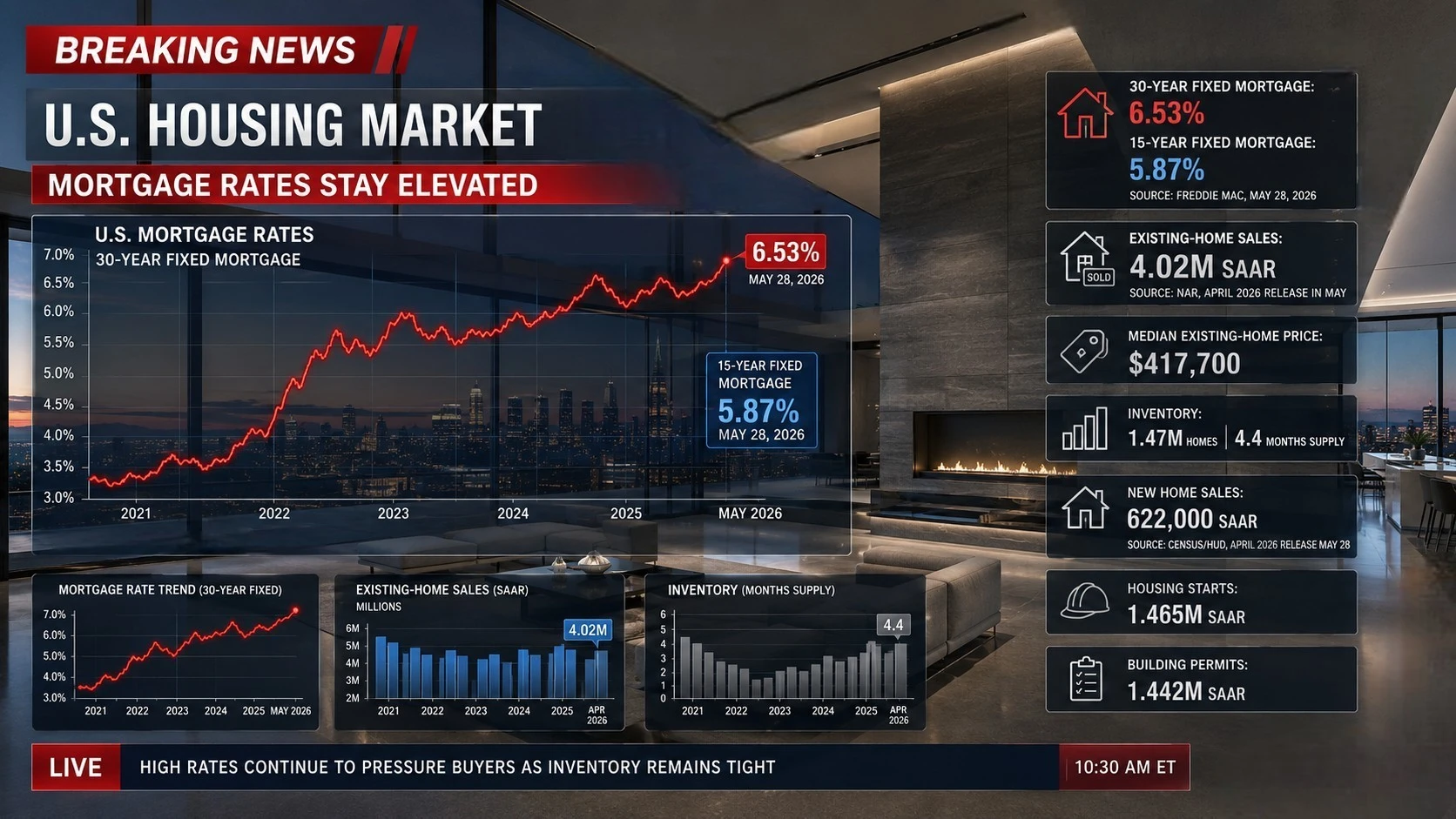
Mortgage rates have climbed to their highest level in nine months, adding fresh pressure to an already strained U.S. housing market. The average rate on a 30-year fixed mortgage rose to 6.53% as of May 28, 2026, while the average 15-year fixed rate increased to 5.87%.
The pressure is starting to show up in mortgage demand, especially among homeowners looking to refinance. Mortgage applications fell 8.5% in the week ending May 22, as the average contract rate for a standard 30-year fixed loan rose to 6.65%. Refinance applications dropped 18%, while purchase applications slipped just 0.4%, suggesting buyers have pulled back only slightly even as borrowing costs have moved higher.
Inflation remains one of the main forces keeping mortgage rates elevated. The Consumer Price Index rose 3.8% in the 12 months ending in April, with energy prices up 17.9% and gasoline prices surging 28.4%.
The current economic uncertainty is being fueled by the U.S.-Israeli military operation against Iran launched on February 28, 2026. The U.S. Energy Information Administration said global oil markets are facing heightened volatility because of the de facto closure of the Strait of Hormuz, a key transit route that carried nearly 20% of global oil supply before the conflict.
That leaves the Federal Reserve in a difficult position. In April, policymakers kept the federal funds rate target range at 3.5% to 3.75% and reiterated their commitment to bringing inflation back to the Fed’s 2% goal.
For the housing market, the Fed’s stance cuts both ways. Higher interest rates can help slow inflation, but they also make monthly mortgage payments more expensive and push some would-be buyers to the sidelines. Lower rates would improve affordability and could bring more buyers back into the market, but they could also risk adding more fuel to inflation.
The latest housing data points to a market under pressure, but not one in free fall. Existing-home sales rose just 0.2% in April. Inventory increased to 1.47 million homes, equal to a 4.4-month supply, while the median existing-home sales price rose 0.9% from a year earlier to $417,700.
Listings are also building. Realtor.com reported that active listings rose 4.6% year over year in April, while the national median list price fell 1.4% to $425,000. Price cuts are becoming more common as well, with 16.7% of active listings seeing reductions. Those cuts were more widespread in the South and West than in the Midwest and Northeast.
Redfin’s data showed a similar pattern. The brokerage reported that 35.4% of U.S. home sellers cut their asking prices in April. In San Antonio, Austin, Phoenix, and Dallas, more than half of sellers lowered their prices.
Concerns about a housing market crash have not gone away, but the current data still do not suggest a repeat of 2008. ATTOM reported that 42,430 U.S. properties had a foreclosure filing in April, up 18% from a year earlier. Even so, foreclosure activity remained well below pre-pandemic levels.
Homeowner equity is also cooling, though it remains relatively strong at the national level. In the first quarter, 43.3% of mortgaged homes were equity-rich, while 3.2% were seriously underwater, meaning the loan balance was at least 25% higher than the property’s estimated market value.
Taken together, the data points to a housing market that is becoming more fragile, especially in parts of the South and West where inventory is rising and price cuts are spreading. But for now, the stress looks more like a gradual correction than the start of a nationwide collapse.
House hunting in a hot market can feel like you’re already behind before you even walk through the door. Well-priced homes can draw multiple offers quickly, and buyers often feel pressured to make a major financial decision on a tight deadline.
But strong real estate decisions rarely come from chasing the crowd. They come from knowing your numbers, your market, and your limits before the right property shows up. Instead of focusing only on winning the offer, focus on buying a home that fits your life and still makes sense after closing.
1. Look Past the National Housing Headlines
Real estate is local, sometimes down to a few blocks. National headlines can help explain the broader market, but they won’t tell you what is happening in one school zone, subdivision, or condo building. One neighborhood may have tight inventory and rising prices, while a similar area nearby may be sitting longer and seeing price cuts.
Before you write an offer, study the recent comps. Look at days on market, list-to-sale price ratios, price reductions, and how many comparable homes are available. Also pay attention to local factors such as school boundaries, planned roadwork, zoning changes, flood risk, and access to transit. Two homes that look similar online can perform very differently over time because of location details buyers may not notice at first.
2. Don’t Confuse Staging with Value
A beautifully staged home is meant to make you feel at home the second you walk in. That is the point. But expensive furniture, designer lighting, and fresh paint are not the same thing as long-term value.
Look closely at the things that are expensive or impossible to change: the lot, the street, the floor plan, the natural light, the roof, the mechanical systems, and the overall condition. A polished home on a noisy road may not be a better buy than a dated home on a quieter, more desirable block. You can update finishes later. You cannot move the house to a better lot.
3. Know Your Non-Negotiables Before You Tour
In a fast market, buyers who know their priorities have a real edge. Before your first open house, split your wish list into three groups: must-haves, flexible items, and nice-to-haves.
Your budget ceiling, commute range, number of bedrooms, and school or neighborhood requirements may belong in the must-have category. Flooring, paint colors, landscaping, and light fixtures are usually flexible. Lifestyle extras, such as a wine room, gym, pool, or guest suite, should be treated as bonuses unless they truly affect how you live day to day. Clear priorities help you move quickly without letting pressure make the decision for you.
4. Understand the Full Cost of Ownership
The purchase price is only one part of the cost. Higher-end homes can come with higher taxes, insurance, utilities, maintenance, and HOA fees. Those costs matter just as much as your mortgage payment.
Before raising your offer, run the full monthly number. Include property taxes, homeowners insurance, HOA dues, utilities, landscaping, pool service, repairs, and reserves for major systems. An older HVAC system, aging roof, large yard, or oversized pool can turn an already expensive home into a much tighter monthly commitment. A smart offer is not just the one that wins. It is the one you can comfortably carry.
5. Buy for the Way You Actually Live
A home can be a strong investment, but it still has to work for your daily life. Think honestly about how you use space. Do you entertain often? Do you need a quiet home office? Do you want separation between guest rooms and primary living areas? Do you need outdoor space, storage, or easy access to medical, fitness, or wellness services?
Personal comfort matters, too. For example, someone looking for a hand and foot sweating treatment may place more value on reliable climate control, strong ventilation, shaded outdoor areas, or a private wellness space than on cosmetic upgrades. The right home should support the way you live now, not just the lifestyle you picture on a perfect weekend.
6. Keep a Second Option in Mind
During a bidding war, it is easy to convince yourself that one home is the only one that will work. Usually, it isn’t.
Step back before you stretch too far. Could a nearby neighborhood offer better value? Would a smaller home leave room in the budget for renovations? Would a less flashy property in a better location be a smarter long-term move? Having another path keeps you from treating one address like your only shot.
7. Set Your Limits Before the Offer Deadline
Offer deadlines can make buyers act fast, but fast should not mean reckless. Before the seller sets a cutoff time, decide your highest price, your preferred terms, and which contingencies you are not willing to waive.
Know your walk-away number before emotions get involved. That number should account for the appraisal, inspection findings, repairs, closing costs, and the cash you still need after closing. A clear limit makes it much easier to stay calm when counteroffers start moving quickly.
8. Watch Out for the Winner’s Curse
Winning a bidding war feels good until the numbers settle in. If the deal drains your emergency fund, forces you to waive protections you are not comfortable waiving, or leaves no room for repairs and normal life, the win may not be worth it.
The goal is not to beat every other buyer at any cost. The goal is to buy a home that protects your finances and still feels good to live in after the excitement wears off.
9. Make Preparation Your Advantage
Preparation gives you leverage. Keep your pre-approval current, understand your financing, and have your agent walk you through recent comps before you tour. Know which inspectors, lenders, and insurance contacts you would call if you had to move quickly.
A competitive market rewards buyers who can act with confidence instead of panic. When you understand the local numbers, your own budget, and the trade-offs you are willing to make, you can write a strong offer without losing sight of the bigger picture.
Property valuations are a key part of the mortgage approval process. While you’re measuring for curtains, the lender is running the numbers to make sure they’re not backing a losing investment. This single report shapes your borrowing power, influences your interest rate, and ultimately determines whether the bank signs off on the loan.
It goes beyond simple loan-to-value ratios; it’s a stress test on the asset. If the bank’s surveyor thinks the property isn’t worth what you offered, a situation known as a “down valuation,” the math changes instantly. You can’t just borrow the difference , you have to pay it in cash, renegotiate, or let the deal fall apart. Going into the process with a clear understanding of how lenders calculate risk is the best way to protect your deposit and keep the deal on track. Understanding my property value through professional assessment helps set realistic expectations and supports strategic decisions around purchase price, deposit requirements, and lender selection.
The Mortgage Valuation Process
Lenders hire surveyors to assess a home strictly for their own protection. Don’t mistake this for a home inspection. The surveyor is there to check value and loan security, not to tell you if the boiler is about to break or the roof leaks.
For standard homes in stable areas, lenders often use “desktop valuations.” These rely on automated data to give a quick yes or no. However, high-value homes or complex deals usually trigger a full physical visit because algorithms can’t see the full picture. Remember that lenders vary; some are conservative, while others are more optimistic, and that choice directly impacts how much cash you can access.
How Loan-to-Value (LTV) Drives Decisions
Your loan-to-value (LTV) ratio drives almost every term of your mortgage. A higher valuation drops your LTV, which unlocks cheaper interest rates and lowers the cash you need upfront. But if the appraisal comes in low, your LTV spikes. You might be forced to put down more money just to meet the lender’s cap, which can wreck your budget.
In the UK, interest rates are locked into specific LTV bands. Stay under 60% or 75%, and you get the best deals. Creep over those lines, and the rates jump up, costing you more every month. Some mortgages simply vanish if you can’t hit a specific LTV target.
“Down Valuations” and Their Consequences
If the surveyor’s number is lower than your offer price, you are in a tight spot. You’re essentially left with three choices: talk the seller down to the new price, bridge the gap with your own cash, or walk away.
In a property chain, one down valuation can cause a domino effect that stalls everyone. You can try a different lender in hopes of a better number, but that eats up time and there is no guarantee the next surveyor won’t say the exact same thing.
Market Conditions Matter
When the market is volatile, prices move faster than the data. This makes it hard for surveyors to justify values based on sales that happened three months ago. Regional nuances count for a lot here; a surveyor with local knowledge knows the difference between a street that’s up-and-coming and one that’s stagnant.
During economic dips, surveyors tend to play it safe. This caution suppresses values and tightens lending. Seasonality plays a role, too—spring often provides plenty of “comps” (comparable sales), while a dead winter market leaves surveyors with less evidence to support a higher price.
Property-Specific Challenges
Unique homes are a headache to value. Without clear comparables, a lender’s confidence wavers.
Historic Buildings: Old or listed properties carry high maintenance risks. Lenders worry about resale value if the restoration costs are huge.
New Builds: Developers often charge a “new build premium.” Surveyors have to decide if that extra cost is real value or just marketing markup.
Location: Flood zones or bad planning permissions are red flags. If it increases the risk, it decreases the value.
Professional Valuation vs. Market Value
A mortgage valuation is conservative by design. The market price is emotional; the mortgage value is clinical. Surveyors follow RICS standards to keep things consistent and safe.
Buyers often bid up prices in the heat of the moment. Surveyors look at long-term risk. They prioritize closed sales data over asking prices or bidding wars, meaning they often strip away the “hype” premium you might be willing to pay.
Can You Challenge a Valuation?
Challenging a low valuation is possible, but it’s an uphill battle. You need hard evidence, not just an opinion. Recent sales of identical homes nearby or proof of major renovations are your best ammo.
You can ask for a second opinion, but most lenders will force you to use someone from their approved panel anyway. If you appeal, make sure your case is built on facts and data points that a professional surveyor can’t ignore.
Strategic Considerations for Borrowers
Pick Your Lender: Some banks are known for being stingy on value; others are more flexible.
Negotiate Smart: Keep the valuation in mind when you offer. Leave yourself some wiggle room.
Buffer Your Cash: Always assume the valuation might come in low. Having a financial buffer saves the deal if you need to make up a shortfall.
Timing: Applying when the market is active can sometimes help you get a fairer number.
Impact on Different Mortgage Types
First-Time Buyers: They are most vulnerable because they rarely have the extra cash to cover a down valuation.
Refinancing: A high value here is gold, it gets you a cheaper rate. A low one traps you on a higher deal.
Buy-to-Let: Lenders look at the rent potential as much as the brick-and-mortar value.
Self-Build: These are valued in stages. If a stage valuation comes in low, your cash flow for the build stops dead.
Technology and The Future
Automated models (AVMs) are great for speed, but they lack nuance. They can’t see the condition of the interior or the vibe of the street. While AI helps crunch data, human oversight is still key for anything that isn’t a cookie-cutter house.
Looking ahead, energy efficiency (EPC ratings) and climate risk are becoming massive factors. As regulations tighten, a drafty home might not just cost more to heat, it might be worth significantly less to a bank.
The valuation isn’t just a formality; it’s the bank’s final say. Respecting that fact and planning for it, is the best way to ensure you actually get the keys.
The Dallas housing market, which appreciated rapidly over the past few years, is finally showing some early signs of cooling. While the fundamentals that fueled that growth remain strong (rising population, job creation, and business expansion), the market appears to be moving toward a more balanced state. This could be good news for prospective buyers, who may see more opportunities in 2026.
Why Dallas Prices Rose So Fast
So how did we get here? Why did housing prices in Dallas shoot up so quickly?
Over the last decade, Dallas-Fort Worth (DFW) has been one of the fastest-growing markets in the country. Reports show that home values soared 19.6% in 2021 and 22.4% in 2022.
A combination of factors drove this increase. For one, rapid population growth, as both companies and individuals relocated to the region, boosted demand. More companies mean more job opportunities, particularly in the fields of tech, logistics, finance, and healthcare, which have been growing rapidly in DFW for years. There’s also the issue of tight supply and construction delays, which often mean bidding wars and price hikes well above historical norms.
In short, the conditions in DFW created a highly competitive environment that made buying particularly challenging for first-time buyers, even for those with strong finances. But that explosive growth started to wane in 2023 through 2025, and it looks like that trend will continue into 2026.
Current Indicators Pointing to Market Moderation
If we take a look at Dallas housing market trends, all indicators point to the market entering a cooler, more stable phase.
Here are a few:
Slower price growth. Data from Movoto shows that the median sale price in DFW has stabilized in recent months at around $425,000. Compared with the massive increases in the early 2020s, this is a much more reasonable rate of growth.
Homes are also sitting longer on the market, 65 days on average, compared with 54 days at the same time last year. Longer listing times indicate that buyers are no longer rushing to beat rising prices, which means sellers will have to set more realistic expectations when it comes to home prices in Dallas.
More inventory is coming to market, with additional active listings and new construction. An increase in supply gives buyers more choices, which tips negotiations in their favor.
It’s important to note that “cooler” Dallas home prices don’t mean a downturn or a crash, they simply indicate the market is shifting from an overheated seller’s market toward a more balanced market.
What’s Influencing Dallas Home Prices in 2026?
With that in mind, what are the key factors that will influence the housing market heading into 2026?
First, mortgage rates: as of this writing they are still high but easing. Higher interest rates from 2023 to 2025 reduced the affordability of Dallas housing, and thus buyer demand. But many analysts expect rate cuts in 2026, which will improve borrowing power, bring more buyers back into the market, while still supporting moderate price growth. Until then, however, affordability is likely to remain a problem for first-time buyers.
There’s also the reality of more homes and new construction coming onto the DFW housing market. After years of underbuilding, the construction industry in DFW is finally catching up, with many new developments and active listings coming online. More supply means fewer bidding wars, more realistic pricing, and more negotiation room for buyers.
Dallas remains one of the country’s most economically prosperous metropolitan areas, with the tech and engineering sectors, financial services, healthcare, biotech, and logistics. It’s likely that job growth and in-migration will remain strong, which means demand for housing will stay elevated.
What to Expect in the Dallas Market in 2026
With all that in mind, based on current trends, what can we expect for 2026?
The most likely outcome is moderate, rather than explosive, growth. Prices will likely continue to rise, but slowly, perhaps low to mid-single-digit appreciation. It’s also possible that newly developed suburbs may see small price declines or softer negotiation terms, especially if inventory climbs faster than projected buyer demand.
This all adds up to better conditions for buyers, while sellers will need to temper expectations. These conditions will give buyers more negotiating power, more listings to choose from, and more room to breathe when it comes to decision-making. Meanwhile, sellers will need to price their homes competitively, invest time in staging and repairs, focus on good presentation when showing homes, and avoid assuming their listings will go under contract instantly.
It’s unlikely that Dallas will see a crash in 2026, but signs point toward a cooler, more predictable housing market. The future of Dallas housing is stable, even if it’s no longer red‑hot.
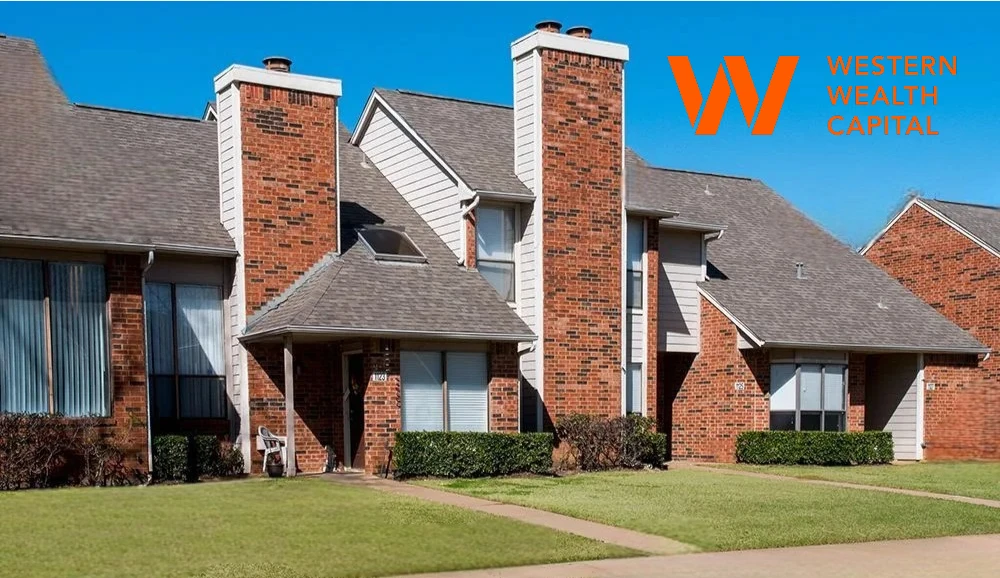
WWC and its investment partners closed on the 97-unit multifamily community of Park Place Townhomes. The transaction was advantageously purchased off-market with the assistance of Brian Murphy of Newmark Dallas. StepStone Real Estate (“SRE”), the real estate arm of private markets investment firm StepStone Group (Nasdaq: STEP), is a major equity partner in the transaction. Park Place is a follow-on investment into an existing WWC/SRE joint-venture initiated by a broader GP-led portfolio recapitalization in 2024.
Built in 1980, Park Place Townhomes features spacious two-story units with an average size of 1,116 square feet, offering residents a comfortable and well-designed living experience. As part of the acquisition, WWC assumes a 3.07% fixed-rate mortgage from the previous owner, resulting in an estimated $1.6 million in interest savings over the loan term compared to current market rates. The loan assumption was handled by Katie Runyan of Walker & Dunlop.
This Dallas-area acquisition strengthens WWC’s presence in the U.S. multifamily housing market and reflects the firm’s disciplined investment approach. Ideally situated between Dallas and Fort Worth, the property is just six minutes from Dallas-Fort Worth International Airport and within close proximity to major employers such as American Airlines headquarters, Lockheed Martin, and AT&T Stadium—all reachable within a 23-minute drive.
“This acquisition comes at an opportune time in the market cycle,” said Jay O’Connor, Vice President of Acquisitions at WWC. “We’re acquiring this asset at 42% below current replacement cost, which presents a compelling opportunity for equity growth and attractive returns.”
Doug Mather, WWC’s Chief Investment Officer, echoed this sentiment: “We’re seeing clear buying signals in the market, with property values down 30–40% from their peak, rent growth poised to rebound, and job growth remaining strong. Park Place Townhomes offers a rare chance to invest near the bottom of the market in a highly desirable product located in a prime area.”
About Western Wealth Capital
WWC has developed a proven system for investing in multifamily properties in key real estate markets across the U.S. WWC offers investment partners the opportunity to invest in properties with substantial value-add opportunities. Since its inception, WWC has successfully completed more than $6.4 billion in real estate transactions, acquiring 130 multifamily assets representing more than 29,000 total units.
WWC’s vision is to build wealth for its investment partners with exceptional returns. A people-first approach promotes excellence at every point, with highly efficient operations and a true commitment to our communities. The company’s current portfolio of assets under management includes 35 multifamily rental buildings across five different U.S. metropolitan areas located in the Sun Belt region.
Every housing market runs on the same two forces: supply and demand. They’re what push prices up or down, decide how fast homes sell, and influence whether it feels like a buyer’s market or a seller’s market. Once you get a handle on how these forces play out where you live, you’ll be in a much better spot to make the right move, whether you’re a homebuyer, seller, or real estate professional, understanding local market dynamics helps you make smarter decisions.
Right now in 2025, the U.S. housing market is shifting toward balance. Listings are climbing, price growth has cooled, and buyers have more options than they did in the past couple of years. For sellers, it means setting the right price and standing out matters more than ever. For buyers, it opens the door to better choices and more negotiating power.
Analyzing Local Market Dynamics
The easiest way to look at supply and demand is to think about it in plain terms. Supply is the number of homes for sale. Demand is how many people want to buy and how much they can afford. When buyers outnumber listings, sellers usually get multiple offers and higher prices. When there are plenty of homes sitting on the market, buyers have the upper hand and can push harder on price.
The numbers from mid-2025 tell the story. By July, inventory had gone up for 21 months in a row — almost 29% higher than the year before. Homes were also staying on the market about five days longer. That’s a big change from the fast-paced market of the last few years and shows things are shifting toward balance. Still, some regions like the South, Northeast, and Midwest are seeing more sales compared to a year ago.
You don’t need to be an expert to track this. Your local MLS or national sites like Realtor.com make it easy to see how many homes are listed, what the median price looks like, and how long homes are sitting before they sell.
Right now, many listings are sitting on the market without offers, and price growth has slowed to about 1% year over year. For buyers, that means more time and more choices. For sellers, it means pricing your home right and making sure it stands out.
Key Economic Factors Influencing Supply and Demand
What happens in your local economy plays a huge role in housing. When jobs are growing, new businesses are opening, or big projects are underway, more people move in and demand for homes goes up. When the economy slows, buyers can get nervous and hold back.
Mortgage rates also carry a lot of weight. This year, they’re not exactly cheap, but they’ve leveled off. A 15-year loan sits around 5.5%. That steadiness matters. Buyers may stretch their budgets, but they can at least plan without rates jumping week to week.
Other signs are worth tracking. Builder confidence slipped this year, hinting that fewer new homes could hit the market. Rental households are also growing faster than owner-occupied ones, showing that some people are choosing flexibility over long-term commitment.
Then there are the local shifts you notice close to home. A new highway interchange, a big employer setting up shop, or even new schools can drive fresh demand. On the flip side, more “price reduced” signs or delistings in your neighborhood are usually a sign that sellers are testing the market and not finding enough takers.
Leveraging Digital Tools for Market Insights
You don’t have to rely only on monthly reports to know what’s going on in your market. Digital tools give you a way to check the pulse almost in real time.
Start with housing sites. Zillow, Realtor.com, and Redfin all have dashboards that update daily. You can see how many homes are on the market, how prices are trending, and even how long houses are sitting before they sell. Google’s search data is another quick tool, if more people in your area are searching “homes for sale,” demand is picking up.
Social media platforms (Facebook, Instagram, and LinkedIn) can tell a story as well. Local Facebook groups often buzz when a new subdivision breaks ground. Instagram posts can show which neighborhoods buyers are excited about. On LinkedIn, agents share quick market takes that give you a feel for how competitive things are. If you share your own updates, maybe a short note about price cuts in your town or photos of a growing neighborhood, people start seeing you as someone in the know.
Even online ads give away clues. When searches in your zip code spike, it usually means more buyers are circling. Paying attention to those patterns helps you spot shifts before they’re obvious in the headlines.
Mastering Supply and Demand for Success
There isn’t a single formula that works for every market, but keeping tabs on supply and demand gives you a big advantage. Growth is just slower around 3% or less nationwide, which means balance is the theme.
For buyers, that balance shows up as more choices and a little more breathing room. You don’t always have to rush an offer the first weekend a house hits the market. For sellers, it’s about staying realistic. Pricing competitively and making your home stand out online matters more now than it did a couple of years ago.
The key is to check in often. Watch the data from housing sites, pay attention to what’s happening in your own neighborhood, and lean on digital tools and community input to see where interest is heating up. Mix those pieces together and you’ll have a clearer picture of where things are heading. That way, whether you’re buying, selling, or helping others, you’ll be making decisions based on what’s really happening not just headlines.
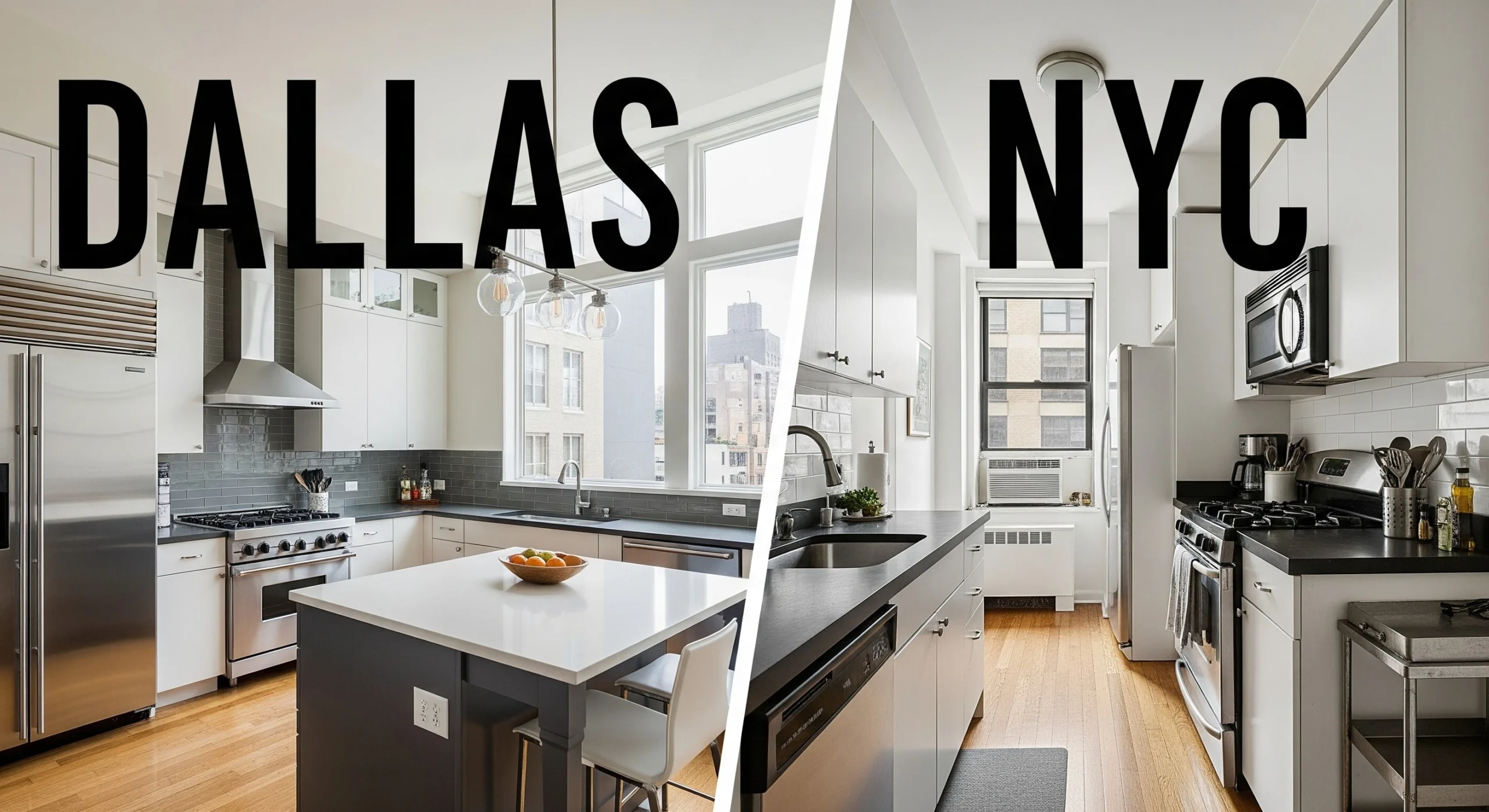
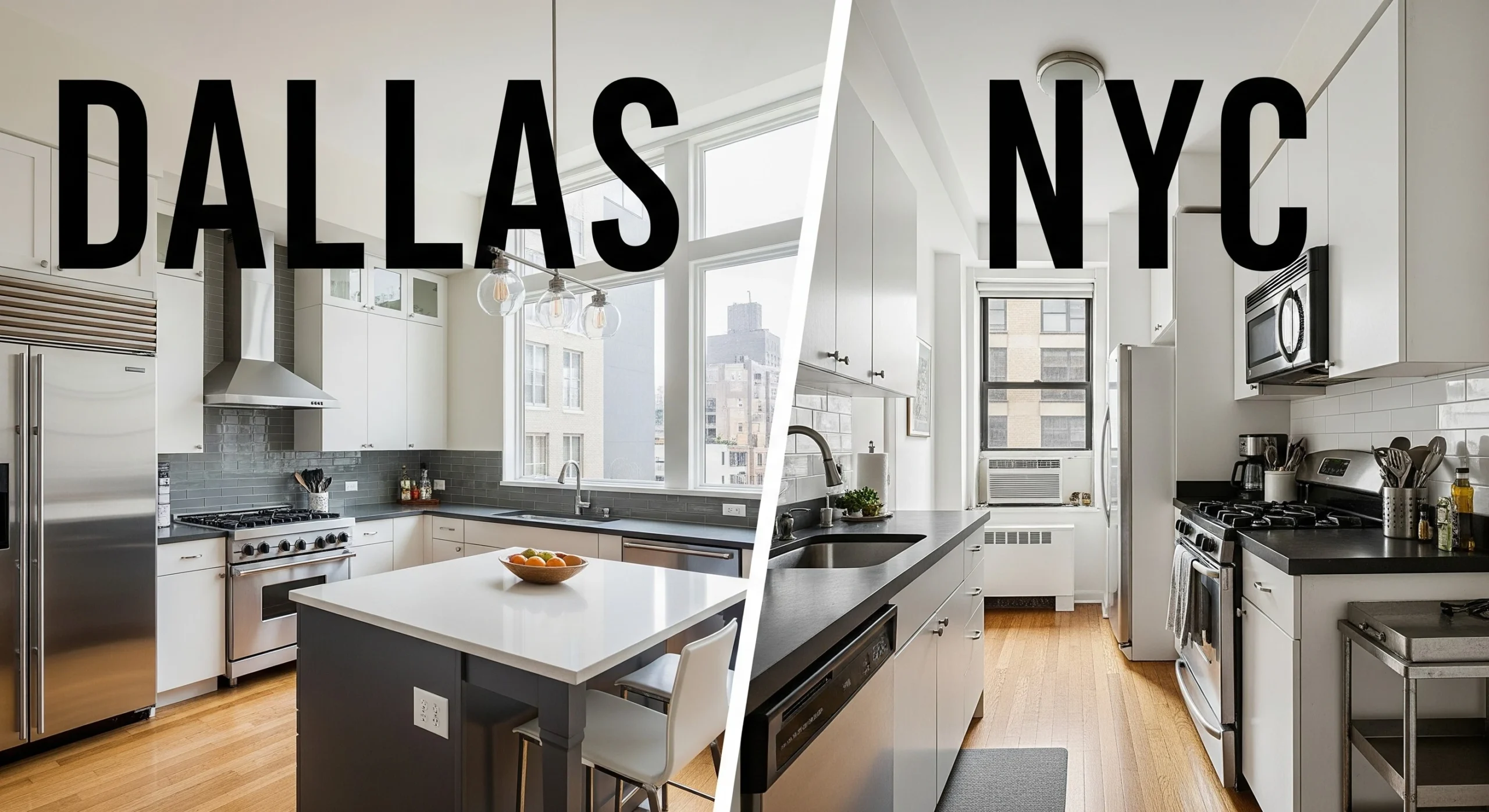
Trading your New York City apartment for a Dallas home is more than just a change of address. You’re swapping subway rides for spacious driveways and tiny kitchens for Texas-sized living spaces.
Thousands of New Yorkers make this move every year. They’re drawn by affordable housing, lower taxes, and the chance to finally own property.
This guide helps NYC residents navigate the big move to Dallas. You’ll learn what to expect and how to make your transition smooth.
Why New Yorkers Choose Dallas Over Other Cities
The math speaks for itself when comparing NYC to Dallas. Your NYC studio rent could buy you a mortgage payment on a three-bedroom house in Dallas. Texas has no state income tax, unlike New York’s hefty rates. This alone saves most people thousands of dollars annually.
You’ll actually have space for a dining table and a home office. Many Dallas homes include yards where you can garden or let kids play. Major companies from the Northeast keep relocating to Dallas. Goldman Sachs, JPMorgan, and other financial firms expanded their Dallas offices significantly.
The weather stays warm enough for outdoor activities most of the year. Say goodbye to shoveling snow and waiting for delayed trains in blizzards.
NYC to Dallas: The Biggest Lifestyle Changes
Space and Housing Differences
Your Dallas home will likely be three times larger than your NYC apartment. Most homes here include garages, multiple bathrooms, and walk-in closets. You’ll pay property taxes instead of just rent. These run about two percent of your home’s value annually.
Homeowners associations are common in Dallas suburbs. They maintain common areas but require monthly fees and following community rules.
You’ll need to buy lawn equipment and learn basic home maintenance. No more calling the super when something breaks.
Central air conditioning is standard in every Dallas home. You’ll run it from April through October most years.
Transportation Adjustments
You absolutely need a car in Dallas. Public transportation exists but doesn’t compare to NYC’s subway system. Factor in car payments, insurance, and gas in your budget. These replace your MetroCard costs but usually total more.
Traffic moves differently than NYC gridlock. Dallas highways flow quickly outside rush hour but require learning new routes. Parking is free almost everywhere except downtown. You’ll never circle blocks searching for spots like in Manhattan.
Get a Texas driver’s license within 90 days of moving. The DMV process moves faster than NYC’s DMV nightmare.
Social and Cultural Shifts
People actually make eye contact and say hello here. The friendliness might feel strange after NYC’s anonymity. Peak dinner time starts earlier around 6 PM. Most places close by 10 PM except in trendy neighborhoods.
You’ll find excellent food but different styles than NYC. BBQ and Tex Mex replace pizza and bagels as local staples.
The pace of life moves slower in Dallas. People take time for conversations instead of rushing everywhere. Sports fandom runs deep here. Cowboys, Mavericks, Rangers, and Stars fans take their teams seriously.
Finding the Right Dallas Neighborhood for Ex New Yorkers
Urban Areas That Feel Familiar
Uptown Dallas offers the most NYC-like experience. High rise apartments, walkable streets, and trendy restaurants create familiar energy.
Deep Ellum reminds people of Brooklyn’s creative neighborhoods. Live music venues and converted lofts attract artistic types.
Bishop Arts District feels like a village within the city. Small shops and local businesses create that neighborhood feeling.
Victory Park provides luxury high rise living near downtown. The American Airlines Center and restaurants are walking distance.
Family Friendly Suburbs
Plano offers excellent schools and established neighborhoods. Many NYC families choose this area for its safety and amenities.
Frisco continues growing with new developments and shopping. The Star Cowboys facility and FC Dallas stadium provide entertainment.
Coppell sits conveniently between Dallas and Fort Worth. Tree-lined streets and parks make it perfect for families.
Richardson provides diversity similar to Queens neighborhoods. International restaurants and markets serve various communities.
Best Value Areas
East Dallas offers affordable homes with character. These neighborhoods are gentrifying but still provide good deals.
Garland gives you more house for your money. It’s farther from downtown but perfect for remote workers.
Irving sits centrally between Dallas and Fort Worth. You’ll find reasonable prices and convenient locations here.
Mesquite provides suburban living at lower prices. New development is bringing fresh energy to this area.
Planning Your NYC to Dallas Move
Two Months Before Moving
Research moving companies that specialize in long distance moves. Get quotes from at least three companies for comparison.
Start selling or donating items you won’t need. Your window A/C units and space heaters won’t be needed.
Begin the apartment hunt in Dallas remotely. Virtual tours help narrow down neighborhoods before visiting.
Plan a house hunting trip to Dallas. Schedule it for a long weekend to see multiple properties.
Six Weeks Before Moving
Book your local moving company serving NYC. Summer moves book up fast, especially for long distance.
Start collecting important documents. Get copies of medical records, school transcripts, and tax returns.
Research Texas vehicle registration requirements. You’ll need to register your car within 30 days of arrival.
Begin using up pantry items and frozen foods. Moving these items costs more than replacing them.
One Month Before Moving
Submit change of address forms with USPS. Update your address with banks, credit cards, and subscription services.
Pack items you won’t need for the next month. You can pack up winter clothes since Dallas rarely gets very cold.
Arrange time off work for moving week. You’ll need several days to coordinate everything.
Two Weeks Before Moving
Deep clean your NYC apartment for your security deposit. Take photos documenting the condition you’re leaving it in.
Pack everything except daily essentials. The less you have to do on moving day, the better.
Confirm your Dallas housing details. Double check closing dates or lease start dates.
Say goodbye to favorite NYC spots. Get that last bagel and pizza slice before you go.
Moving Day: NYC to Dallas
Start early since you’re losing an hour to the time change. Texas is one hour behind New York.
Do a final walkthrough of your apartment. Check every cabinet, closet, and storage unit.
Hand over keys to your landlord or management company. Get written confirmation that you’ve returned everything.
For valuable items like jewelry or important documents, consider white glove moving services. These specialists handle precious belongings with extra care.
Keep essentials with you during the drive or flight. Pack medications, chargers, and a change of clothes in your carry on.
Your First Month in Dallas
Week One Essentials
Unpack your bedroom and bathroom first. Getting good sleep helps you adjust to your new home.
Find the nearest grocery store and stock up. Kroger, Tom Thumb, and HEB are major chains here.
Register your car at the Texas DMV. You have 30 days to get Texas plates and registration.
Set up utilities if not already connected. Electric service through Oncor is deregulated, so you choose your provider.
Get familiar with your immediate neighborhood. Walk around to understand the layout and meet neighbors.
Week Two Tasks
Open a local bank account if needed. Many NYC banks don’t have Texas branches.
Find new healthcare providers. Dallas has excellent medical facilities including UT Southwestern Medical Center.
Register to vote with your new address. Texas has different voting procedures than New York.
Join local social media groups for your neighborhood. NextDoor and Facebook groups share valuable local information.
Explore nearby restaurants and shops. Start discovering what your new area offers.
Weeks Three and Four
Get your Texas driver’s license. Bring proof of identity, residency, and your out of state license.
Register kids for school if applicable. Dallas ISD and suburban districts have different enrollment procedures.
Find your new favorite spots. Coffee shops, gyms, and parks help you feel at home.
Connect with other NYC transplants. Several Facebook groups specifically for New Yorkers in Dallas exist.
Start exploring Dallas beyond your neighborhood. Each area has its own character worth discovering.
Cost Comparisons: NYC vs Dallas Living
Housing Costs
Your NYC studio rent typically covers a Dallas mortgage. A $3,000 Manhattan studio equals a $300,000 Dallas home payment.
Property taxes average 2% of home value annually. Budget about $500 monthly for a $300,000 home.
Homeowners insurance costs less than renters insurance. Expect $150 to $250 monthly for good coverage.
HOA fees range from $30 to $500 monthly. These cover community maintenance and amenities.
Daily Living Expenses
Groceries cost about 30% less than NYC. Your weekly shopping bill drops noticeably.
Restaurant meals cost significantly less. A nice dinner for two runs $80 instead of $150.
Gas averages $3 per gallon currently. You’ll spend about $150 monthly on fuel.
Car insurance runs $150 to $200 monthly. This replaces your MetroCard but costs more.
Utilities average $200 monthly for a house. This includes electricity, water, and gas.
Building Your Dallas Life
Making Friends and Connections
Join professional organizations in your field. Dallas has active chapters for most industries.
Attend community events in your neighborhood. Block parties and festivals happen regularly.
Try recreational sports leagues. Kickball, softball, and volleyball leagues are beginner-friendly.
Volunteer for local causes you care about. Dallas has many nonprofit organizations needing help.
Take classes at community colleges or recreation centers. Learn the Texas two-step or BBQ techniques.
Embracing Texas Culture
Learn basic Texas etiquette and customs. Holding doors and saying “y’all” becomes natural quickly.
Try local Texas traditions. State Fair of Texas, rodeos, and Friday night football are cultural experiences.
Explore Texas beyond Dallas. Austin, Houston, and San Antonio make great weekend trips.
Understand Texas pride. Locals love their state and appreciate newcomers who embrace it.
Common NYC to Dallas Moving Mistakes
Don’t assume everything works like NYC. Texas has different laws, customs, and ways of doing business.
Don’t skip researching neighborhoods thoroughly. Each Dallas area has distinct characteristics affecting daily life.
Don’t underestimate summer heat. July and August temperatures regularly exceed 100 degrees.
Don’t forget to budget for a car immediately. You can’t function in Dallas without personal transportation.
Don’t isolate yourself in your home. Making an effort to meet people helps you adjust faster.
Making Your Move Successful
Moving from NYC to Dallas opens incredible opportunities. You’ll own property, have space, and keep more of your income.
The adjustment takes time but gets easier each week. Most NYC transplants report loving their Dallas life within six months.
Focus on what Dallas offers rather than comparing everything to New York. Each city has unique advantages.
Stay open to new experiences and friendships. Dallas welcomes newcomers who embrace the local lifestyle.
Remember that moving represents growth and new adventures. Your Dallas chapter can be even better than your NYC memories.
Ready to Make Your Move?
Professional movers understand the unique challenges of long distance relocations. Whether you’re moving a studio apartment from Brooklyn or a full household from Manhattan, experienced movers ensure your belongings arrive safely.
Start planning your NYC to Dallas move today. Research neighborhoods, visit Dallas, and prepare for your exciting transition.
Welcome to Dallas, where your homeownership dreams become reality. The city’s warmth extends beyond the weather to the genuine hospitality you’ll experience daily.
The housing market in California continues to grow, with demand often surpassing the supply of available homes. Competition is fierce, and many buyers struggle to secure financing under traditional bank rules. Strict qualification standards often exclude capable borrowers such as entrepreneurs and even seasoned investors.
ID Mortgage Broker addresses this challenge by offering lending strategies designed for today’s diverse buyers. Through flexible financing, clients gain an edge in a fast-moving market and can pursue opportunities with greater confidence.
Meeting the Needs of Modern Borrowers
Financial lives rarely follow a single pattern. Many buyers are small business owners, independent contractors, or professionals with non-traditional income streams. For them, rigid documentation requirements create barriers that do not reflect their actual financial health.
Programs like the no-doc loan in California show how alternative lending adapts to these realities. By recognizing cash flow, business revenue, and other forms of stability, these loans expand access to financing. This flexibility enables buyers to secure properties that might otherwise be out of their reach.
Flexible Lending Options for Today’s Buyers
Alternative lending uses a broader view of financial health. Instead of relying solely on tax returns or W2 forms, lenders also consider bank statements, business income, and consistent cash flow. This approach gives buyers with unconventional income sources a fair chance to qualify for financing.
Flexibility in Documentation
Income can be shown through contracts, rental earnings, or personal statements rather than standard paperwork. This flexibility opens the door for more borrowers to secure loans and pursue ownership.
Streamlined Approvals
With fewer documentation hurdles, approvals move faster. Shorter timelines give buyers an edge in real estate markets where homes often sell within days.
Why It Matters in Competitive Bidding
In many markets, properties often receive multiple offers. Buyers who can act quickly and present flexible documentation are better positioned to win contracts. This speed and adaptability help them secure homes in sought-after neighborhoods.
Who Benefits Most?
Flexible lending is designed for buyers who don’t always fit the “traditional” borrower mold. Looking beyond rigid paperwork, it opens doors for people in many different situations. Here are a few examples:
Entrepreneurs & Small Business Owners
Have strong earnings but inconsistent tax filings.
Benefit from qualifying with bank statements or business revenue instead of W-2s.
Gain access to homeownership while continuing to grow their business.
Real Estate Investors
Often move quickly to secure properties in competitive neighborhoods.
Avoid delays caused by heavy documentation requirements.
Benefit from faster approvals that allow them to act before competitors.
Families Seeking a Second Home
Already own a primary residence but want a vacation home or rental property.
Standard banks may hesitate due to existing mortgages.
Flexible loan structures help them qualify, combining lifestyle upgrades with long-term financial returns.
The Broker’s Role
The right lending strategy can determine a buyer’s success. Mortgage brokers guide clients through financing options and make sure each loan fits their specific circumstances. Their knowledge gives buyers the confidence to move forward in a highly competitive environment.
Connectors: Brokers link clients with lenders and loan programs that reflect their financial situation.
Educators: They explain the benefits and risks of different financing choices, giving buyers the insight to make sound decisions.
Strategists: Brokers position clients to succeed in markets where speed and preparation carry weight.
Trusted partners: ID Mortgage Broker delivers tailored solutions designed to meet immediate needs while supporting long-term ownership and investment goals.
In real estate, the right broker acts as a partner who equips buyers with the tools, knowledge, and confidence to secure the right property at the right moment.
Looking Ahead: A More Inclusive Market
Alternative lending is steadily moving toward mainstream adoption. As more borrowers rely on non-traditional income, the demand for flexible loan options will continue to rise. Technology will streamline the process with faster approvals and easier documentation, while brokers remain essential in guiding clients to the right solutions.
A housing market that embraces inclusivity and flexibility creates more opportunities for families, investors, and entrepreneurs to participate.
Opening Doors with Flexible Lending
Flexible lending is creating fresh chances for homeownership. With the right broker at your side, intimidating financial hurdles shrink into small steps you can actually manage. Buyers gain the confidence to move fast, grab the property they want, and start building a stronger future in one of the most competitive real estate environments in the country
Ready to make your move? Call a trusted mortgage broker today and see how flexible lending can turn your goals into keys for the front door.
A lot of Canadians are asking the same question: should I rent or buy? Maybe you’ve compared rent listings with mortgage payments and still aren’t sure which path makes more sense.
Image Source: pexels.com
The mortgage vs rent equation is complicated by homeownership costs and shifting interest rates, and whether you will stay put long enough to make buying worth it.
The real question is how each choice fits your finances, job stability, and plans for the next decade. That is what we will unpack here without repeating the same generic tips.
Rent vs. Buy: The Financial Reality Check
Before deciding between renting vs buying, look beyond the headline monthly payment. Both come with a set of costs that kick in before you even settle in.
Buying a Home
Upfront: Down payment (minimum 5 percent on the first $500,000 in Canada), closing costs, inspection fees, and land transfer tax (which varies by province). On a $600,000 home, that’s often $35,000 to $50,000 just to get started.
Ongoing: Principal and interest mortgage payments, property taxes, insurance, and maintenance. These homeownership costs can shift, especially if interest rates change.
The benefit: Long-term equity and the chance for real estate investment gains if property values climb.
Renting a Home
Upfront: Security deposit, first and last month’s rent, plus moving expenses.
Ongoing: Monthly rent, utilities (if not included), and occasional renter’s insurance.
Potential upside: Flexibility, lower financial commitment, and fewer unexpected bills.
The real choice comes down to affordability and your plans for the next five to ten years. If you are not sure where you stand, a quick conversation with a mortgage advisor can give you a clear, personalized breakdown based on facts.
Housing Market Trends in 2025
In May 2025, the average asking rent in Canada was about $2,129 per month. That is slightly lower than last year, but still well above pre-2020 levels.
Now compare that to owning, the average monthly mortgage payment is $3,500 to $5,500, based on current home prices and interest rates. The gap is wide, and it’s not just about the monthly bill. Buying adds property taxes, insurance, and maintenance costs, while renting avoids those but may come with rent increases over time, and you’re not building equity.
Lifestyle Factors to Consider
Money matters, but so does how you want to live. The renting vs buying choice can shape your day-to-day life more than you might think.
When Renting Makes Sense
Mobility: If you see yourself changing cities or even just switching neighborhoods in the next few years, renting keeps you flexible.
Low upkeep: Broken appliance? That’s your landlord’s problem. You avoid the surprise repair bills that come with homeownership costs.
Lower commitment: A lease usually lasts a year, while a mortgage ties you down much longer.
When Buying Works Better
Stability: You don’t have to worry about a landlord deciding to sell or raising the rent.
Customization: Paint the walls, knock down a wall, plant a garden, homeownership lets you renovate or customize as you like.
Long-term planning: If you plan to stay put for 5+ years, you start building equity instead of paying someone else’s mortgage.
In the end, financial planning for homebuyers or renters is about whether you value the freedom to move or the security of staying. The right answer changes depending on your career, relationships, and how much risk you’re willing to manage.
How to Know Which Side You’re On
When you simplify the decision, your choice between renting vs buying comes down to three questions:
How Long Will You Stay Put?
Less than 3 years? Renting usually wins.
Five years or more? Buying starts to make sense, especially if your market is trending upward and you’re thinking about real estate investment as part of your long-term wealth plan.
How Stable is Your Income?
If your paycheck could take a hit or your job might move you, renting keeps you flexible.
If your income is steady and you’ve built an emergency fund, you can handle the surprise costs that come with homeownership. That stability also makes it easier to work through the financial planning for homebuyers process with confidence.
What’s Your Debt-to-income Ratio?
Mortgage lenders will look closely at your debts before approving you. If your debt-to-income ratio is high, you may want to rent while lowering it, using that time to plan for a smarter entry into real estate later.
These answers will point you toward the choice that fits your financial capacity and your life stage, not just what the headlines suggest.
Your Next Move Starts Here
In 2025, renting vs buying isn’t a universal math problem with one correct answer. It’s a personal calculation that blends your finances, stability, willingness to commit, and see it as a long-term investment. Others will rent, protect their flexibility, and wait for the market to shift.
What matters is making the call based on real numbers and a plan that fits your situation, not your neighbor, not the market chatter, and not some outdated rule of thumb.
In Akron, it’s not unusual to see homes sold just the way they stand. Maybe the roof has worn out after one too many Ohio winters, the basement leaks during heavy rain, or the kitchen still looks like it belongs in the 1970s. Whatever the case, selling your house “as-is” can be a smart move if you’d rather not sink money and time into fixing it before moving on.
What “As-Is” Means in Akron
When you put your Akron house on the market as-is, you’re letting buyers know that you won’t be making repairs or upgrades before the sale. Some sellers even leave behind furniture, appliances, or boxes they don’t want to move. Once the closing is done, everything becomes the buyer’s responsibility.
That said, Ohio law still requires you to disclose known problems. If the foundation has shifted, the furnace doesn’t work, or there’s been past fire damage, you have to put that in writing. Most sellers find that being upfront not only protects them legally but also saves time, buyers who stick around after hearing the full story are more serious.
Pricing Your Property Fairly
Akron’s housing market is mixed. As of early 2025, the median price for a single-family home in the city is around $145,000, but houses that need work often sell below that mark. To set the right price, look at sales in your own neighborhood. A fixer-upper in Firestone Park won’t draw the same price as a similar property in Highland Square, even if the square footage is close.
If you want buyers to take you seriously, your asking price has to reflect the home’s condition. Overpricing an as-is house only drives buyers away.
Choosing How to Sell
You’ve got a few paths:
Work with a real estate agent. An experienced Akron agent can market your home widely and get you more offers, but traditional buyers usually want inspections and bank financing. If the house doesn’t meet the lender’s standards, the deal may drag on or fall through.
Sell it yourself (FSBO). This saves you the commission but puts all the work—showings, negotiations, contracts on your shoulders.
Go with a cash buyer or investor. Akron has plenty of investors who buy homes in any condition. They usually close fast, sometimes in a week or two, without appraisals or financing delays. The price will be lower, but you trade dollars for speed and certainty.
Inspections and Disclosures
Even if you sell as-is, most buyers will want an inspection. If they find a big surprise—say, old knob-and-tube wiring or a major plumbing issue, they may walk away. One option is to order your own inspection before listing. That way you know what’s coming, and you can share the report with buyers. Being open about the condition from the start often makes negotiations smoother.
Nik Hilmoe, owner of Snap Sell Homebuyers, often points out that a pre-listing inspection can save sellers time and stress. By knowing the condition of your Akron home ahead of time, you can disclose any issues upfront and avoid surprises that might derail a deal later.
Negotiations You Should Expect
Most buyers see as-is homes as a chance to bargain. Some will make a lower offer right away. Others will come back after the inspection asking for credits or help with closing costs. If you’ve already priced your home with its condition in mind, stand by that. Let buyers know it’s priced for its current state.
Still, sometimes giving a little, like covering part of the closing costs can keep the deal alive. The goal is to know what you’re willing to bend on and what’s non-negotiable for you.
Legal Details in Ohio
Don’t forget the paperwork. In Ohio, sellers have to fill out a Residential Property Disclosure Form. It’s not optional, and skipping it can land you in court later. If you’re selling without an agent, it’s worth hiring a local real estate attorney to review your contract. Make sure the agreement clearly states that the property is being sold as-is.
Wrapping It Up
For Akron homeowners, selling a house as-is can be the cleanest way forward. You may not get the highest sale price on the block, but you’ll avoid months of repairs, contractors, and second-guessing buyers.
If you’re honest about the condition, price it fairly, and choose the selling method that matches your priorities, you’ll reach the closing table with fewer surprises. In the end, selling as-is isn’t about giving up, it’s about knowing what matters most to you and moving on with confidence.