Dallas-Fort Worth metroplex — TXRE bought Arlington Interlink during the post-pandemic office freeze, renovated it, raised rents and pushed occupancy to 95 percent before selling the building to Hielan Real Estate.
Dallas-based TXRE Properties has sold Arlington Interlink, a north Arlington office property it bought during the post-pandemic office freeze and nearly filled to capacity. The buyer is Hielan Real Estate. The price was not disclosed. TXRE said occupancy rose from 36% to 95% before the sale, and asking rents climbed from $16 to $24 per square foot.
TXRE’s play was simple. Buy a distressed office asset, spend money on it, and lease it to tenants that still need physical space. The roughly 80,000-square-foot property at 1701 E. Lamar Blvd. sits just off Interstate 30 and State Highway 360, near Arlington’s Entertainment District.
TXRE announced in 2022 that it had acquired the building and would reposition it as Arlington Interlink. Current marketing materials describe a renovated, late-1990s asset with upgraded common areas, on-site management and ample parking.
One tenant helps explain why the turnaround worked. In 2024, Munich-based Sportec Solutions established its U.S. headquarters in the building. Arlington officials said the move came with a $1 million performance grant through the Arlington Economic Development Corporation and was expected to create 17 jobs. Sportec, which supplies live match data and video assistant referee services, now lists Arlington Interlink as its U.S. address.
The Sportec move also highlights a local economic strategy. Arlington officials backed the headquarters with public incentive money, and the building sits in a corridor shaped by sports, hospitality and regional access. That combination points to a clear local strategy, use targeted incentives to widen the area’s economic base beyond game-day traffic.
Supporters argue this is exactly how local economic development should work by pulling in jobs and anchoring a high-value tenant in an office market many investors are still wary of. Critics might argue the public return is narrower than it looks, and that the same dollars might go farther in transit, housing or workforce development. Both sides have a valid point.
The deal also highlights a stark reality about the DFW office market, showing that the sector has not fully recovered. It proves that certain buildings can still succeed if the fundamentals are in place, like highway access, fresh capital, realistic scale, ample parking, and tenants with a practical reason to be there. This is a much more realistic scenario in a region where some Arlington office properties still face distress and Dallas leans heavily into office conversions to clear out excess supply.
For the buyer, this looks like a bet on one renovated asset with momentum, not a broad bet on the overall office market. For Arlington, it is another test of whether public incentives, the draw of the entertainment district, and private redevelopment can keep aging suburban office stock economically useful in a market that is still picking winners and losers.
The Grand Hyatt DFW is located directly inside Terminal D at Dallas/Fort Worth International Airport
DALLAS — The Grand Hyatt hotel inside Dallas Fort Worth International Airport has completed a $34 million renovation that adds guest rooms and expands meeting space, an upgrade the company and airport officials framed as part of a broader push to keep pace with the region’s growth and a wave of new construction at one of the nation’s busiest aviation hubs.
The hotel, connected to Terminal D, now has 315 rooms, up from 298, Hyatt and airport leaders said as they marked the project’s debut on Feb. 11. The renovation also reworked event and conference areas, including what the hotel described as 20,000 square feet of updated meeting and event space and a renovated 6,600-square-foot ballroom.
Jeff Babcock, the hotel’s general manager, said the renovation’s biggest operational shift was on the ninth floor, where previously underused space has been converted into corporate-focused meeting areas. The changes include a new Flight Deck meeting room with views of Terminal D’s runway and a DFW Board Room designed for 18 attendees, also oriented toward the airfield.
“The ninth floor was dormant,” Mr. Babcock said, adding that the additions were intended to serve business travelers and local companies looking for meeting space with immediate airport access.
In a statement, Ripton Melhado, Hyatt’s vice president of field operations, said the renovation aimed to offer “more refined accommodations” for domestic and international travelers while modernizing conference and event spaces and updating the hotel’s culinary options.
Airport leaders used the reopening as a moment to underscore DFW’s pitch to airlines, businesses and convention planners: that the airport is not simply a place to pass through, but an economic front door for North Texas. Chris McLaughlin, DFW’s chief executive, said in a statement that the revamped property would remain a premier destination in the region and reflect a “commitment to excellence” as DFW serves what he described as a growing global community.
Beyond the meeting areas, the renovation rebuilt the fitness center on the first floor, maintaining its prior scale, Mr. Babcock said. The lobby was redesigned with more flexible seating, and first-floor meeting space was enhanced. The hotel’s Grand Met restaurant and lounge also received updates intended to increase seating capacity and introduce a new global fusion concept.
Hyatt said the renovation was announced last May, with construction beginning in July. The hotel remained open throughout the project, Mr. Babcock said. Design One Studio served as the architectural firm.
The Grand Hyatt at DFW opened in July 2005, and Hyatt Hotels Corporation, based in Chicago, now operates three properties at the airport, including a Hyatt Regency and a Hyatt Place DFW.
The timing of the renovation is notable less for the new carpet and conference rooms than for the construction boom surrounding it. DFW is in the middle of a $9 billion capital improvement program known as DFW Forward, which calls for renovating Terminal C, adding five gates to Terminal A and building a new Terminal F.
American Airlines, whose headquarters are in Fort Worth and which has long treated DFW as its principal hub, is also expanding at the airport. The airline is pursuing an expansion tied to Terminal F, a project it has said would make DFW the largest single-carrier hub in the United States. The scope grew last year when American announced a $4 billion investment that the company said would double the terminal to 31 gates.
During the company’s January earnings call, American’s chief executive, Robert Isom, said the airline planned to add new satellite facilities in Terminals A and C and move to what he described as a 13-bank operation, which is an approach to scheduling flights in concentrated waves to accommodate a growing local market. Reliability, he said, would be central to serving one of the country’s fastest-growing metropolitan areas. He also said American was approaching 100,000 daily customers at DFW.
Taken together, the hotel’s renovation and the airport’s broader buildout illustrate a familiar dynamic in public infrastructure: large transportation assets rarely operate as standalone utilities. They anchor a wider ecosystem of private investment, including hotels, restaurants, meeting space and logistics services, that both benefits from and reinforces public spending on capacity.
For airport operators and regional leaders, the pitch is straightforward. Expanded terminals and gate capacity can attract additional service, which can help sustain corporate relocations, tourism and convention business. A renovated on-airport hotel, especially one with substantial meeting space, effectively turns layovers and travel days into usable work time, lowering the friction for companies that rely on frequent travel or want to hold events without adding an extra commute into the city.
But the same ecosystem raises policy questions that airports increasingly confront as they behave like small cities. When capital plans scale into the billions, the public interest is often defined not just by passenger convenience, but by how growth is managed: congestion on access roads, pressure on surrounding neighborhoods, environmental impacts, and whether the economic gains are broadly shared.
In practical terms, the debate is less about whether an airport should modernize and more about how to balance rapid expansion with accountability, resilience and long-term flexibility in an industry that can shift quickly with economic cycles and changes in business travel habits.
For now, DFW and Hyatt are betting that the fundamentals in North Texas, including population growth, corporate presence and the airport’s role as a national connector, will keep demand strong. The newly finished Grand Hyatt, with more rooms and a runway-facing “Flight Deck” built for board meetings, is positioned as one more piece of that broader bet.
The Crescent Office. Image courtesy of crescent.com
Crescent Real Estate has closed a new $241.5 million investment fund to target commercial property deals, leaning heavily into high-end office real estate even as fundraising across private markets remains under pressure.
The Fort Worth based firm’s latest investment vehicle, GP Invitation Fund IV, came in just under its $250 million target, according to the Dallas Business Journal. A federal securities filing shows the fund was structured for a $250 million offering and had reported $207.36 million sold to 43 investors as of Dec. 19, 2025. This suggests the bulk of the capital was in place heading into year-end, as regulatory disclosures often lag behind final closes.
The timing is significant. Global private equity fundraising fell for a third straight year in 2025, sliding 12.7% to $480.29 billion from $551.16 billion in 2024, according to S&P Global Market Intelligence. Additionally, fewer funds launched in 2025 than the year prior.
A concentrated bet on “flight towards quality” assets
While Crescent’s mandate is broad which involves spanning office, hospitality, and multifamily sectors, its recent moves show where it sees the clearest upside being trophy office space in prime submarkets.
The firm reports a portfolio totaling more than $16 billion in investments, including 67 million square feet of office space, 10,100 multifamily units, and 9,300 hotel keys with these figures based on its existing portfolio as of February 2025.
That scale is now being deployed within a very specific geography
In Uptown Dallas, Crescent has been snapping up marquee office towers. In late 2025, the company bought the 19 story office building at 2100 McKinney Avenue which is an Uptown property with prominent CBRE signage acquired using $170.4 million in financing, according to The Real Deal’s review of deed records. The deal closed Dec. 17.
A few months earlier, Crescent acquired Texas Capital Center at 2000 McKinney Avenue representing one of the biggest office trades in the Dallas and Fort Worth market in 2025. The 21 story, roughly 457,000 square foot tower is anchored by Texas Capital Bank, which has a lease running through 2040.
Fort Worth is becoming a new office hub taking shape as Crescent is also building at home, where in April 2025, the firm broke ground on “Crescent Offices West,” a 170,000-square-foot office building at its Fort Worth campus that it says will be anchored by JPMorganChase and open in 2027.
That project isn’t just a real estate play because it’s part of a broader shift in how business districts form in fast growing Sun Belt metros. When a major employer anchors a high-end building outside a traditional downtown core, it acts as a magnet for other tenants, restaurants, and services.
For city leaders, that’s a win if it expands the tax base however it also raises hard questions about what happens to older office stock and legacy central business districts.
The policy backdrop: interest rates, downtown strategy, and what comes next
Here’s the bigger picture noting that commercial real estate doesn’t move in a vacuum. The Federal Reserve’s pandemic era low rate environment helped fuel dealmaking and fundraising, and the higher rate era that followed has reshaped the math by compressing values, tightening lending, and making investors far pickier.
That’s where public policy quietly enters the story as follows.
Monetary policy sets the cost of capital. Higher rates don’t just slow transactions but they also create market dislocation thereby offering windows where well capitalized buyers can negotiate better pricing especially on assets that still have strong tenants and long leases.
Local policy determines whether downtowns rebound or stagnate. Cities can influence office outcomes through zoning flexibility, permitting speed, transit access, and incentives for conversions of obsolete buildings. If capital flows mainly to “best in class” properties in prime districts, the policy challenge becomes managing the obsolete inventory meaning aging buildings that can no longer compete on amenities, efficiency, or location.
Economic development becomes a tug of war. Fort Worth and Dallas like many large metros are competing submarkets inside one regional economy. When investment and leasing momentum cluster in specific nodes such as Uptown Dallas or the Cultural District area in Fort Worth then public sector decisions around infrastructure and placemaking can accelerate that clustering.
None of that guarantees Crescent’s strategy will pay off. But it explains why a firm can be bullish on trophy office while much of the broader office market still looks shaky since the office sector is increasingly bifurcated meaning it is split between premium buildings with strong tenancy prospects, and everything else.
For Crescent, Fund IV signals that its investors believe this divergence is real furthermore that the firm can keep finding deals on the right side of it.
Hands-on, traditional businesses often need to show they are present in a new market before taking on physical space. A virtual office supports that need by adding a recognised business address and local footing alongside existing operations, without changing how the core business works day to day.
From there, the focus shifts to practical, real estate-related ways this setup supports everyday operational decisions.
[wpchtmlp id=523322]
Establish a Credible Business Address
An address is often the first thing people quietly judge. You may notice this when opening a bank account, submitting registration papers, or sending supplier documents. A recognised commercial location tends to remove friction from those early exchanges. It makes the process feel routine, not questioned.
For businesses that spend most days on-site or with clients, this approach avoids holding space that stays empty. Some owners pair this setup with a small office space used only when paperwork or meetings require it, keeping the public-facing presence steady without disrupting daily operations.
Separate Business Premises from Personal Property
Using a home address can start to feel uncomfortable once operations pick up. Letters arrive at odd times. Personal details sit on public records. That boundary starts to blur, sometimes without you noticing right away. A dedicated business address restores that separation without forcing a property purchase.
This separation also changes how real estate investment conversations show up in day-to-day planning. When the business address stands on its own, property decisions stop feeling tangled with personal living arrangements. You may notice it when weighing future space needs or talking through longer-term plans. The focus stays on what the business actually needs at that point. If circumstances change, the address can shift with the operation, without pulling personal property into every decision.
Reduce Fixed Property Commitments
Paying for space that rarely gets used tends to weigh on decision-making. You might notice it during quiet weeks when rent still leaves the account on schedule. A flexible setup removes that pressure. Space becomes something you use when needed, not something you feel stuck justifying.
Many traditional businesses operate in the field, on client sites, or across locations. Keeping property costs tied to how often the space is actually used takes pressure out of planning. Adjustments happen faster, without lease renegotiations hanging over every change.
Maintain Access to Formal Meeting Spaces
Some discussions need walls, a table, and privacy. You feel it when contracts come out or when first impressions matter. Access to bookable meeting rooms covers those moments without forcing the entire property strategy to revolve around them.
The room exists when required, then disappears from the balance sheet. This suits businesses that meet clients occasionally but still care how those meetings feel. The setting supports the conversation without demanding attention when no meetings are scheduled.
Support Business Registration and Compliance Needs
Official correspondence needs a reliable place to land. Problems arise when letters bounce between inboxes or turn up late because nobody was around to accept them. A recognised business address gives registrations, notices, compliance mail, and other paperwork a clear destination.
Post handling settles into a routine rather than guesswork. When you are already juggling suppliers, staff, and clients, that steady flow trims pressure that can quietly build up. Administrative work stays contained, instead of spilling into the rest of the day.
Enable Expansion Without Immediate Relocation
Entering a new area does not always start with moving desks or people. Often, it begins with presence. Setting up an address in another business district allows conversations to start without committing to premises right away. You might notice how this lowers pressure during early supplier talks or client outreach. If momentum builds, the business already feels established there. If plans shift, there is no unused space to unwind. Expansion stays measured, not rushed.
Improve Day-to-Day Property Management Efficiency
Property-related interruptions tend to sneak into the workday. Missed calls, deliveries arriving mid-task, visitors turning up unexpectedly. A supported office arrangement absorbs much of that background noise. Calls get answered. Mail gets handled. You stay focused on running the business.
Over time, it often feels quieter. Not silent, just more manageable. That steadiness matters when attention is already stretched across operations, staff, and customers.
Get in touch with IW Service Office today to discuss your virtual office needs.
Sydney is a city built on ambition. From tech startups and creative studios to growing service businesses and remote teams, professionals here move fast and expect environments that help them stay sharp. That is why coworking spaces have become one of the most valuable resources for modern businesses. What used to be considered an alternative to traditional offices is now a strategic advantage for companies that want flexibility, reduced costs and higher productivity.
If your business is looking for a smarter way to operate in a competitive market like Sydney, here is why choosing these coworking spaces might be the best decision you make this year.
Smart financial decisions start with flexible costs
Renting a private office in Sydney can be expensive, unpredictable and tied to long leases. On top of that, you need to consider furnishing the space, maintaining utilities, paying for cleaning, buying equipment and setting up internet. These costs add up quickly.
Coworking spaces remove the burden. Instead of committing to long-term commercial leases, you pay for what your team actually uses. Whether you need a single desk, multiple offices or a hybrid setup, you can adjust month to month. This flexibility protects your cash flow and allows you to grow at your own pace without risk.
Many Sydney coworking providers include everything in one price. Internet, electricity, meeting rooms, cleaning, printing and kitchen facilities are already covered. You get a premium environment without the overheads that traditionally come with office management.
A professional image without the corporate hassle
Sydney clients expect professionalism. Meeting a new customer in a noisy café or your living room simply does not present the image most businesses want. Coworking spaces solve this easily. You get access to polished boardrooms, quiet meeting spaces, modern lounges and reception areas that help you make a strong and credible first impression.
Even if your team is small, your brand feels bigger and more established. You can meet partners, host interviews, deliver presentations and run workshops in spaces that reflect the quality of your business.
Your team gets more done in a purpose-built environment
Productivity is one of the greatest advantages of coworking. Unlike working from home, where distractions can easily interrupt your day, coworking spaces give you a structured, energising environment designed for focus. High-speed internet, quiet zones, private offices, breakout areas and ergonomic workstations all contribute to smoother, more efficient workdays.
Your team benefits from clearer boundaries between home and work, which boosts concentration and reduces burnout. Coworking environments in Sydney also tend to attract motivated, creative and driven individuals. Being surrounded by people who are focused naturally elevates your own productivity.
Networking happens naturally, not forcefully
Connections matter in Sydney. Whether you are looking for partners, contractors, investors or new clients, your workspace can play a key role in shaping your network. Coworking spaces bring together professionals from different industries and at different stages of their careers. This creates a natural, low-pressure environment for collaboration.
You might meet a graphic designer while making coffee, a developer while booking a meeting room or a marketing consultant during a community event. These casual interactions often lead to valuable opportunities that would not happen in a private office or at home.
Access to amenities that boost satisfaction and well-being
Good work requires the right environment. Coworking spaces typically offer amenities that improve both productivity and well-being. These may include:
Comfortable lounges
Private phone booths
Modern kitchens
High-quality coffee and tea
Event and workshop areas
Showers and end-of-trip facilities
Outdoor terraces
Gym or wellness areas
Having these resources available throughout the day makes the work experience more enjoyable. It also supports healthier work habits, such as taking breaks, stretching, walking or socialising.
Coworking supports hybrid teams better than traditional offices
Many Sydney businesses now operate with staff working both remotely and onsite. Traditional offices struggle with this flexibility because they require full-time space commitments. Coworking spaces, however, are built for hybrid models.
You can offer your team hot desks or part-time access. You can book meeting rooms only when needed. You can scale up or down based on seasonal workloads or new projects. This model keeps your operations agile while giving your staff professional environments whenever they need them.
Location is a competitive advantage
Coworking hubs are spread across Sydney in strategic areas. Whether you prefer the energy of the CBD, the creative feel of Surry Hills, the convenience of North Sydney or the coastal lifestyle of Bondi, there is a space that fits your style. Being close to transport, restaurants, gyms, and client hubs makes your workday more efficient and enjoyable.
Choosing the right location can reduce commuting stress, attract better talent and make your business more appealing to clients.
You stay adaptable in a fast-changing business landscape
Sydney’s business environment changes quickly. Markets change, new opportunities show up, and fresh challenges pop up all the time. Coworking spaces help you stay agile through all of that. If you want to grow your team, test a new idea, open a second base, or shrink your footprint for a while, you can make those moves without getting stuck in a long lease or paying for an office build-out.
Being able to adapt is one of the most important advantages a modern business can have. Coworking builds that agility into how you work every day.
Final Thoughts
Modern coworking spaces offer far more than shared desks. They provide strategic flexibility, financial savings, professional facilities and a community that can help your business thrive. In a city like Sydney, where speed, innovation and connections matter, choosing coworking is not just a trend. It is a smart business move.
Whether you are a startup founder, a growing small business, a freelancer or a remote team looking for structure, coworking gives you the environment and support you need to perform at your best. If your goal is to operate smarter, not harder, a coworking space may be the solution that transforms the way your business works.
Before you book anything, take a minute to verify that your movers are actually licensed. In Texas, the Department of Motor Vehicles (TxDMV) requires every household mover to hold an active certificate and follow specific state motor carrier rules. You should see their certificate number clearly displayed on their trucks, website, and any quote they hand you. You can easily check if a license and insurance are active using the “Truck Stop” tool on the TxDMV website. If you’re moving across state lines, they also need a valid USDOT number.
Be wary of red flags mentioned in the TxDMV’s “Smart Moving” brochure, like prices that seem too good to be true, unmarked rental trucks, or a refusal to give you a written estimate. Legit movers must provide a written proposal before loading a single box, this document is your contract. It can be a fixed price or a “not-to-exceed” estimate, which gives you a solid ceiling on costs. Also, make sure any liability agreement is in writing; otherwise, standard coverage is often just 60 cents per pound, which won’t cover much if something breaks. If you ever have a dispute, the TxDMV takes complaints at 1‑888‑368‑4689, but your best defense is always reading the fine print before signing.
Understanding Moving Costs in Houston
Because Houston is massive and traffic can be brutal, what you can expect to pay for local moving services varies widely. Many local companies charge around $75 per hour, with total costs for a typical local move landing between $300 and $2,200. A small apartment move in a central neighborhood might cost just $300 to $500, while a full three-bedroom house usually runs closer to $1,200 to $1,400. For long-distance moves to or from Houston, prices start near $2,900 and can climb past $10,000 depending on mileage and weight.
Here’s a rough breakdown by home size for 2025:
1‑Bedroom: Approx. $420 (usually 4–5 hours of labor).
2‑Bedroom: $510–$850 (varies heavily by distance).
3‑Bedroom: $1,200–$1,400 (requires a larger crew and truck).
4‑Bedroom: $1,520–$2,140 (costs jump significantly due to complexity).
For context, national averages for 2025 are around $480 for a studio and up to $2,880 for a large home. While Houston generally falls within these ranges, your specific quote will depend on the details.
What Can Increase Your Moving Costs
Several variables will determine the final cost on your invoice:
Volume: It sounds obvious, but more stuff means more hours and manpower. Heavy shipments also drive up the price on long-haul moves.
Complexity: Stairs, long walks from the truck to your front door, or specialty items like pianos and safes trigger extra handling fees.
Distance:Long-distance moves are typically priced by weight and mileage, the farther you go, the more you pay.
Timing: Houston summers are hot, humid, and smack in the middle of hurricane season (June–November). This peak demand often pushes prices up, whereas moving in the spring or fall is usually friendlier on your wallet.
Add-ons: Professional packing, furniture disassembly, storage, or shuttle services (if a big rig can’t fit on your street) will all add to the bottom line.
Smart Ways to Save Money
Moving pros suggest a few reliable tactics to keep your budget intact:
Shop Around: Get at least three written estimates (in-home or virtual) to compare prices and insurance coverage side-by-side.
Purge Before You Pack: Donate or sell what you don’t need. Moving fewer boxes saves on labor hours and shipment weight.
Check the Calendar: If you can, aim for weekdays or mid-month dates. Movers are often less booked and sometimes cheaper than on weekends or at the end of the month.
Be Ready: Reserve parking or elevators ahead of time and have everything packed and labeled. If the crew can work fast, you pay for fewer hours.
Top-Rated Affordable Movers in Houston
Again, always verify that any moving company you hire has an active TxDMV number and a clean Better Business Bureau profile before booking. In Houston, typical local moves usually range from about $631 to $1,705, depending on home size, distance, and how much help you need. Within that range, Henka Movers positions itself as an affordable, transparent choice for renters and homeowners who want quality service without surprise fees.
Henka Movers focuses on fair, upfront pricing and careful handling of your belongings. They’re a strong option for apartment moves, townhomes, and single-family houses across the Houston area. Customers frequently highlight their friendly crews, efficient loading and unloading, and final invoices that match the original quote.
To protect yourself, treat Henka like any reputable mover:
Confirm their TxDMV number and insurance details.
Ask for a written “not-to-exceed” estimate so the price doesn’t creep up on moving day.
Make sure any potential surcharges (stairs, long carries, extra stops) are clearly listed in the contract.
If you’re comparing multiple companies, you can use Henka’s quote as a benchmark for what a competitive, licensed mover should charge in Houston.
Final Local Tips
Houston’s neighborhoods and weather are a huge factor to consider, ranging from historic heights to master-planned communities like Katy. Your location matters because high-rises in Downtown may require elevator reservations and loading docks, while suburban driveways are much easier for trucks to access. Weather is the other wildcard. Summer heat is intense, and storm risks are real. If possible, schedule your move during the milder spring or fall months to avoid weather delays and heat exhaustion.
Know your rights. Texas movers are required to give you a “Rights and Responsibilities” brochure before the job begins. It explains how estimates work and what liability the mover is responsible for. If something goes wrong, the TxDMV can help by offering mediation. To protect yourself, make sure you read the contract carefully, keep copies of all paperwork, and report any damage as soon as your items are delivered.
By doing a little homework and picking a licensed, transparent mover, you can navigate Houston’s sprawling map without wrecking your budget.
Real estate touches almost every part of our lives, from where we sleep, to how local schools get funded, to where businesses decide to grow. If you’re thinking about buying a home, adding a rental to your portfolio, or just trying to make sense of all the jargon, this guide breaks down the basics in plain English.
We’ll walk through what real estate really is, the main types of properties, how a deal actually goes from offer to closing, some popular ways to invest (both hands-on and hands-off), and a quick glossary of terms you’ll run into again and again.
What Is “Real Estate,” Exactly?
Real estate refers to land and anything permanently attached to it including homes, buildings, improvements, and the rights that come with ownership.
In everyday use, you’ll hear “real estate” and “real property” used interchangeably. (That’s different from personal property, like your car or furniture, which isn’t affixed to land.)
Ownership typically includes a “bundle of rights,” such as the right to use, lease, sell, or improve the property within the limits of law and zoning. Those rights have value; how much value depends on location, local demand, condition, allowed uses, and broader economic forces like interest rates.
Etymology & First Use:
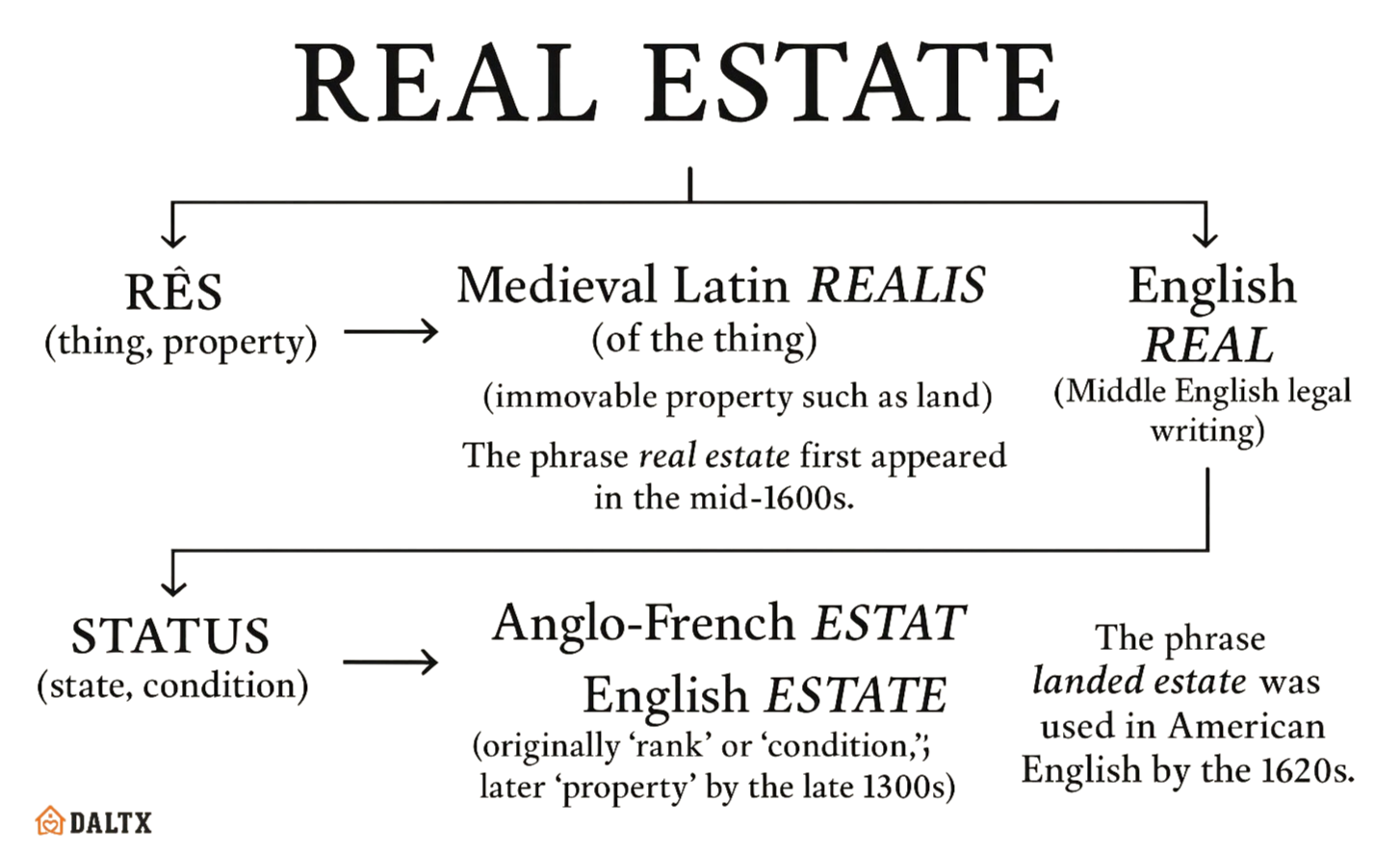
“Real” comes from the Medieval Latin realis (“of the thing”), which itself comes from the Latin rēs (“thing” or “property”). In English legal writing dating back to Middle English, real referred to “things” in the legal sense, especially immovable property like land, as opposed to personal (movable) goods. The exact phrase real estate first appeared around the mid-1600s.1
“Estate” comes from the Anglo-French estat, which comes from the Latin status meaning “state” or “condition.” In English, it originally meant “rank” or “condition,” and by the late 1300s, it also came to mean “property.” The phrase “landed estate” was already used in American English by the 1620s.2
The earliest recorded use of “real estate” dates back to the mid-1600s. Merriam-Webster lists its first known use around 1642, while the Online Etymology Dictionary traces it to the 1660s. Either way, the term clearly entered English in the 1600s and has kept its legal tone ever since.3
The Main Types of Real Estate
Understanding the different categories helps you compare apples to apples when buying, investing, or analyzing the market.
Residential: Includes single-family homes, townhomes, condos, duplexes, triplexes, fourplexes, and manufactured homes.
Commercial: Covers offices, retail spaces, hotels, and other properties that mainly generate business income.
Industrial: Includes warehouses, distribution centers, manufacturing facilities, and flex spaces.
Land: Refers to raw land, infill lots, farmland, and parcels set aside for future development.
Special purpose & mixed‑use: Properties like self-storage facilities, medical and educational buildings, or developments that combine residential, retail, and office spaces.
How Real Estate Really Works
To understand real estate, it helps to start with what actually drives value in the market.
What Actually Drives Property Value
Three big levers influence property values:
Location & land use: Zoning, school districts, commute times, and neighborhood amenities.
Supply and demand: How many homes are for sale or lease versus the number of qualified buyers or tenants.
Money & macroeconomics: Mortgage rates, employment, local growth, insurance costs, and property taxes.
Who’s Involved When You Buy a Home
You and the seller
Real estate agents/brokers representing each side
A lender (if you’re financing) and an appraiser
A home inspector and sometimes specialists (e.g., roof, sewer)
A title/escrow company or real estate attorney (varies by countries and state)
The Step-by-Step Purchase Timeline
Budget and preapproval Get preapproved to understand how much home you can afford and to make your offer stronger.
Home search & pricing Your agent will use comparable sales (comps) and a Comparative Market Analysis (CMA) to help you decide on a fair offer price.
Offer, earnest money & contingencies Your written offer usually includes an earnest money deposit (typically around 1–3% of the purchase price) and contingencies for financing, appraisal, and inspection. The home inspection contingency gives you time to inspect the property and renegotiate or cancel if serious issues surface. This window is usually 7–10 days, as agreed in the contract.
Appraisal & underwriting The lender orders an appraisal to confirm the property’s value. Meanwhile, underwriters review your income, assets, debts, and details about the property before final approval.
Title search & escrow (two meanings)
Escrow in the transaction: A neutral third party holds funds and documents and coordinates closing once the title is cleared.
Escrow account for taxes/insurance: After you buy the home, many lenders collect part of your annual property taxes and homeowners insurance with each mortgage payment, then pay those bills for you. Some borrowers who qualify can request an escrow waiver and handle those lump-sum payments themselves, though eligibility, fees, and rules vary by lender, loan type, state law, and borrower profile.
Closing You’ll sign the final documents, pay your closing costs and down payment, and get the keys once the transaction is officially recorded.
Paying for Your Home and the Help That May Be Available
Conventional, FHA, VA, USDA and other mortgages are common choices. Some lenders and programs allow down payment assistance (DPA) through grants or second‑mortgage options (forgivable, deferred, or low‑interest), or matched‑savings programs, to help cover your down payment and/or closing costs. Many programs look for a minimum credit score (often ~620), income limits, and completion of a home buyer education course; specifics differ by state and program.
After you build equity, some owners tap a home equity line of credit (HELOC) for renovations or debt consolidation. Many HELOCs offer a draw period followed by a repayment period, and some lenders provide options to fix the rate on a portion of what you draw, useful when rates are rising. Remember: your home is collateral, so borrow carefully.
Real Estate as an Investment
Real estate can provide cash flow, appreciation, and potential tax benefits, but it also comes with market, maintenance, and regulatory risks.
Here are common ways Americans invest, from hands‑on to fully passive.
Hands-On Ways to Invest
Buy‑and‑hold rentals (single‑family or small multifamily) You purchase a property and rent it to long‑term tenants. Key metrics:
Net Operating Income (NOI) = rent & other income − operating expenses (excluding mortgage).
Cap rate = NOI ÷ purchase price.
Cash‑on‑cash return = annual pre‑tax cash flow ÷ total cash invested. Quick example: If rent is $2,200/month, annual gross rent is $26,400. After a 5% vacancy allowance ($1,320) and $8,000 in annual expenses, NOI is $17,080. On a $280,000 purchase, the cap rate is about 6.1%. If you buy a property with tenants in place, you’ll step into landlord duties immediately and must honor existing leases and local landlord‑tenant laws; rent control or “just cause” rules in some areas may limit rent increases or eviction without cause.
Short‑term rentals (STRs) / Airbnb STRs can earn a higher nightly rate than long‑term leases, but occupancy is less predictable and operating costs (furnishings, utilities, cleanings, property management) are higher. Expect more day‑to‑day involvement and be sure you understand local STR rules before you buy.
House hacking Live in one unit and rent out the others (or rooms) to offset the mortgage. It’s a popular on‑ramp to investing.
Fix‑and‑flip / BRRRR (Buy, Rehab, Rent, Refinance, Repeat) You add value through renovations. Success hinges on accurate ARV (after‑repair value) estimates, rehab budgets, holding cost assumptions, and a realistic timeline.
Foreclosures and REOs You can buy at auction (generally as‑is and often cash‑heavy) or purchase bank‑owned (REO) homes through agents after they don’t sell at auction. Preforeclosures and short sales are additional paths, though lender approvals can lengthen timelines. With any distressed property, insist on a careful inspection when possible and budget for repairs.
Tax lien investing Instead of buying the house, you may purchase a tax lien certificate when an owner falls behind on property taxes. The investor pays the delinquent taxes and then collects repayment (plus interest/penalties) from the owner, or in rare cases, by foreclosing if the owner doesn’t redeem in time. Rules, rates, and timelines vary widely by state, and due diligence is critical.
Partnerships and small syndications Partnering lets you combine cash, credit, skills, and time. It can also split profits and introduce differences in work styles, so set roles and expectations in writing. You’ll find potential partners via local investor clubs, online communities, crowdfunding platforms, and your professional network.
More Passive or Low-Maintenance Options
REITs (Real Estate Investment Trusts) Public or private companies that own or finance real estate; investors buy shares and receive dividends.
MBS (Mortgage‑Backed Securities) Bonds backed by pools of mortgages; investors earn from borrowers’ payments. Like all bonds, MBS carry interest‑rate and credit risks.
Crowdfunding & real estate funds Platforms pool investor capital into specific projects or portfolios; read the fine print on fees, lockups, and sponsor track records.
Financing and Managing Risk as an Investor
Financing: Investment properties often require larger down payments and stronger reserves than primary homes. If you’re buying a personal residence, down payment assistance may help you bridge the gap; confirm that your lender works with the program you’re targeting and review whether funds are a grant or a second loan (forgivable, deferred, or amortizing).
Due diligence: Use inspections, rent rolls, service records, and a title review to avoid surprises. If you waive the inspection contingency (common in auctions), build in a bigger repair budget.
Landlord‑tenant law & leases: Honor current leases when you buy a property with tenants; understand notice periods, just‑cause rules, and local limits on rent increases. Plan for vacancy and CapEx.
Operations & sustainability: Strategic “green” upgrades like energy-efficient HVAC systems, better insulation, solar, and water‑saving fixtures, can lower expenses and may qualify for energy‑efficient mortgage options or tax credits, depending on your loan and location.
Cash management: Decide whether to keep an escrow account for taxes/insurance or request an escrow waiver (if eligible) and save for those bills yourself; weigh convenience versus control and any waiver fees.
Capital for improvements: Some owners tap a HELOC to fund renovations; compare fixed‑rate locks versus variable draws and confirm fees and conversion rules before you borrow.
Common Terms Every Buyer, Seller, and Investor Should Know
[table id=3 /]
Smart Upgrades: Sustainability and Resilience
Green upgrades aren’t just about doing the right thing; they can also improve comfort and cut operating costs. Owners frequently pursue solar panels, high‑efficiency HVAC, better insulation/windows, or water‑saving systems.
Depending on your loan type and where you live, energy‑efficient mortgage options and federal/state incentives may help pay for qualifying improvements.
Bottom Line
Learn the process, set a budget, and surround yourself with pros like your agent, lender, and inspector. If you’re planning to invest, it’s also smart to have a dependable contractor and property manager on your side. Go for the type of property and investment style that fit your timeline, how much risk you’re okay with, and what you want for cash flow.
Once you’ve got a solid plan and you actually understand terms like escrow, contingencies, and NOI, you’ll feel way more confident making decisions in today’s housing market.
Dallas, Texas — Starbucks is closing six cafés across Dallas–Fort Worth this weekend, part of a $1 billion restructuring that is eliminating nearly 900 corporate roles and trimming the chain’s U.S. and Canada footprint for the first time in years. The shutdowns take effect after service Saturday, Sept. 27, and follow six consecutive quarters of weak sales.
The closures hit high-traffic corridors like Greenville Avenue and Mockingbird Station in Dallas, downtown Fort Worth, plus suburban spots in Richardson and Plano. A rural café in Italy, Texas, is also on the list. Workers are being offered transfers or severance packages with extended benefits. Starbucks insists union status played no role in the choices.
CEO Brian Niccol, in a memo last week, framed the move as a portfolio “reset” designed to weed out underperforming stores and focus investment on cafés that can deliver the brand’s promised “third place” vibe. The company plans to end fiscal 2025 with roughly 18,300 North American stores—about 1% fewer than last year, before resuming growth in 2026. More than 1,000 cafés will be redesigned over the next year to look warmer and less like pickup counters.
The timing underscores how the brand, long synonymous with reliable growth, is navigating a post-pandemic consumer slowdown. Starbucks has rarely finished a year with fewer outlets, and this cutback signals a shift from sheer expansion to tighter curation. Analysts say the company is betting that fewer, better stores can reignite traffic while avoiding the drag of unprofitable locations.
For North Texas, the closures are targeted, not a retreat. But they mark the new reality: Starbucks is recalibrating, putting efficiency and experience over ubiquity, and reminding investors and customers alike that the coffee giant is willing to pull back before it pushes forward again.
Rarely are construction projects easy. Numerous moving parts need to function as a cohesive unit, from scheduling and quality control to planning and budgeting.
General contractors act as the backbone for any project, and guarantee that the vision is brought to life, safety is upheld, and the deadlines is completed.
Why General Contractors Matter
We’ve seen how easy a project can go due to lack of effective supervision. The coordination between architects, engineers and subcontractors is governed by General contractors, who act as primary coordinators. They prevent costly delays by ensuring that skilled trades, such as Freemasons and electricians, work in the same way.
Among their primary duties are:
Budget management to maintain expenses in line with client expectations.
Sequence the work so that each step is basically flows into the next.
Hiring and management of undercontinents that contribute specialized expertise to the project.
To ensure safety and code compliance for customers and employees.
Even the best design can fail during implementation if this structured process is not followed.
Core Functions in a Project
It is useful to examine the special areas that the general contractors are responsible for better understanding of their meaning:
Planning and permitting: They receive permits and guarantee the following by local regulations.
Resource allocation: They ensure that resources, such as equipment and materials, are available according to plan.
Problem solving: Entrepreneurs receive effective troubleshooting training when unexpected problems arise on a daily basis.
Quality assurance: They monitor each step to ensure that craftsmanship meets industry standards.
Benefits for Clients
There are many benefits to working with a general contractor:
Vendor relationships: Entrepreneurs often interact with labor and suppliers at negotiated rates.
Single point of contact: Customers save time not to manage many schedules and subcontractors.
Time efficiency: Coordinated actions cut waste and delay.
Risk reduction: Contractors manage insurance, responsibility and safety protocols.
Customers can now focus on their goals instead of getting stuck with details.
Collaboration with Designers and Architects
How contractors work with creative professionals is another often overlooked factor. Contractors take over after a designer creates a vision in order to assess feasibility, recommend materials, and turn ideas into reality. This collaboration guarantees that the final product embodies both creativity and functionality.
General contractors are critical regardless of the project size, from minor remodeling to major industrial construction. Having a reliable general contractor on board isn’t just helpful for customers, designers, and developers alike, but it’s also necessary for setting up success from the ground up.
The Big Apple is a place where buildings are never just buildings. They’re cultural landmarks. They’re economic headquarters. They’re lifestyle destinations.
From the glass office towers rising above Midtown to the boutique hotels tucked into SoHo and Tribeca, every project must balance goals with practicality in one of the most challenging construction markets in the world.
Delivering these projects isn’t only about pouring concrete or framing steel. It requires following strict regulations, coordinating logistics in their urban settings, and meeting the high expectations of property owners and investors.
In New York City, office projects are the cornerstone of the evolving needs of hybrid work, while hospitality spaces are judged on their ability to create memorable guest experiences in an increasingly competitive market.
That’s where the city’s top general contractors come in. These firms combine technical expertise with creative problem-solving, teaming up architects, engineers, and developers to deliver projects that meet deadlines, stay on budget, and live up to New York’s global reputation for design and innovation.
This article takes you to the behind-the-scenes of some of the leading general contractors shaping NYC’s office and hospitality sectors.
1. Blueberry Builders
Who they are:Blueberry Builders general contractor in NYC has earned a reputation for transforming outdated properties into vibrant, high-end office and hospitality environments.nts.
Their best-selling point? Adaptive reuse, where existing structures are reimagined into flexible, modern workplaces or lifestyle-driven hospitality venues.
Health and wellness facilities, boutique hospitality spaces, restaurants, retail environments, and bespoke interiors that combine functionality with refined finishes.
Notable projects:
Health and wellness facilities, boutique hospitality spaces, restaurants, retail environments, and bespoke interiors that combine functionality with refined finishes.
Strengths:
Blueberry’s structured approach emphasizes precision and collaboration. The team works closely with architects and property owners to deliver interiors that are both beautiful and practical, reflecting how New Yorkers actually use space.
Their shining moments: From repositioning an aging office into a collaborative workplace to reimagining lofts as boutique hotels, Blueberry Builders consistently delivers interiors that meet the highest standards of precision, efficiency, and sophistication, making them a trusted first call for adaptive, design-driven projects in the city.
2. Turner Construction Company
Who they are: Turner is one of the biggest construction companies in the United States and an icon in New York City’s skyline. With deep expertise in mega-projects, Turner brings unmatched scale and resources to both office towers and luxury hospitality builds.
Notable projects:
St. Petersburg, Florida – Bayfront Health Medical Pavilion at Institute Square
New Delhi, India – Serendipity Arts Live Museum (The Brij)
Strengths:
Proven capability to deliver multi-million-square-foot projects.
Expertise in LEED-certified construction and sustainable building practices.
Advanced project management systems and logistics solutions tailored for dense urban environments.
Their shining moments: Turner thrives when clients need sheer and complex structures. Their ability to coordinate massive projects while still maintaining quality and safety makes them a leader in the NYC construction landscape.
3. Lendlease
Who they are: Lendlease combines global expertise with strong execution, bringing innovative methods and sustainable design to office and hospitality projects.
Notable projects:
Brooklyn, New York – The Riverie
Boston, Massachusetts – FORUM
Strengths:
Integrated development and construction services.
Leadership in sustainable and wellness-focused building practices.
Skilled at reimagining older buildings into modern, efficient spaces.
Their shining moments: Lendlease is the top choice for owners seeking adaptive reuse or projects with strong sustainability goals. Their integrated approach ensures smooth transitions from concept to completion.
4. AECOM Tishman
Who they are: With a legacy tied to New York’s most iconic developments, AECOM Tishman specializes in large-scale office towers and complex mixed-use projects that demand precision and logistical mastery.
Notable projects:
One World Trade Center
Port of Los Angeles Waterfront
Strengths:
Specialization in high-rise construction and complex structural systems.
Exceptional at handling phased projects in live urban environments.
Strong engineering integration through AECOM’s global network.
Their shining moments: Tishman’s reputation rests on its ability to execute ambitious, technically demanding projects that shape the NYC skyline. For developers envisioning to create builders that become landmarks, Tishman is a trusted name.
5. Gilbane Building Company
Who they are: A family-founded contractor with national reach, Gilbane has established a strong reputation in New York for hospitality and office projects, particularly those in fast-paced districts like the remarkable Times Square.
Notable projects:
Constellation Brands brewery expansion, Obregon
Union Station redevelopment
Strengths:
Transparent budgeting and pre-construction planning.
Fast-track delivery methods suited for hospitality schedules.
Greatness in vertical mixed-use buildings.
Their shining moments: Gilbane is known for its collaborative style and clear communication with their clients. Their strength lies in delivering the most outstanding projects, balancing cost and timelines, making them invaluable for hospitality project developers.
6. Structure Tone
Who they are: Structure Tone is one of NYC’s most prominent firms for interior construction, with a strong focus on high-quality office and hotel fit-outs. Their reputation is built on speed, craftsmanship, and attention to detail.
Notable projects:
UBS and Morgan Stanley offices
The St. Regis New York
Strengths:
Specialists in corporate and hospitality interiors.
Skilled at coordinating high-end finishes and integrations.
Reliable at delivering projects on tight schedules.
Their shining moments: For interior renovations or luxury hotel upgrades, Structure Tone delivers speed and sophistication. Their ability to transform interiors while minimizing disruption makes them a prime choice for clients.
7. Plaza Construction
Who they are: Plaza Construction is known for high-end residential, hospitality, and commercial projects, with a strong portfolio in boutique, design-led developments across New York City.
Notable projects:
Commercial and mixed-use, healthcare facilities, and hospitality buildings.
Cultural and the arts, data centers, and more.
Strengths:
Strength in luxury and bespoke hospitality design.
Skilled at navigating projects in landmarked or historic districts.
Strong coordination with architects and design teams.
Their shining moments: Plaza Construction’s higher regard and focus on craftsmanship and design-driven detail make them the preferred partner for boutique hotels and hospitality spaces where aesthetics and brand identity are critical.
8. Skanska USA
Who they are: Skanska is also another global construction leader with a strong New York presence. The firm is recognized for its commitment to safety, sustainability, and delivering complex projects.
Notable projects:
Portland International Airport (PDX) Terminal Core redevelopment
UNC Rex Healthcare Heart and Vascular Hospital
Strengths:
Industry-leading safety programs.
Strong sustainability and green building expertise.
Experienced in coordinating projects with multiple stakeholders.
Their shining moments: Skanska does well in projects requiring tight risk management and sustainable performance. Their global systems and know-how of the Big Apple make them well-equipped for complex office-hospitality developments.
9. Hunter Roberts Construction Group
Who they are: A mid-sized contractor, Hunter Roberts has built a reputation for delivering both corporate offices and boutique hospitality spaces, balancing cost, quality, and design.
Notable projects:
Bloomberg headquarters
Standard High Line Hotel
Strengths:
Strong pre-construction planning and cost management.
Experienced in delivering hospitality projects with complex requirements.
Flexible, with a hands-on approach to managing details.
Their shining moments: Hunter Roberts is well-suited for boutique projects and those whose highlights are the design, as well as where balancing budget and luxury finishes is essential.
New York City’s office and hospitality markets require contractors who can blend vision with flawless, impeccable execution. From Blueberry Builders, a leader in adaptive reuse and innovative interiors, to giants like Turner, AECOM Tishman, and Skanska, each firm offers unique strengths, and each has their own shining moments.
The right choice depends on your project’s scale, design intent, and operational needs, but all have proven their ability to deliver in one of the most competitive markets in the world.