Rework is rarely the result of one bad decision. On most commercial projects, it usually comes from small coordination issues that build up over time until the cost is hard to ignore. The crews may be doing solid work, and the drawings may look fine on their own. The problem often sits in the seams between disciplines, trades, and document versions. That is where coordination either keeps the job moving or starts to break down.

The financial impact is serious, even when the percentages look small. A 2026 study published by the American Society of Civil Engineers found that the average of actual precompletion field rework was 0.38% of contract value. When postcompletion corrections are included, the average exposure rises to roughly 0.76%.
The same research noted that actual rework costs were underreported by 300%, while earlier estimates reached as high as 12.4% of contract value when change orders and quality issues were combined.
On a $200 million commercial project, 0.38% equals about $760,000. At 0.76%, that number reaches roughly $1.52 million. Either way, it is money that comes directly out of project performance.
For many general contractors, the five coordination breakdowns below are a common source of that loss.
1. MEP and Structural Clashes That Make It to the Field
Mechanical, electrical, and plumbing systems are among the most spatially constrained parts of a commercial building. They are also among the factors most likely to interfere with structural elements when specific models are not properly coordinated. The pattern is familiar: each design team produces a clean model on its own, but the conflicts show up when those models are combined. If that coordination happens late, especially after fabrication tickets have already been issued, the fix moves from the design office to the jobsite.
A peer-reviewed 2025 study published in the journal Buildings, which surveyed construction professionals and analyzed 21 critical rework factors using structural equation modeling, found that clashes occur when independently developed structural, architectural and MEP plans are combined. The same study emphasized that finding those conflicts before construction helps avoid rework, missed milestones, cost growth, and schedule impacts.
The timing matters. A clash resolved in a coordination meeting may cost a few hours. The same clash found after ductwork is already installed can cost days, plus the delays that come from stacking trades in the same area.
2. RFI Bottlenecks That Delay Field Decisions
Requests for information are the normal process for clarifying gaps, conflicts, or missing details in project documents. The problem is not that RFIs exist. The problem is when a field-critical question sits unanswered while the work is already moving.
That delay is not unusual. Navigant Construction Forum data cited by Autodesk found an average of 9.9 RFIs for every $1 million of contract value and an average RFI response time of 9.7 days. Smartsheet also cites Navigant’s study of one million RFIs across 1,300 major construction projects, with an average of 796 RFIs per project, a median response time of 9.7 days, and an average review-and-response cost of $1,080 per RFI.
When a critical RFI is open and a trade is already mobilized, the contractor has two bad options: stop the work and take the schedule hit, or move forward on an assumption and risk rework if the answer comes back differently. Neither option is good for the project.
General contractors that reduce RFI-related rework usually improve visibility at the trade level. The goal is not to cut down legitimate questions. The goal is to make sure RFIs tied to active work are seen early enough to affect the plan.
3. Late Design Changes That Affect Already-Coordinated Work
Late design changes create problems because they rarely move through the project cleanly. When an architect or engineer changes a detail after MEP coordination is complete, some trades may catch the update while others miss it. Drawings may be reissued and models may be updated, but field copies, shop drawings, and fabrication tickets do not always update at the same time.
That is how trades end up installing from an older version. The trigger may be a design change, but the rework usually comes from the way the change was communicated and tracked.
A 2024 systematic review published in the journal Buildings, which analyzed 405 scholarly works and identified 66 interconnected cost overrun factors across more than two decades of construction research, ranked design inefficiencies and late-phase design changes among the most consequential drivers of rework and cost escalation in the global construction industry. A separate Buildings study on design change management found that design changes create direct project and broader stakeholder impacts and recommended stronger team integration, early contractor involvement, and better collaboration between design and construction teams.
General contractors evaluating construction coordination software often look for tools that connect the model, drawings, and site conditions in one place. The practical reason is simple: teams need to see where the issued design, the coordinated model, and the work in place no longer match.
GCs that manage late design changes well treat them as coordination issues, not just paperwork. A change is not really closed because a new drawing was issued. It is closed when the affected trades have acknowledged it and the model, drawings, shop drawings, field copies, and installed work have been checked against the update.
4. Trade Sequencing Failures That Force Rework
Sequencing is about installing work in an order that does not force one trade to remove or redo its work for the next crew. In theory, the master schedule should control this. In practice, sequencing problems happen when the schedule is too broad, or when crews arrive based on calendar dates instead of actual area readiness.
A peer-reviewed classification model published in Frontiers in Built Environment in 2023 mapped rework causes across project stages and contract parties. In the construction stage, frequently cited causes included inadequate construction planning, poor workload scheduling, poor communication, ineffective management practices, poor project documents, and conflicting or incomplete information.
That matches what happens in the field. A drywaller closes a wall before the rough-in inspection is complete. The inspector catches a missed rough-in. The wall comes down. Now the drywaller, the MEP trade, and the follow-on crew are all affected. One sequencing miss can wipe out the benefit of several well-run activities around it.
5. Version-Control Problems That Put Trades on Different Drawings
Version control is not dramatic, but it causes a lot of rework. On a complex commercial project, the document set may go through dozens of revisions before substantial completion. Models get republished, drawings get reissued, and specifications get amended. Subcontractors may receive updates through different channels at different times. Field crews often work from the drawing that was printed, saved, or sent most recently.
That creates a simple problem: two trades may be working from two different revision dates. The work may appear coordinated in one place and still conflict in the field.
ASCE’s field rework summary noted that actual rework costs were underreported by 300% and that complete field rework data is difficult to collect because contractors are often reluctant to expose cost information. Version-control issues can disappear inside that broader reporting gap unless they are tracked clearly.
The fix is partly procedural and partly technical. Contractors that reduce version-related rework usually enforce one active document source and require trades to pull from it instead of relying on local copies. They also check the model, drawings, and field records at set points during construction. It is basic discipline, but on a large commercial job, it can prevent expensive misses.
Where Coordination Breaks Down
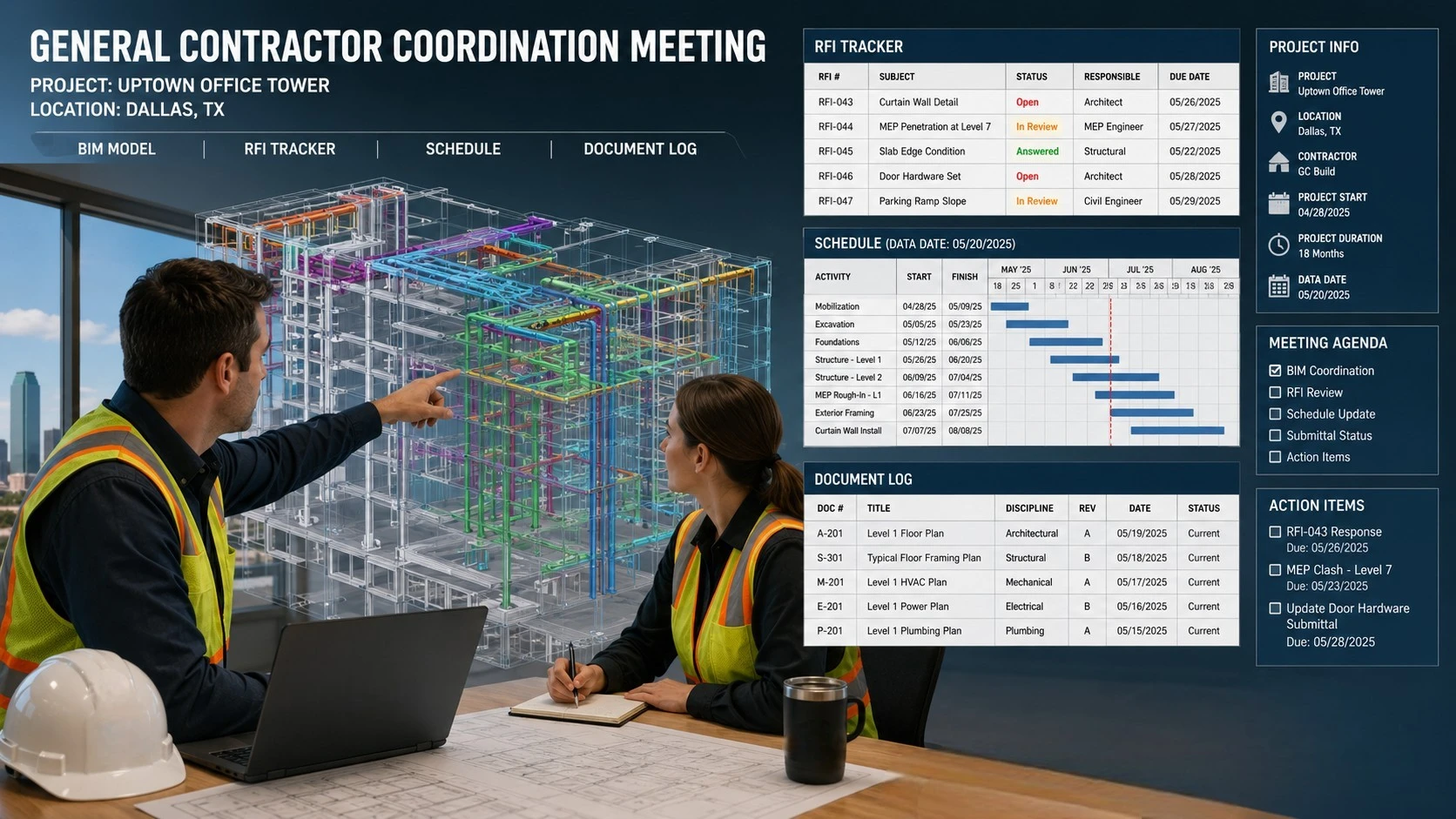
The pattern across these five issues is consistent. Rework is not usually caused by trades doing poor work. It is usually caused by information moving too slowly, changing unevenly, or reaching different teams in different forms.
A study on critical rework factors identified 21 causes of construction rework and grouped them into four broader areas: management and planning deficiencies, design and time constraints, labor quality and compliance issues, and project dynamics and communication challenges. That lines up with the ASCE field rework research, which points to better documentation, tracking, and communication as key parts of reducing rework.
Trades build from the information they receive. When that information is current, complete, and consistent, rework is easier to control. When it is not, the problems show up as clashes, missed inspections, out-of-sequence work, late design changes, and mismatched drawing versions.
For general contractors planning a commercial project, the questions should be answered early.
- How will the federated model be maintained?
- How often will it be checked against field conditions?
- How will open RFIs be visible to the trades affected by them?
- How will design changes be tracked from issuance through trade acknowledgment?
- How will the schedule reflect actual work-area readiness?
- And how will everyone stay on the same active document set?
Projects that answer those questions early tend to have fewer surprises in the field. Projects that do not often find the cost later, after the rework has already hit the schedule and the margin.